
The rhyming verse and adorable yet silly illustrations celebrate the nightly childhood rituals of bedtime, by seeing them through the lense of a family of mice. When there are 38 little ones to be settled, the feeding and bathing and brushing and dressing and reading and drinks take a while. The rhymes are fun and the illustrations are full of personality, and the topic is so familiar. I can see kids wanting to read it again and again.
Category Archives: Recommendation
Poopsie Gets Lost
I really like this one, and can see it being great as an interactive read-aloud. The illustrations a fun and full of personality, and the text is written as an interaction between the narrator, who is giving some very bad advice, and the main character, Poopsie, an adorable and pampered house cat living a rather sedate life. That is until our narrater dares her to venture out into the world, where she tangles with snakes and crocodiles and tigers. When put to the challenge, Poopsie shows she’s got some real spunk, but in the end chooses to return to her to the safety and simplicity of home, turning her back on the pushy narrator who got her into that mess.
Clementine and the Lion
It’s okay. It’s a version of the classic “kid thinks parents are ogres and would rather live without grown-up interference” trope. In this case mom got snatched by dragons and dad is lost at sea in a bottle. When an aunt shows up and tries to take over, Clementine invents an invisible paint to hide the house and get rid of the aunt. When she accidentally leaves the door open one day she ends up with a lion as a houseguest and must find a way to make peace with it and carry on in case her parents come back some day. On the one hand, a lot of kids can relate to the living-without-adults fantasy, on the other hand, it seems a bit disjointed.
Stick and Stone: Best Friends Forever!
This picture book is a rollicking, rhyming celebration of friendship and what being a family means. Ostensibly, Stick and Stone are off looking for Stick’s family tree, but when the adventure turns from fun to frightening to hopeless Stone tells Stick that he is his family and Stick agrees.
The delightful end papers have stick sprouting leaves of many different trees, which tie in with an illustration in the book. The humor around a stick looking for his family tree, which literally is a tree, remains funny throughout. The sunny illustrations reflect the energy between the two friends. The palette temporarily becomes darker when things get tense, but returns to vibrant color after help is received from another friend. Emerging readers will be successful with the repetition and simplicity of words and the short sentence length.
This book might be an especially good fit for young children who are adopted or, for whatever reason, are unable to make a connection with their heritage or ancestry.
The Care and Keeping of Freddy
The only thing I would change about this book is the title. I kept looking for a connection, but Freddy remained a minor character.
This story does a fabulous job of showing what can happen to kids when they are let down by adults who are supposed to care for them. Georgia’s mom leaves suddenly the same day she buys Freddy, a bearded dragon, for Georgia. She returns with a new husband and a baby over a year and a half later. Georgia is thrilled. . .or is she? Georgia’s best friend and aspiring writer, Maria has parents who happily retreat to the camper behind the garage all summer leaving her Abuela and six kids to pretty much fend for themselves. New kid in town Roland (Roly) is in foster care with the very religious Farley family because his dad is incarcerated and his mom was declared “unfit”.
These eleven and twelve year old characters come to life as the reader experiences their friendship, struggles, and adventures. Georgia’s relationship with her clearly depressed but doing-his-very-best-for-his-daughter father is especially poignant. We see the emotional roller coaster and hurt Georgia and Roly endure. Georgia is determined to get her parents back together, but then she starts noticing the not-so-great things about her mom that she had forgotten about when her mom abandoned her.
There are no easy answers for anyone in this story, but there is hard won wisdom. It is an intense, emotional ride, but well worth the trip.
Out of a Jar
by Deborah Marcero
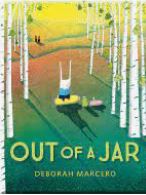
This picture book discusses feelings and when Llewellyn the bunny experiences tough feelings he puts them aside in a jar and locks them away. This works well for him for a while until suddenly, he isn’t feeling much of anything at all. One day, the jars all break. See what happens to Llewellyn when his feelings all get loose. This book is a good addition to your S.E.L. library. Younger students will enjoy and understand what happens when one does not express their feelings and keep them inside. I would recommend this book for elementary school (k-3).
M is for Monster by: Talia Dutton
Reviewed by OHS Student, Blaze
This graphic novel is a creative with an intriguing twist on a classic horror story (Frankenstein), a worthwhile read for anyone who enjoys graphic novels. Fiction, Magic, Science, Psychology, and Coming of Age are blended well in this story as the author delves deep into grief and its consequences.
Summary: Frances Ai has failed in her attempt to bring back her sisters soul, instead creating a new mind in her sisters body. This new being, M, struggles with the pressure placed on her as Frances tries to find any hint of the sister she lost.
I believe that the mechanics of magic within the story were altogether unnecessary, as they did not serve as more than occasional mentions and did not serve much purpose. The story would have been perfectly fine without mentions of magic.
The Thirteenth Hour
Before the first chapter the author tells the reader that she wrote her first book when she was eleven and that if we want to, we will write a book also. This statement sets the tone for a book that lends itself very well to being a book that teachers will read aloud to their students and that some students will then choose to read for themselves.
The young Rosemary is given an intriguing golden watch accompanied by some precise but mysterious directions on a hospital visit to her sick Aunt Jo. Rosemary’s dreams, under the influence of the watch, become adventure reality as she tries to save her frenemy Jeremiah with the help of a new friend, Alejandro, and some helpful dream world friends.
Teachers are cautioned to read the book first as some images and scenarios may be troubling to some students.
Jazz for Lunch!
This book is a visual celebration of Jazz. Written in the rhyme, you can feel the music in the rhythm of the words as they connect the food prep of Auntie Nina and her young nephew to the sounds of different instruments. Each page has a few words in large, colorful fonts that jump off the page. The vivid illustrations match the excitement of the music. There are also nods to the legends of Jazz including Ella Fitzgerald, John Coltrane and Thelonius Monk. The end papers have paragraph bios of the musicians mentioned in the text. This book would work well to introduce children to the joy of experiencing Jazz.
There’s a Ghost in This House
Every day students ask me for scary books. Here is one that is more Casper the Friendly Ghost than Elm Street. A girl moves from room to room in her 18th century house looking for ghosts that she has heard live there, but she never sees one. The fun is when you turn the translucent page that overlays where she is looking to reveal the playful ghosts that are having fun hiding from her. Each page has one or two short sentences. This book appeals to young children who enjoy the surprise factor in “lift the flap” books. The illustrations of the rooms are done in brown and cream contrasting the girl who has bright yellow and green. This palette also allows the white ghosts to appear clearly. One consideration, is the translucent ghost pages are less durable that the paper ones. Readers will also want to flip these back and forth several times to make the ghosts appear and disappear, so they will have more use. This is a delightful, engaging book that is a perfect fit for early elementary students.