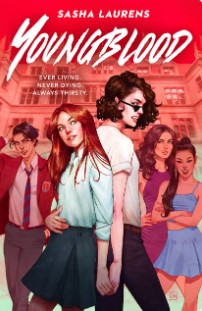
Be prepared for plot twists and the unexpected–even for a vampire book. You will never know where it is going to go. Kat and Taylor were best friends until the age of 13 when their parents fought, and Kat moved away. Later, Kat and Taylor find themselves roommates at a private school, a vampire school. My favorite part is when Kat finds out who her true fang-maker is. It all begins to make sense when Kat has a meeting with Victor Castel.
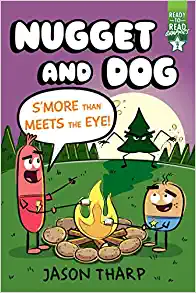
Nugget (a chicken nugget) and Dog (a hot dog) are so excited to have some fun at summer camp. Unfortunately, Dijon (yes, he’s mustard) has an evil plan to scare everyone! He and his sidekick, Crouton (self-explanatory) mess up their plan to scare everyone with the Mean Green Pine Thing, which ends up being Honey Dijon (Dijon’s cousin), who just wanted a little attention herself. Rounding out the cast of delicious campers is Fry and the grumpy camp counselor, Grizzle.
This beginning graphic novel begins with some simple information about panels, thought bubbles and speech bubbles as well as how to follow the story on a page. This is very helpful for those readers new to graphic novels. Illustrations are bright and text is simple. This is a nice introduction to graphic novels and is really humorous. How can it not be funny with a hot dog and chicken nugget as main characters? highly recommended.
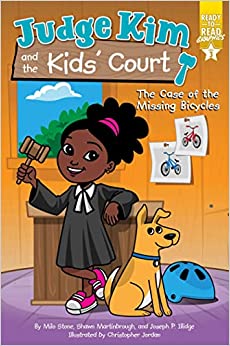
Bicycles are missing from Kim’s school and rumors are flying. Kids start accusing the new boy, Corey. So, Kim takes matters into her own hands and assigns her friends to gather facts and evidence. She convenes a “Kids’ Court” in the tree house that her dad just built, overcoming her fear of heights to climb the ladder for court. Kim handles the case with unusual maturity, which is not surprising since her mom is a judge and Kim’s been to her courtroom. The story ends happily with Corey’s explanation that he wanted to fix up his peers’ bikes in order to make friends and apologizing for stealing them to do so. His classmates forgive him and are thrilled with their newly fixed bikes.
The book begins with a short explanation about the correct way to read a graphic novel. This is helpful, because readers new to graphic novels will now know the difference between a speech and thought bubble and the direction of the story on each page. The story itself is fairly short and the text is very accessible. Illustrations are bright and characters are diverse. Highly recommended for those new to graphic novels.
This is one of those picture books that has a place with older readers as well. It is a beautifully illustrated biography about a girl who loved music, but when she started to go deaf at the age of ten, a doctor told her parents she would need hearing aids for the rest of her life, would need to attend a school for the deaf, and would never be able to play music. Her parents pushed back and she continued in traditional schools. At the secondary level she was interested in joining the percussion section of the orchestra, but the school’s test of music ability tested only her ears’ ability to hear, when she listed with her whole body. Persistence and an understanding teacher brought her into the world of percussion, where she excelled. But when she wanted to attend The Royal Academy of Music, persistence was again required to win an audition. Her successful career in music brought her to the attention of Queen Elizabeth and brought the world’s attention to the doors too often closed too quickly to those with disabilities.
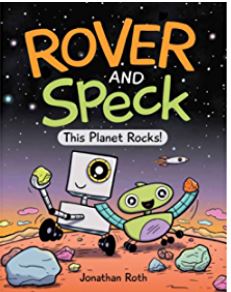
This fun graphic novel is an adventure that delves into the science of terrestrial planets. Rover lands on a planet and is ready to search for information only to find Speck who had landed before and was unable to power up it’s solar panels. Once Speck is charged up, they travel in search of life forms. They discover a type of “rock creature” and find that they are friendly when they hear music. While the story is not realistic, there are many facts about planets that are interspersed throughout the book. The back pages show images of the Mars and the Rover that was sent to it. Students will enjoy this book and learn along the way – Highly Recommended!
I really like this one. The illustrations are absolutely charming. The story addresses a theme so common among young kids — the wish to be bigger in a hurry. On Wellington’s fifth birthday he’s determined to be more grown up. He’s excited to get a coat like his dad’s as a present, but he’s disappointed that it’s too big for him. On the way to the tailor (where his dad gets his own clothes altered), he’s excited when the bus driver tells him he’s old enough now that he has to pay for his ride. When they tailor’s not in, he and his dad pass the time at the music store and the ice cream parlor, but Wellington is disappointed that he can’t quite keep up with his dad. By the time they stop to visit his granddad, he’s decided it’s not that his jacket is too big, but that he’s too small. When his granddad measures him against the wall, he is amazed to see he’s the exact same size his dad was at his age. Encouraged, he’s willing to wait until he grows into his new jacket.
So many children’s books address the theme of feeling like one doesn’t fit in and having the courage to be oneself, and that is fitting, as it’s a struggle we all face at one time or another. This one has the added benefit of addressing this common theme through the experiences of a group often underrepresented in our libraries. It tells of a girl who is so excited to be heading to the pool with her mom in her new burkini, feeling like “a dainty seahorse, or a splendid pineapplefish,” ready to enjoy a day as a mermaid girl. Her joy vanishes when other swimmers point out that her swimsuit doesn’t look like a “real” swimsuit, and question whether she’ll even be able to swim in it. Her mother reminds her of the brave mermaid girls who have come before her and the many more that will come later, and that to stand out is to be full of the things that make you you. With a boost of courage, she joins in and her friends see that she can do all the things they can do, until they want to be mermaid girls, too (even Sam).
I like it. It celebrates being yourself, while recognizing that it’s not always easy to do so. It tells of a young boy who loves to dance. He’s excited and nervous on his first day of ballet lessons, knowing it will be different than the cumbia or bhangra dances he enjoys at home with his family, but inspired by memories of seeing a Swan Lake performance. When another boy in the class asks why he’s wearing a tutu, he simply answers, “Because it’s pretty.” I like that the story shows both boys and girls in the ballet class. I like that the parents and dance teacher never once make any kind of issue about Teo’s tutu, but are only ever positively encouraging Teo to enjoy himself, and yet when it comes time for Teo to choose a costume for the big performance, it only takes feeling the eyes of the other students on him to make him feel pressured to choose the shirt and pants. Even when peer pressure is subtle it can be powerful. In the end, Teo chooses the costume in which he feels most comfortable and thoroughly enjoys a successful performance before his biggest fans.
Readers who like Karen McManus will love this new book by Rebecca Barrow. Set on an old-money island, Luca and her peers believe the place to be cursed. Too many of Parris Island’s young girls have gone missing and turned up dead; including Luca’s best friend and sister. As Luca pursues the clues surrounding the disappearance of the girls, she quickly becomes surrounded by her own dangers. This is a thrill ride from the start; lots of clues to be had in this fast paced mystery. Just when we think things are working themselves out; there’s always more to uncover. Highly Recommend.
This picture book about legendary Hollywood costume designer Edith Head is a story stressing the themes of determination and persistence. As a young girl growing up in the deserts of Nevada, Edith made costumes for her pets and dolls. While still school age she discovered the power of costumes to create characters for her human friends. After moving to Los Angeles, California, one of her first jobs in Hollywood movies was to create costumes for animals in films. She could imagine and construct costumes, but couldn’t sketch well enough to be taken seriously as a designer.
Edith worked hard at learning to illustrate and eventually earned her way to dressing some of the most famous actresses in popular motion pictures of the last century. Fun illustrations, suggesting the bits and scraps of fabric from which Edith made her earliest pet and doll costumes, decorate the book with lots to enjoy. The book ends by noting the recognition of Ms. Head’s work in film with her many Academy Award nominations and wight wins.
The Author’s Note after the story is an excellent addition for older readers sharing the book with younger students.