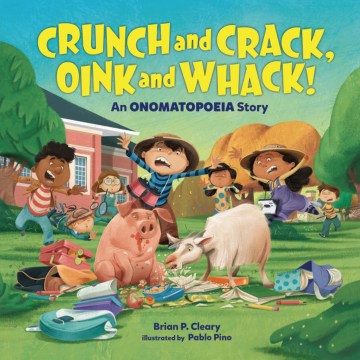
Crunch and Crack, Oink and Whack! : an Onomatopoeia Story

Mrs. Garcia’s class roams the school and nearby farm searching for onomatopoeia in this silly, rhyming picture book. They find numerous examples of this elusive literary device in the gym, science lab and elsewhere until they are “shooshed” at the end by the concerned principal (apparently, they were a little loud with their “shrieks”, “grunts” and so forth!

This book will be useful for the teacher that is working on this topic. Students will enjoy the fun illustrations and the additional examples in the back of the book. They might be excited enough about it to go on their own search for the elusive onomatopoeia!

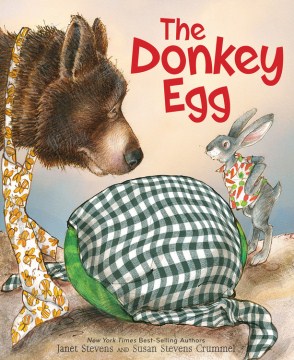
The Donkey Egg

Bear and Hare are back after their escapades in Tops and Bottoms. Fox stops by Bear’s ramshackle home and sells him a $20 watermelon, convincing him that it is a donkey egg. Well, Bear takes care of that “donkey egg” for quite awhile. He does a great job caring for it, keeping it warm and playing with it. Hare stops by occasionally (he seems to be training for a race against a tortoise) to give bear encouragement. One day, Bear falls asleep and the “egg” rolls away from him and crashes, breaking into several large pieces of watermelon (surprise!). Bear and Hare decide to make the best of it, after Bear realizes he was fooled by the Fox. They plant the seeds and end up with so many lovely watermelons! They take some to town to sell and buy …a donkey! Fox sees the trio and the book ends with Fox scratching his head and climbing up on a watermelon.

The story moves smoothly along, with some interesting facts about time along the way. This might distract some readers, but most won’t be bothered. They will be busy moving on to the next page to find out what will happen with Bear, Hare and the ‘egg’ on the next pages. The illustrations are wonderful. It is like seeing old friends again after several years away (24 years since Tops and Bottoms). Highly recommended.

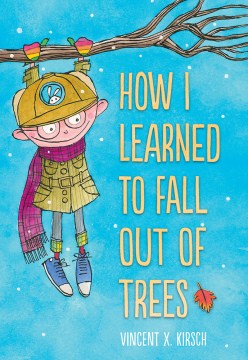
How I Learned to Fall out of Trees

Edward and Adelia have been friends for a very long time and now she has to move. So, they gather many of their favorite things as Adelia explains to Edwin that she is going to teach him to climb a tree and fall. As she is explaining the steps to climbing (and falling from) a tree, she is also teaching Edwin to say goodbye. And, at the end, he does fall out of the tree onto all the things they used and collected and he has a smile on his face, because “Adelia made certain that falling was the easiest part of all” and saying goodbye wasn’t too painful.

This is a very sweet book that gently moves along to the day Adelia leaves and Edwin climbs her tree and let’s go (in more ways than one). Pictures are bright and the characters are sweet. While the underlying message of letting go of one’s friend might be missed by readers, the books is still a very sweet friendship story and will open up discussions about friendships.

Crab Cake

Crab Cake, written by the author of Accident! starts out innocently enough. The sea creatures are doing what sea creatures normally do – “Seahorse pretends to be seaweed” and “Puffer fish puffs up” and “Crab bakes cakes’ – what?? Yes, crab is a different sort of sea creature and bakes lovely cakes. This comes in handy when disaster strikes their lovely undersea world. A boat comes by and dumps a huge amount of trash into their home. Everything turns dark and they all freeze! Then, crab does what crab does best – he bakes a cake. The other sea creatures come out of hiding and begin to relax, brainstorming ideas as they eat his yummy creation. They are united in their resolve and each works with the others to clean up the terrible mess. They deposit the pile of garbage on the dock with a sign that reads “Come get your junk!’. And, life turns back to normal. The sea is clean and bright, the animals are doing what they do and crab is baking cakes (with some help from his friends!).

This story is so multifaceted in its message! While it is a lovely little narrative about a crab that doesn’t act like his fellow sea creatures, it is also a powerful reminder that individuals can come together to solve a big problem and highlights that individuals can all contribute in some way to the solution. In this case, “Snapper shoves”, “Clownfish rolls”, “Clam encourages” and all the other sea creatures help in their own ways to clean up their home and send a message to the humans above. This book is also a reminder that we shouldn’t stand by and let the others destroy the earth. All of this begins with a crab that bakes!

The last page has some great links to a variety of ocean environmental websites that are appropriate for kids. Read this book during Earth Day or any day that you are empowering your students to work together to benefit the world!

Boats on the Bay

With artwork reminiscent of Ezra Jack Keats, this book details a day on the Bay (San Francisco?). Simple text details the action of different types of boats, like tugs, kayaks, and fishing boats. The day culminates in a beautiful fireworks display in a gatefold fired from the deck of a barge.

Young readers will enjoy the many different boats and the activity around them as they ply the water of the bay. The more observant readers will notice that the sentences on the first two pages are quite similar to the sentences on the last two pages, moving the story into a somewhat circular manner. Artwork is muted and the reader does not see expression of the characters’ faces. But, the real art is in the boats and they are done beautifully.

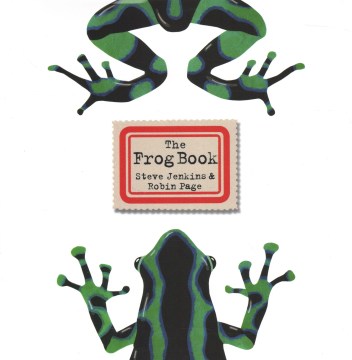
The Frog Book

The Frog Book is a 33 page mix of glorious illustrations and amazing facts about some of the over 6,000 (that we know of so far) amphibians that inhabit most parts of the world. Information is presented in small bites under such page headings as “What is a frog?” and “Finding a mate”. While this information could tend to be somewhat dry if presented in a flat, fact-filled tome, it is nothing short of incredible in this incarnation. Many of the pictures are presented half life-sized, except for a few notables (the largest and smallest, fore example). Some of the illustrations are labeled and there is a fine two page spread of the life cycle of a typical frog. Students will love the detailed information given in this book and, I am sure, will ask to share some of the more ‘interesting’ facts such as the facts that the golden poison frog has enough poison to kill ten adult humans and the hairy frog (yes, it does look a little hairy!) can break its own finger bones that penetrate its skin and act like claws. Wow! I want to learn more about frogs now! This magnificent book will enthrall your young scientists and turn your non-scientists into frog experts hungry for more!

Pug Meets Pig

Pug has the good life – a great home, yard, food and a bed. Things are going great until the day a Pig moves in. All of sudden, life isn’t so great as the Pig takes over all of Pug’s stuff! Well, life isn’t too good until a doggy door is put into the house door and Pig doesn’t fit. Suddenly, life is great. Except…Pig is sad! So, Pug decides to help him by gnawing through the doggy door to make a larger Pig door and the (now) friends are together and having fun.

This is a sweet little story with simple illustrations and text. There are many books out there with animal friendships. But, pugs are popular and and who doesn’t love a cute pig? Buy it if you need to refresh your dog picture books.

My Adopted Family

Lenny visits his classmate, Adam, and his family to report on this Student of the Week. Along the way, he discovers that Adam and his sister are adopted and are part of a loving, normal family, much like his own.

This book is part of a series on different types of families and the story introduces this particular family type in a very natural way. The illustrations are somewhat cartoon-like and colorful. My Adopted Family, along with the rest of the books in the My Family series would be a sweet introduction to units on families in the primary grades. Recommended

Rhymes with Doug

Doug receives a mysterious package in the mail and opens it to find a magical rhyming parrot. Everything is great while the parrot rhymes ‘Doug” with “mug” and Doug gets hot chocolate and “Doug” with “pug” and a puppy appears. But things get crazy when the rhyming words are “slug” (Doug turns into one) and “bug” (ditto). The rhyming mayhem continues until the end when the word is “snug” and Doug is pictured in his bed. Uh-oh, did the bird just add “…as a bug in a rug”? No wonder the last page shows the same mysterious package near his friend’s car. A gift, perhaps?

Cartoon like characters and a mix of word bubbles and narrative text make this book an enjoyable tool in teaching rhyming. It is one of many out there (Seuss, et al). So, buy it if you have extra money to spend to freshen up your collection of rhyming books.

A world of cookies for Santa : follow Santa’s tasty trip around the world

This is a delectable collection of Christmas traditions around the world, some of which include cookie recipes. Each short description is on a page with colored illustrations of children from that particular country. Young readers will enjoy learning the names and traditions surrounding Santa on his travels around the world. Endpapers have maps of Santa’s path around the world and the end of the book includes recipes for several of the cookie recipes.

This book will be a fun addition to holiday collections. And, BONUS! Students might bring you some cookies from the recipe collection in this book! Recommended