This book starts with something everyone sees all the time and doesn’t think much about (a crosswalk signal), and asks the reader to stop and think about it, to imagine that the little man inside the sign might have some ambitions and adventures. It brings the man inside the walk signal to life, imagining what he’s thinking as he looks out on the world, and what he would do if he could climb out of his box and explore the world on his own. After exploring the world for a bit, jumping to the rescue when he sees a small child alone in the middle of the street, he finds himself missing his own corner and recognizing the value he serves in keeping people safe, so he returns home (but still needs a vacation occasionally). I think it would be a great launching off spot for discussion and/or writing prompts getting kids to imagine stories for other common items in our world.
Category Archives: Recommend
Happy Cats
It’s essentially an illustrated list of different kinds of cats, and when I say kinds, I’m not talking breed, I’m talking about color and attitude and pose, etc. Yet it works in opposites and rhyming and adjectives in a way that makes it a great support for emergent literacy. The illustrations are full of personality and act as a support for the text, all while capturing some classic cat moments that will be very recognizable to cat families.
Light for All by Margarita Engle illustrated by Raul Colon
Margarita Engle weaves immigration with how the light from the Statue of Liberty welcomes us all. Even though we are different, come from a variety of places, and have many reasons for coming to the United States we are the same in that we have a love for the home that we have left and the place that we now call home.
While I appreciate and think it is important that Engle included that land was taken from Indigenous People and others were forced to come here on slave ships, it felt disjointed with how it was incorporated into the book. The author’s and illustrator’s notes at the end add their own personal stories to the book.
Pig and Horse and the Something Scary by Zoey Abbott
Pig is scared of something but she is trying to ignore it. Her friend, Horse, tries to get her mind off of her fear with bike rides, swimming, and making her laugh. Pig realizes that ignoring it does not make the problem better. They decide to talk about it and face her fear together. Pig’s fears are things that are very common for children (night, being alone, and a character from a story she read). Horse supports her friend in talking about and facing what is bothering her.
The book offers a gentle way to help children name their feelings and to realize that talking about their feelings may be better than ignoring them.
The animals are anthropomorphic in the way walk on two legs, they cook, and they use floaties in the pool. The illustrations are colorful and add to the story.
Piece by piece: the story of Nisrin’s hijab, by Priya Huq
This graphic novel is a powerful story of friendships, tragedy, inclusion, nationalism, multi-generational trauma, and hope. It packs a lot into its pages and, because of that, it sometimes feels rushed. Some of the most traumatic scenes flash by in harsh, bold colors that might confuse some readers. This is the story of Nisrin’s decision to wear an orna, or scarf, to cover her head, as she explores what it means for her to follow Islam. It is a complicated decision because her family does not follow the practice of an orna or hijab. Her decision also brings up old family wounds from a regime change in Bangladesh and the reason for the family’s immigration to the United States. It’s also a story of changing friendships and the ways we sometimes reconcile conflicts. Raw and compelling, Piece by Piece would be a graphic novel that might be a mirror for some readers and a window for many others willing to take on a challenging story.

Kiss & Tell by: Adib Khorram
Reviewer: OHS Student, Ffiona
Kiss & Tell was a cute book but could be a bit cliche at times. It highlights the struggles of being out of the closet, but staying true to yourself. It shows the difficulty of being seen for more than your sexuality, and skin color. Kiss & Tell shows examples of a healthy, and unhealthy relationship between two boys, and the importance of having friends and family to support you.
Kiss & Tell is a boy band on its first major tour. The main character, Hunter, goes through his first breakup with a boyfriend. The details of Hunter’s personal life are leaked and put in the lime-light.

Otto: a Palindrama, by Jon Agee
A silly graphic novel adventure told in palindromes, this crazy tale had me reading forwards and backwards! Every piece of text in the book, from dialogue to signs in the background, is written in palindromes (200 of them!) The plot is a very loose wandering adventure of a boy, Otto, looking for his dog, Pip. I was amazed at the many ways the author conveyed silly palindromes in a logical, if fanciful, manner in the story. Illustrations are boldly & simply drawn and softly colored. Certainly, this is a great book for teaching palindromes. Short episodes of the adventure could be shared with whole classes. It had me wanting to write some of my own or share some of the more clever ones with others. The appeal may not be as broad as some, but it would be a solid purchase for upper elementary or middle school libraries.

So why is it that reindeer are the animals who pull Santa’s sleigh? This story answers that question by filling us all in on the interviews and test runs that Santa conducted in the days leading up to his first Christmas deliveries. Sloths would never have been up to getting around the world in a single night, elephants were too heavy for the integrity of the rooftops, and monkeys very nearly got the job, if it hadn’t been for all their monkey business. It’s fun, imaginative, and really makes perfect sense. The silly illustrations do a great job of adding personality to each animal group, and helping show why some were ill-suited to the task. A great December read aloud.
Wow in the World. The How and Wow of the Human Body: From Your Tongue to Your Toes and All the Guts in Between
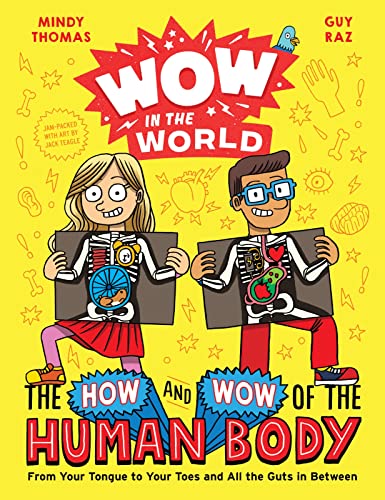
You can find just about any answer you need to your questions in this fast-paced nonfiction book about the human body. It begins with the head and moves its way through the systems, stopping here and there to deliver some facts that will add a “Wow” factor (actually, more of a “Gross” factor) to the information. It is illustrated with cartoon-like characters and body parts. The characters are diverse, with differing skin tones and abilities.
A glossary, bibliography and source notes are available. Something really cool to note is a page of QR codes that lead to relevant episodes of the authors’ podcasts of Wow in the World on NPR.
There is a lot of information to take in through these 188 pages. But, kids will likely be engrossed in the gross facts added to the information presented. A rather vivid description (and illustrations) of various types of poop on the Bristol Stool Scale is one example of the extra stuff that kids will love to read about and share with unsuspecting adults. Now, I know seven types of feces and I might just share that information, too!
This book is part of a series called “Wow in the World”, in which there are currently two books and a third due out in April 2022.
Crazy Horse and Custer: Born Enemies, by S.D. Nelson
A double biography about two imperfect men who were born within a year of each other, lived on opposite sides of historical issues, and died within a year of each other. Both are flawed because of the prejudices from which they were raised. Both were leaders for their respective cultures who were both celebrated and reviled at different times in their lives. They had much in common though they despised the other. I found this book interesting and hard to read because of the biases of each of the historical figures. In that way, I think the author did a splendid job of helping the modern reader see both sides of the westward movement – from the Eurocentric, white point of view to the Native American perspective. I appreciated the map of the region placed in the center of the book and referred to it often. Photographs and sketches were well placed to help the reader visualize the historical events. The book also includes a timeline, an index, and an extensive bibliography of many of the historical details included in the accounts of these men’s lives. It’s an important book to have on library shelves to give youn modern historians perspective on the westward expansion in this country.
