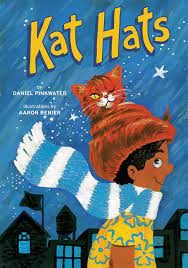
Kat Hats by Daniel Pinkwater

Kat Hats Incorporated is a special training facility where special cats learn to be “living hats” for specific purposes. These cats are rented out to mountain climbers, Arctic explorers and other extreme adventurers. It is owned by Matt Kats, his wife, Glamorella, and their children, Pocketmouse and Lambkin.

Their most prized cat is Thermal Herman 67/8ths, who is the warmest cat ever known (a good thing, since over 90% of the the body’s heat is lost through the head). In this story, it’s a good thing he wasn’t on an expedition, because he was sent on an emergency mission – to find and help Thirdbeard’s mother, Chickarina (the witch), who walked off licking a fruitsicle. He was worried that she might get a brain freeze. So, Thermal Herman 67/8ths hurried up the mountain, encountered his own adventures on the way and saved Chickarina in the knick of time by pretending to be a witch’s hat. She put him on and warmed up enough to save herself!

This very silly story is engaging, helped along by the outrageously colorful illustrations. Young readers will need to spend extra time on each page, because there is so much going on. Kat Hats is a goofy book and is sure to make kids wonder why the notion of Cat Hats hasn’t been invented yet.

The Swallows’ Flight, by Hilary McKay

The Swallows' Flight by [Hilary McKay]

This book follows four ordinary children, Eric, Hans, Kate and Ruby (& one dog) as they grow up and find their lives intertwined in the years leading up to and during World War II. Eric and Hans come from Berlin, so the reader sees what life was like leading up to the war in Germany. Kate and Ruby are from Britain. All struggle through pretty normal bits of childhood set in a time of approaching conflict. I loved the book once it got going, though I found it a bit slow and confusing to keep track of the various characters at the beginning of the book. Once the book caught its stride and various characters met each other, it was not a problem, and the action pulled the reader along. Seeing family life from the two countries will help readers understand that war is made of regular people – not all evil or good Just ordinary folks caught in extraordinary times. The book has one of those satisfying endings that lets the reader know what happened to characters years after the main conflict is over. At least I always like to know that! The author also gives some background information at the end of the book of some historical facts about the world the children have inhabited. There is also a family tree at the end, indicating some of the characters may have been in another book by this author, The Skylark’s War.  (Perhaps keeping track of all Kate’s family members would have been easier if I’d read this earlier book.) Definitely one to include for students interested in historical fiction about WWII, especially because it includes a look at both sides of the war.

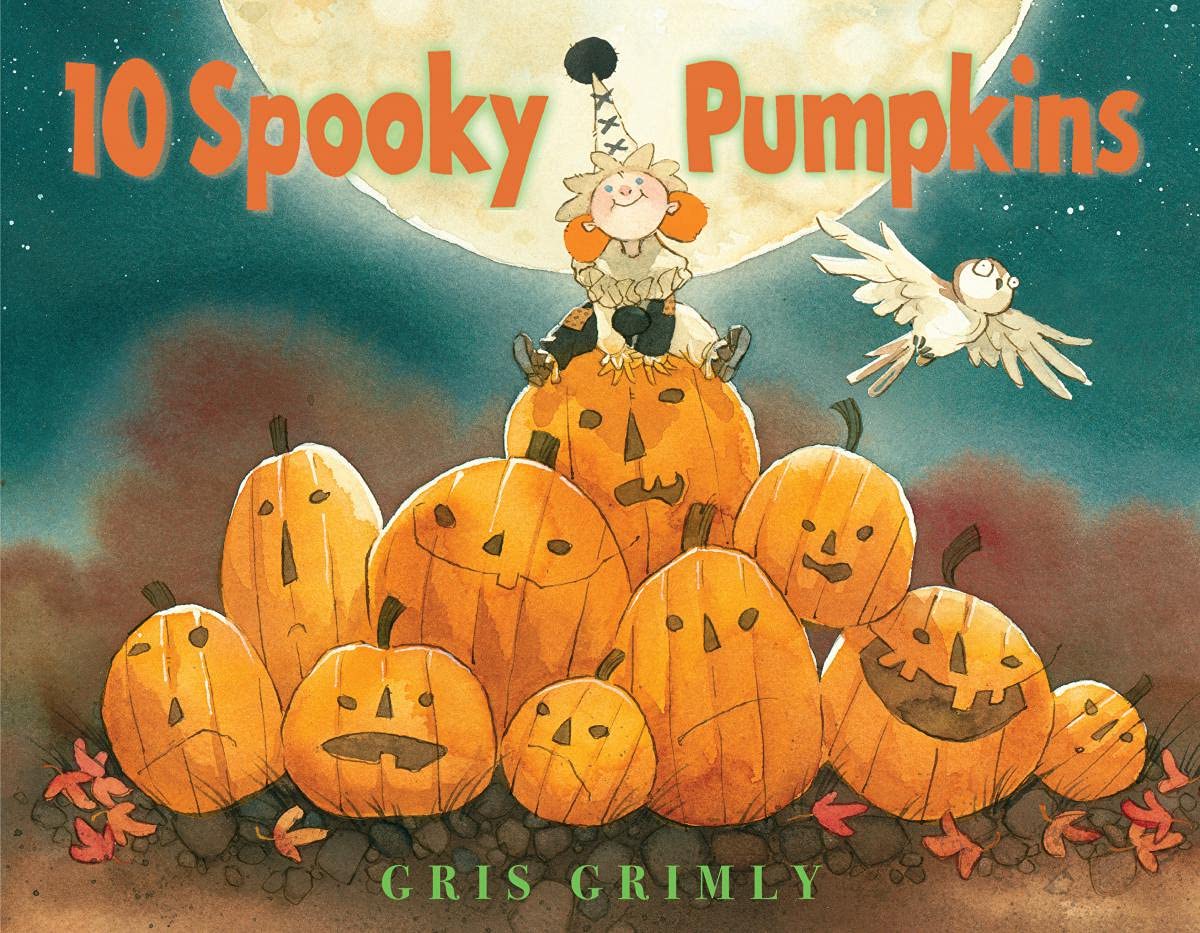
10 Spooky Pumpkins by Gris Grimly

A little red haired girl steps out of her house on Halloween, dressed as a cute little clown and walks into a story that begins with “10 Spooky Pumpkins”. She saunters through the pages of the story as the countdown ensues through nine black cats, eight screeching bats and so on. The story ends when the moon scares them all off and the girl goes safely home to bed.

Reminiscent of “Five Little Pumpkins” and “Five Little Monkeys” in cadence and rhyme, the story is somewhat more eerie with its darkly humorous illustrations. Yet, the cute little clown breezes through each two page spread, adding a bit of lightness.

The author adds an artist’s note at the end of the book with information and background. Black and white drawings surround the note, giving readers another look at the spooky characters within the story. This is a nice addition to fall books. Recommended.

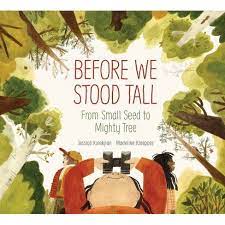
Before We Stood Tall: From Small Seed to Mighty Tree by Jessica Kulekjian

The story of a deciduous tree’s life in reverse, beginning with the giant tree in the “kingdom of trees” is a unique change from typical nonfiction life cycle books. Told from the tree’s perspective and working backwards, the spare text explores each step of the tree’s life. Accompanying illustrations are from a variety of perspectives – looking up, down and even underground.

Young readers will enjoy this ‘counterclockwise’ life cycle book. There are just a sentence or two on each page. So, there is no chance of getting bogged down in facts. There is a fairly technical author’s note that goes much more in depth. This is better shared with an adult, who can explain some of the more difficult concepts. A resource list of books, videos and websites are also included for further exploration. Recommended.

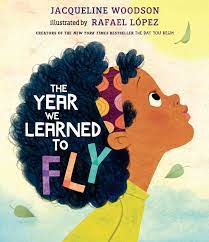
The Year We Learned to Fly by Jacqueline Woodson

This story follows a brother and sister, who become bored one stormy summer day and start to argue. Their grandmother offers advice “Lift your arms, close your eyes, take a deep breath, and believe in a thing.” They come to realize that their imaginations can take them anywhere as they imagine themselves flying over their city, which is full of color. They relive this experience many times over through the fall and winter and they realize that they can use their imaginations in a wonderful way.

Grandmother “had learned to fly from the people who came before. They were aunts and uncles and cousins who were brought here on huge ships,their wrists and ankles cuffed in iron.” She reminds them “But, nobody can ever cuff your beautiful and brilliant mind.” 

They move to a new neighborhood and remember their grandmother’s advice when they feel lonely. They aren’t alone for long as they share with their new friends, who ‘One by one they too learned to fly.”

This is a poetic piece that reminds all of us to close our eyes and use our imaginations. There are so many possibilities and the challenges can be overcome. We have that power to look to a brighter future.

Text is accessible and accompanying illustrations are bold, bright and engaging. The author’s afterward gives credit to Virginia Hamilton’s “The People Could Fly: American Black Folktales” for her inspiration. The Main characters are Black and supporting characters are diverse. This is the second book by the author/illustrator duo of Jacqueline Woodson and Rafael Lopez (“The Day You Begin”) and it is just as richly created. Highly recommended.

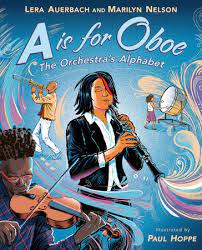
A is for Oboe : The Orchestra’s Alphabet by Lera Auerbach and Marilyn Nelson

“A is for Oboe: The Orchestra’s Alphabet” is a poetic journey through music and instruments. Each letter is on a page or two page spread with at least one musical word. Many are recognizable, such as drum and clarinet. Others are less obvious, like meter and motif. We are introduced to the notion that musical instruments can be a ‘he’ or ‘she’ or even somewhat gender-bending (glockenspiel) because to musicians the instruments are ‘beings’ with character and mood.

Illustrations are vibrant and full of detail, with a great diversity in orchestra members. Text flows and is rich in tone and meaning. This book, while not necessarily a quick read for a student, will be a wonderful read aloud for music teachers as an introduction to the orchestra and all its members/instruments. Recommended

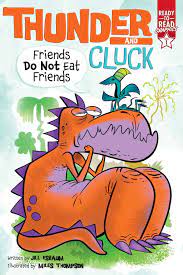
Thunder and Cluck. Friends do not eat friends by Jill Esbaum

Thunder and Cluck are an unlikely pair of friends. Of course, they don’t start out as friends, as told in this easy-to-read graphic novel. Big, toothy dino Thunder comes upon small, birdlike dinosaur Cluck and prepares to eat him. But, Cluck doesn’t do what he is supposed to do – run! A discussion ensues, with Cluck attempting to strike up a friendship and Thunder giving all kinds of excuses about how this can’t happen. Suddenly, another large, toothy dinosaur sidles up to eat Cluck and Thunder protects his “little buddy” (his words). He finally acquiesces to a friendship experiment, muttering something about hanging out with Cluck will be …interesting.

This beginning graphic novel is a perfect starting point for new readers. The book’s introduction explains how to read a graphic novel, describing panels and word versus thought bubbles. Each page has one to three panels on it and the colors are bright and bold. The main characters are cartoon dinosaurs – can it get any better? Buy this one for your youngest readers. They will be hooked! Highly recommended.

Animorphs, the Graphic Novel: The Visitor

Based on the novel by K.A. Applegate & Michael Grant, adapted by Chris Grine

This is the second volume in the new graphic novel adaptation of Katherine Applegate & Michael Grant’s popular series Animorphs, adapted by Chris Grine. Having never read the original series, I did read the first graphic novel to get the gist of the big problem, namely the alien ability of the 5 main characters, Jake, Marco, Cassie, Tobias, and Rachel, to now turn into animals. Their new abilities will help them fight the Yeerks, an alien race trying to take over Earth while our planet waits for the good aliens, the Andalites, to come join the fight. In the second volume, Rachel agrees to go undercover in a cat form to discover what they can from their assistant principal, Mr. Chapman, who has become a host to the main Yeerk. Illustrations are bright and bold. The transformation scenes are clever as we see part human and part animal morphing. Text bubbles are different when characters are talking vs when they are using mind reading, adding a visual element to inner dialogue. If the first book in the series is popular, students will definitely enjoy the second. And, if like me, you never experienced the original series, I think the animal element and the high action will appeal to new audiences. Some scenes might be visually scary for younger audiences, though I think this will be fine for upper elementary and middle school level readers.

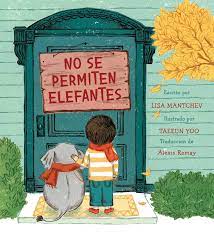
No se permiten elefantes by Lisa Mantchev

A small boy and his tiny pet elephant are turned away from the Pet Club. There’s even a sign that specifically states “Strictly No Elephants” (No se permiten elefantes). They walk away sadly, only to come upon a dejected girl and her pet skunk, who were also turned away (“He doesn’t stink” she says). Together they form an inclusive Pet Club at a tree house and make it official with a sign that says “All Are Welcome”. And, others come with their unusual pets, like a bat, giraffe, armadillo and tiny narwhal.

Text is simple and illustrations are warmly detailed using block print, Photoshop and colored pencils. Observant readers will notice that the boy, girl and their pets are colorful, while everything else in the background is teal and black on one double page spread. They might also notice a few unusual pets peeking out windows as they walk by on their way to start their new club.

This is a message of inclusion and caring friendship. Characters and pets are diverse. The boy and his elephant have a special bond as noted when the boy helps the tentative elephant over cracks – “I always go back and help him over. That’s what friends do: lift each other over the cracks.” “Siempre regreso y lo ayudo. Eso es lo que hacen los amigos: apoyarse en medio de las grientas.”

This is a lovely book with a wonderful message. It may lead to some great discussions about what friendship looks like for children and what it means to be included. Highly recommended.

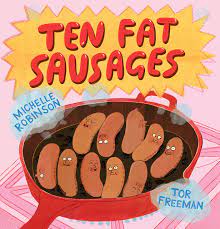
Ten Fat Sausages by Michelle Robinson

“Ten fat sausages, sizzling in the pan…” begins a fresh take on a familiar nursery rhyme, with every other sausage refusing to go “bang” or “pop” and attempting escape instead. Most are not successful, due to a cat, fan, blender and so forth. But, at the end, two escape – not unscathed.

While the notion of a redo of a nursery rhyme is fun, this particular rendition is rather dark and somewhat unpalatable, so to speak. Illustrations of whirring blenders full of pulverized sausage and sliced or bitten sausages are just…yucky. The accompanying text explains each sausage’s end to the general rhyme of “Ten little monkeys”, but falls short on occasion in its faithfulness to the original rhyming sequence.

There are other “food” picture books out there that might be more fun. Or, buy this one and wait for the reactions when you read it aloud. That might be fun, too.