What is a poem? This question is answered, first in Spanish and then in English. Short, playful text tells us the many things a poem can be. In the end, we see that a poem can really be anything. As the author notes, “A poem is a mirror inside your head”.
Black line illustrations on a vast white background playfully draw the reader along through the pages. They add to the whimsy of the words and together open a world of creative thought. Recommended.
Bookie and Cookie are best friends with very different tastes. Bookie loves books and is surrounded by books at his home. Cookie loves cooking and baking and his home is shown with a kitchen and table central to the illustration. They always hang out at Cookie’s and Bookie suggests they change and go to his place. Cookie doesn’t want to do something different and a disagreement occurs. Both parties end up alone and unhappy in their own spaces. Bookie bakes some cookies and they come together at his home for a snack. Then, they read together at Cookie’s home. They work out their differences and their friendship is preserved.
Text is spare and conveys the main points of the story succinctly. Illustrations are colorful with lots of white space, which provides a clean background for the story. Emotions are clearly noted as the characters’ relationship becomes strained with even a few tears. Their happiness at the resolution of their disagreement is also shown. Characters are diverse. Reviewed copy in Spanish as translated by the author. Recommended.
Written by Traci Sorell and illustrated by Michaela Goade
A young Cherokee girl, her mom and her dog pack up and leave the city to return to their ancestral home. She leaves behind the crowded streets, quick pace and lack of family to a place where there is room to roam, a different tempo, and that connection to her family now and from the past. Her travels are documented in her drawings as her mom drives toward their ancestral lands. When they arrive, they are surrounded by family who happily help unload their belongings, they visit and play. The tempo is slower and she is home.
Spare text and richly hued illustrations convey the warmth and excitement of the this change. The depth of her connection to her family and home is shown in the final pages as she happily engages with her relatives and her place. Sorell (Cherokee Nation) and Grade (Tlingit and Haida) combine their considerable talents to create a special story. Highly recommended.
Clara travels with her parents to her extended family’s orange groves in California. She listens to family stories around the table with her cousins, aunts and uncles and grandparents. Wanting to make her own memories with family, she hides in her grandpa’s truck when he leaves for the fields. After she reveals herself, they spend the day there together making those memories that she needs to connect to her family there in California. He shares the family history with her, mostly good but some painful.
Based on the author’s own family history, this is a sweet story of generational connections and strong family roots. Written in Spanish with lovely illustrations and a strong message of family. Add this one to your collection. Recommended.
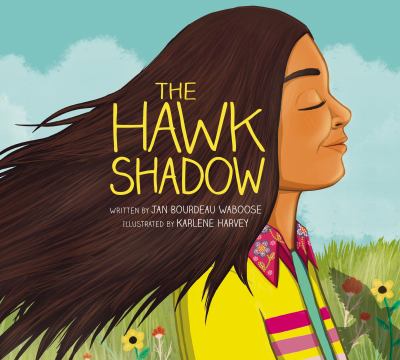
written by Jan Bordeau Caboose and illustrated by Karlene Harvey
Serenity accompanies her brother, Big Ed, on a fishing trip to the Hawk River. As they walk, the siblings chat and tease each other and Big Ed explains the significance of the river’s name. It is named for the the Hawks, Gekek, Keepers of the River and their Protectors. Big Ed and Serenity arrive at the edge of the river and cast their lines, his from a beautiful new fishing pole and hers from a spruce branch made by their father. Serenity is daydreaming as she fishes when a Red Tailed Hawk (Gekek) suddenly appears, swooping over her and screaming, before flying off over the river. Serenity looks around and her brother is no longer there. Gekek, the Red-Tailed Hawk, returns, screams and flies up the river again. Serenity follows and finds her brother, his foot caught between rocks in the river. She doesn’t know what to do until Gekek swoops down over her pole. Serenity holds the pole out to Big Ed and he grabs hold. Together, they work to return him to safety on the river bank. They lay on the river bank for a few moments before heading back home, thankful for the protection of the Spirit guides.
This lively story is wonderful for many reasons. We are given a glimpse of the culture and lives of the Anishinaabe people, an exciting rescue and the loving relationship of a brother and his younger sister. All of this is set in a picture book with vibrantly colored illustrations that transport the reader to the trails and river banks of the Hawk River. Highly Recommended.
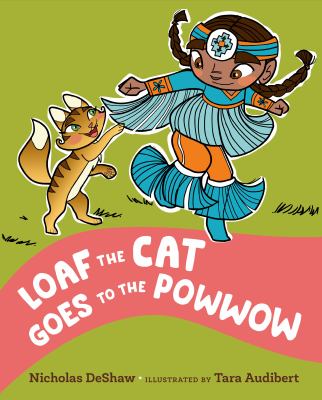
written by Nicholas DeShaw and illustrated by Tara Audibert
Loaf the Cat (she looks like a loaf of bread) loves her boy, Charlie. She plays with him, purrs a lot and looks for him when he is gone one day. She finds him at the powwow, where he is dancing the grass dance in the regalia he made while she played with the ribbons. She is so happy to see him that she jumps on his shoulder and stays there as he dances, happily part of the experience. After they went home, the boy asked Loaf if she wanted to go to another powwow and she happily purred.
This book is a burst of energy and colorful illustrations as we meet a lovable cat and her boy, Charlie. The story is told from the cat’s perspective as she spend time with her boy, playing and watching him create his regalia and joins him at his first powwow as a dancer. Their bond is evident throughout and the end is fitting – we know that this is the first of many powwows together for this pair! There are some words that might be unfamiliar to readers, including regalia, powwow, “miigwech” and “howah”. But, readers will enjoy delving more deeply into the meaning of those words, which will lead to more insight into the Native American cultures portrayed in the story.