
The illustrations are really fun, with a cute little dog with great big eyes who sucks you in immediately. The story is one that will be familiar to anyone who has a short-legged dog, but from the dog’s perspective: he really wants to climb “Comfy Mountain” (i.e. the back of the couch), but he just can’t manage it. When finally realizing all he needs to do is ask his human for help, the rewards prove better than his imagination. It ends with a gentle reminder that though it’s great to do things by ourselves, sometimes doing them together is even better. Some kids need a reminder that it’s okay to ask for help when you need it.
Category Archives: Recommend
Patchwork Prince
The illustrations are vibrant and joyful and celebratory, even as the story is describing events born of poverty. Many students used to making the most of hand-me-downs may relate to the power of recreating something beautiful from that which has been discarded by others. They may be perplexed though at the idea that the narrator and his mother had to sneak through the night to scavenge the fabric scraps before they were set afire. Reading the author’s note at the end helps to give context, explaining that the book is based on his own childhood experiences growing up in St. Lucia, where wealthy factory owners made a point of having their scraps burned so that poor families couldn’t steal their trash, but that sometimes a kind worker would give them time to rummage before starting the blaze. We say books can sometime serve as mirrors, reflecting the reader’s own experiences, or sometime a window, showing the reader some aspect of the world beyond. This one may do both at the same time for some readers.
Just Because
It’s not a story to be read straight through from start to finish. It’s a poem to be read and pondered in bits and pieces — would be a really good conversation starter. It’s a series of rhyming couplets, each making a statement that seems on the surface to be self-contradictory, yet the accompanying illustrations sets forth a scenario in which it makes sense after all. “Just because I’m finished, doesn’t mean that I’m done” is matched with illustrations that show a girl all tucked up in bed, saying goodnight to the parent at the door, followed by the same girl reading with a flashlight under the covers once she’s alone; “Just because I’m sitting still, doesn’t mean that I’m not busy,” is illustrated with a girl sitting in a yoga pose. Some of them work better than others, and some could be argued, but that’s what gives it such potential to start meaningful discussions.
Brave Little Bear
The illustrations are absolutely charming! The big eyes on the bear cub, Arlo, capture the reader’s heart from the start. The message may be a familiar one, that “Being brave when you feel afraid is the very bravest brave of all,” but because the cute little bear sucks us in at the beginning, we feel for him every step of the adventure that teaches him this lesson. He doesn’t want to leave his cozy cave all snug with his mom and sister, but mom tells him to be brave as they set out. He sees his sister as the brave one, until she gets lost in a snowstorm and he rushes out on his own to save her without even thinking about it. In the end, once they’ve all reached their destination safely, he once again finds himself snuggly curled up with mom and sister. It’s a feel-good story that leaves the reader comforted by the reassuring ending of everything turning out alright in the end, and the confidence that we all have the capacity to be braver than we believe when need arises.
A Day in the Sun
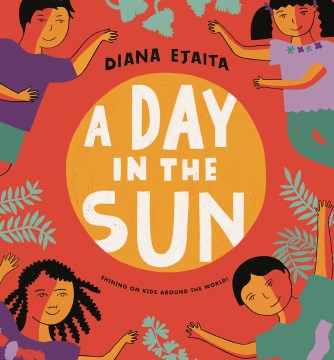
by Diana Ejaita
As the world travels around the sun and daylight shines in all the different places , we see how it affects us in the most positive ways. Each two-page spread highlights children in a noted country and what happens on a sunny day, whether it is covering their heads from the very hot sun to taking a swim to cool off. The bright, vibrant colors add to the story and the smiling children throughout remind us that we are all living on the same world under the same sun. This is a lovely book to share.
Babajoon’s Treasure
This is a good addition for libraries wishing to expand their multicultural offerings. The main characters are immigrants from Iran, but the story line is one that could fit any young child on a day out with her grandfather: As the narrator describes her visit to her grandfather, she starts noticing details that set her imagination going: he’s got a gold coin, and he sings to a parrot, and he speaks an unknown language with a friend who gives him magic crystals (a.k.a. rock candy), so she decides he must be a pirate. Even after he sets her straight, she still recognizes his many great traits and decides she wants to be just like him someday.
Our Day of the Dead Celebration
The illustrations are bright and cheerful, suiting the intended tone of the day it is describing. The text is straightforward and enthusiastic. Because it is written in the first person plural, it avoids trying to cover all the ways different people/families/communities celebrate; it simply shares one small girl’s descriptions of how her family celebrates. Though I do think most of the common themes of the day are included. Students who celebrate the day withing their own families are likely to find much to relate to, and those who don’t will still likely find much to relate to, while also gaining a clear understand of what may be an unfamiliar holiday.
Palace of Books
The only thing I’m not sure I like about this book is the title. Though the title edifice does play a significant role in the story, it’s really a much more expansive story than just that piece of it. Drawing on personal memories, as so many of Polacco’s books do, this one tells of year of her life when she was in transition. It’s about going through changes, and saying goodbye to familiar places and venturing into to ones. it’s about meeting new people and finding your niche, discovering what you have to offer. It’s about people who help us discover our passions and talents. It’s about using our passions and talents to make an impact on the world around us, even if we’re not in one place very long. Great book. My one reservation about giving it a highly recommended rating, is that the lengths of Ms. Polacco’s books often make them hard sells to the picture book crowd. Are they really targeting children? Or adult readers who love children’s books?
Aston Martin Valkyrie

by Kaitlyn Duling
“Cool Cars” series literally says it all in the series’ name. These are books about fast, luxurious and fun cars that are, well, COOL! High interest topics paired with a load of brilliant photos and accessible text make this 28 book set a must-have in your library. Nonfiction elements include: Table of Contents, glossary, index, bolded words and labeled illustrations. Each book has the important facts about a car like its engine type, history, size, speed and future plans of the manufacturers. This photo-heavy, high-low series will be popular among your patrons!
The Aston Martin Valkyrie is a very special car – only 150 have been made and the starting price is over $3,000,000! This is a hybrid model, with a powerful gas engine and an electric motor as well. Because it is so rare, this car is popular at car shows and people stop to stare when one drives by. Readers will dream about seeing one of these cars one day!
Audi RS E-Tron GT

by Kaitlyn Duling
“Cool Cars” series literally says it all in the series’ name. These are books about fast, luxurious and fun cars that are, well, COOL! High interest topics paired with a load of brilliant photos and accessible text make this 28 book set a must-have in your library. Nonfiction elements include: Table of Contents, glossary, index, bolded words and labeled illustrations. Each book has the important facts about a car like its engine type, history, size, speed and future plans of the manufacturers. This photo-heavy, high-low series will be popular among your patrons!
The Audi RS E-Tron GT is an all electric car that is super fast and luxurious. It was first made in 2021 and has a driving range of nearly 300 miles. There are a lot of plans for this model, including animated lights and, possibly, a smart version in the future!