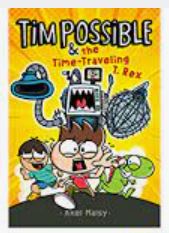
Tim Possible & the Time-Traveling T. Rex

Written by Axel Maisy

The main character, Tim Possible, is an adventurous boy who worries a lot. He and his best friend, Tito, run into a time traveling T-Rex whose time machine has turned evil. This humorous and adventuresome book will be a great addition to a library that may see a need for more books along the vein of “Captain Underpants”, “DogMan” or “Diary of a Wimpy Kid”.

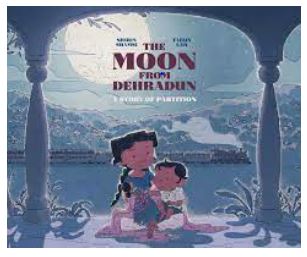
The Moon from Dehradun: a Story of Partition

Written by Shirin Shamsi Illustrated by Tarun Lak

This is a beautifully written and illustrated picture book about the partition of India in 1947. It follows a family that suddenly has to leave their home and move to what is now Pakistan where they find an empty house and move in (presumably because that family had to move to what is now India). While recommended for ages 4-8, this book would be a more relevant purchase for intermediate grades. The story will be relatable to individuals who have an understanding of refugees and individuals that flee from their homelands due to fear. This book also contains maps, a glossary as well as the author’s family experiences in the back that would better explain the story to more advanced intermediate readers.

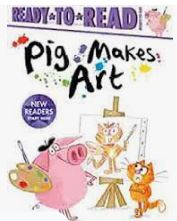
Pig Makes Art

Written by Laura Gehl Illustrated by Fred Blunt

This book is an “emerging reader” book about a pig who creates art but leaves out the cat from the picture. The cat gets bored and takes a nap so the pig makes art on the cat while it’s sleeping. This makes the cat angry. In the end, pig and cat both make art together as friends. This book contains a list of word families, sight words and bonus words. It also has questions about the book on the last page.

Clementine and the Lion

It’s okay. It’s a version of the classic “kid thinks parents are ogres and would rather live without grown-up interference” trope. In this case mom got snatched by dragons and dad is lost at sea in a bottle. When an aunt shows up and tries to take over, Clementine invents an invisible paint to hide the house and get rid of the aunt. When she accidentally leaves the door open one day she ends up with a lion as a houseguest and must find a way to make peace with it and carry on in case her parents come back some day. On the one hand, a lot of kids can relate to the living-without-adults fantasy, on the other hand, it seems a bit disjointed.

I am Malala Yousafzai by Brad Meltzer

Another book in the Ordinary People Change the World Series, I am Malala Yousafzai, starts out with Malala introducing herself as an ordinary girl who likes pink, cupcakes, and pizza. The narrative quickly turns to how girls in her country are not treated the same as boys. It discusses the school started by her father and her quest to seek education. It does depict when she was shot and does show someone holding a gun. The illustrations show Malala as a young girl throughout the entire book. The end includes a timeline and photographs of Malala.

Different Kinds of Fruit by Kyle Lukoff

From the author of the Newbery Honor book “Too Bright to See” and the picture book “When Aidan Became a Brother,” Kyle Lukoff presents us with a novel on the queer community through the eyes of sixth grade Annabelle. When a vocal, cool binary student, Bailey, joins her class, Annabelle is instantly infatuated with them, and begins to wonder if this is actually a crush. When she brings Bailey home, Annabelle’s parents instantly act awkward and seem to be discouraging their friendship. Misreading their attitude about Bailey’s gender identity, her parents share with Annabelle that her dad is not only transgender, but a seahorse father. (He was the one who birthed Annabelle when it was discovered that her mother was unable to have children). Once this is out in the open, Annabelle, Bailey, and their families get involved in the Spectrum Families chapter in Tahoma Falls and Seattle, WA. Annabelle continues to try to “figure out which letter in LGBTQ+ applied to me, now that I know that I was something.” National Coming Out Day (NCOD) is quickly approaching and Annabelle feels pressured to figure it out soon.

From the very beginning, I saw this is as an “instructive manual” on how to “they/them” and teach terms such as butch, femme, seahorse, pan, and more. While I respect this possible motive by the author, for me, it drove the book rather than an interesting plot. I believe there are better books out there on questioning your sexual and gender identity, but if you’re looking to add to your collection, this may appeal to lower middle school students.

When You Call My Name by: Tucker Shaw

This is an LGBTQ+ Romance set in the early 90s. Usually, I love books set within this time period because I was a teen during that era; however, this one falls short for me. The pop culture references sprinkled within the book are pretty obscure; I worry today’s teens will not have enough knowledge to understand the reference and grow bored of it, unable to relate.

I appreciated the way the author told of society’s attitude toward the LGBTQ+ community during that time period; however, I feel as though parts were very trite and predictable.

I also dislike the title – it feels like it’s trying to allude to Call Me by Your Name by Aciman (which it does not compare).

I do think that our high school libraries will have an audience for this title. I am curious to hear what today’s teens say about it it.

When You Call My Name

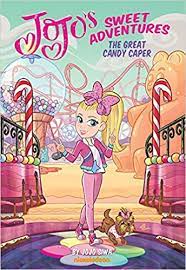
The Great Candy Caper by JoJo Siwa

Nickolodeon;s JoJo Siwa is invited to sing at the opening of a new candy-themed park, SugarPalooza, and takes her two friends, Grace and Kyra for a special tour before the show. The park’s owner’s daughter, Avery, and her friend, Jada, join the tour. Something’s not quite right, but JoJo can’t figure it out. Actually, there’s a lot that isn’t right, including a big mess of chocolate as the chocolate pumps malfunction. Candy is everywhere, rides are breaking down and Grace is missing! JoJo and Kyra spring into action to fix both calamities. The chocolate malfunction is fixed, thanks to help from Jada and their tour guide, Maddy. And, they locate Grace, who has a history with Avery (not a nice girl). But, Grace saves Avery despite their bad relationship, and Avery apologizes. The show must go on and, after a cleanup, the park opens and JoJo performs for the adoring crowds. Everything is sweet in this Candy Caper.

This graphic novel is full of color and a simple story line (girl drama that is fixed in the end). The font is fairly small. The illustrations are set in one to five panes per page. Fans of JoJo Siwa will enjoy this book and a wider audience might like the adventurous romp through SugarPalooza.

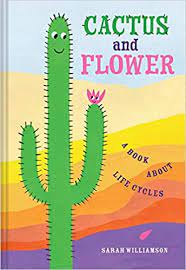
Cactus and Flower : a book about life cycles by Sarah Williamson

Cactus and Flower are best friends. They watch the sky as it changes color throughout the day. They visit with their desert animal friends and they watch the stars. These are “Butterfly Days”. One day, one of Flower’s petals drops and then another and another, until…flower is gone. Cactus is so sad. Even the beautiful butterflies can’t cheer him up. But, sadness eventually changes to sweet memories of his friend, Flower. One day, a little green bud appears on Cactus and it turned into a new Flower. “Butterfly Days” are back.

This is a simple, sweet rendition of the life cycle. While the botany might not be totally accurate, the desert animals are there and the basic story line works. Illustrations are bright and simple. Endpapers add interest with clouds in the front and their constellation counterparts in the back. This would be a nice introduction to plant life cycles.

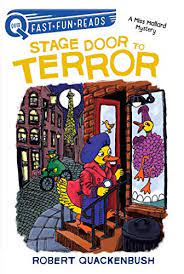
Stage Door to Terror by Robert Quackenbush

Miss Mallard is in Paris visiting her nephew, Inspector Willard Widgeon. They decide to go to the theater performance of Claudine, granddaughter of family friend (and retired performer) Lily Pilet. In her day, Lily was a famous dancer, who was even rumored to be courted by royalty and showered with jewels. They are especially excited to see Claudine’s recreation of Lily’s famous “Rain of Light” dance. Claudine enters the stage and is swept up and ducknapped! Fortunately, Miss Mallard and Willard quickly discover her tied up in the attic of the theater. Unfortunately, they also discover that her dressing room has been ransacked by the ducknappers.

Upon further discussion, Claudine tells them that her grandmother sent her her bejeweled costume for the show. This costume is studded with real gems. Lily has some later misgivings and sends her a reproduction of the costumer and asks Claudine to hide the real one. Claudine has a claim ticket for the suitcase with the costume, which is at the railroad station. The problem? The ticket is torn and only Claudine’s assistant, Marie, knows the station name. A rush through all the major Paris landmarks ensues and they find Marie in a cafe. They “hatch” a plan to catch the thieves with a fake suitcase and claim ticket before retrieving the real bejeweled costume and their plan works. The thieves/ducknappers are apprehended and the valuable costume is back with Claudine.

This book is intended for those students that are ready to move on from picture books to early chapter books. The font is large and there are numerous half page illustrations. There is also a glossary and question page in the back of the book. The only sticking point of this story is the unfamiliar setting (Notre Dame, Montmartre, Eiffel Tower, etc.) of Paris. Young readers might become bogged down a bit, instead of just enjoying the story. Otherwise, this is nice stepping stone to chapter books.