Football Records

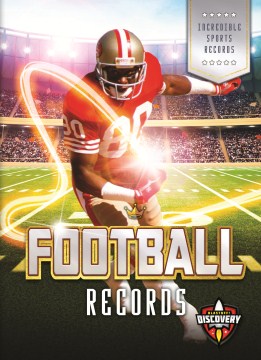
Football Records, part of Blastoff! discover. Incredible sports records series, is a quick “dip your toes into the stats” kind of book. Glossy action shots of various record holders with short paragraphs and extras in scattered text boxes will leave the casual reader satisfied and the sports fanatic ready to explore more (which will be simple, given that there are extra print and internet resources listed in the back of the book). Highlighted words are defined in the glossary and an index is a nice quick reference. This will be a good purchase if you are looking to update your sports collection.
I Want to Grow

It’s fine. Worrying about growing is certainly a concern of many small children. In this case, it is Muriel’s imaginary friend (small, green, rather alligator-esque) who notices that Muriel is growing and he is not. He tries planting himself in the garden; he tries having Muriel roll him like her play dough; he tries forcing the issue; and he tries tall shoes and hat. Nothing really proves successful, but gee, overnight he does indeed grow (even if he doesn’t actually catch up to Muriel, since she grows too). It’s really intended for the youngest readers, probably best suited to PreK or Kindergarten.

Possum and the Summer Storm

It’s a cute story about animals coming together to help a neighbor in need. When a storm washes away Possum’s brush pile home, he gathers his young and sets off to find a new home. Along the way he meets other animals who offer their assistance, beginning with chipmunk who offers to help dig a new home, which the baby possums love, but is unfortunately to small for Papa Possum. As each animal offers to help, they are of course offering their expertise for their own type of homebuilding, but when put all together, Possum ends up with quite a lovely home, and just as he asks how he can possibly thank them all for their assistance, another storm strikes, so they all hunker down together.

Boom! Bellow! Bleat! Animal Poems for Two or More Voices

A great choice for readers’ theater! Because so many of the words repeat or are not real words at all, but animal sounds, this book would be a great choice for having partners share reading performances in a less intimidating way. The two-voice formatting is fun and adds to the appreciation of sound in poetry. There is a wide variety of animals included, so it would be useful as an introductory or cross-curricular connection for a variety of science units. Paragraphs in the back offer additional scientific background for deeper understanding of each poem.

Which One Doesn’t Belong? Playing with shapes

It’s a simple concept book, suitable for even the youngest students, yet it doesn’t over-simplify the concepts. Each two-page spread includes four images of shapes opposite the title question. But the first set of four shapes adds the question, “why?” and goes on to explain how each of the four shapes could be the correct answer for different reasons. The important part isn’t which shape the reader chooses; the important part is in discussing why. A letter from the author in the back of the book reminds the reader that what words they choose to describe their thoughts aren’t what’s important either — as long as they are considering they different traits of the shapes, they are thinking mathematically. A great book for divergent thinking.

Pony Poems for Little Pony Lovers

I like it. Pony Lovers abound in elementary school, and the sweet illustrations both draw readers in and offer support for the text. The poems are short and simple and child-like, which I think make them less intimidating that poetry can sometimes be for young readers. This book makes poetry approachable, inviting students to try composing themselves.

Poetree

What a sweet story! When Sylvia writes a poem to celebrate the coming of spring, she carries it into he park to read it to a squirrel and tie it to a tree. On her way to school the next day she thinks she sees her poem fluttering in the breeze, but soon realizes it’s a new poem, and she believes the tree is writing back to her. For several days she continues to write the tree poems and find others in return (all the poems are, of course, included in the story). Then one day she finds a boy from school, who she doesn’t particularly like, at the tree and learns that the poems came from him, not the tree. At first she is sad to learn her tree wasn’t really writing to her, but then the two bond over poetry and become friends. The illustrations are soft and sweet and well-suited to the mood of the story.

All You Need Is Love

I’m afraid I didn’t like it quite as much as I had hoped I would. I generally really like when they do picture books to song lyrics, and who doesn’t like The Beatles? But these lyrics maybe didn’t lend themselves so well to illustrations, or to being written as text without the musical accompaniment, because it just felt a little awkward. I was trying to make connections between the lyrics and the illustrations, and though there were times they fit better, there were also times I wasn’t seeing it.

The True Tale of a Giantess: the story of Anna Swan

This picture book biography a little known figure (who was not so little) will make for a good bit of reading for those who feel awkward, and as if they don’t quite fit in. Anna never did fit in — she was taller than her mother by the age of six — but she had a definite sense of adventure and found a way to use her unusual height to help her see the world. I like the way the book gently describes the ups and downs we all face, regardless of our individual struggles, by sharing the differences between good days and glum days. The author’s note in the back offers additional details as well as photos to remind the students that this is indeed a true story.

The Sun Is Kind of a Big Deal

It’s packed with information, and both the cartoonish illustrations and the chatty writing style make it very approachable for young readers. I kind of have to like it because it makes clear to students a misconception that I carried with me until I got to college: that the sun isn’t bigger than other stars, it just looks that way because it’s so much closer. Though it covers lots of aspects about the sun and its place in our solar system and our solar system’s place in the greater universe, it can’t go into great depth, given that it is a picture book. One element I thought was over-simplified a bit was when, in explaining that the tilt of the earth gives us seasons, it declares that there are four seasons (spring, summer, fall, and winter), where it would have been more accurate to say that much of the earth has those four seasons; not everywhere has the same four seasons and North America and Europe.