
Glitter on the cover is always a draw, but these books have substance to their stories, too. I’ve yet to meet a Tallulah story I didn’t appreciate. This one does a nice job of balancing the dual messages that it takes practice and persistence to get good at something, while simultaneously reminding readers that it’s not always important to practice and succeed — sometimes you’re allowed to just have fun. As an added bonus, the super skilled ice skater who gives Tallulah tips and reminds her that it will take time to improve, is a boy, avoiding what could have been a sexist stereotype.
Category Archives: Reviewer’s Library Type
Super Potato. #2.Super Potato’s galactic breakout
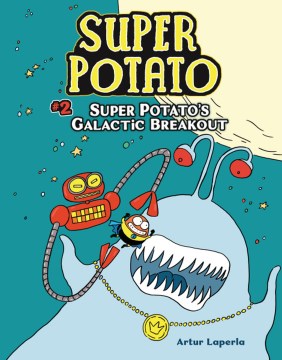
Super Potato is captured by the evil Zort, a slug king that collects creatures from different planets for his personal zoo. Fortunately, the slug’s robot servant is easily manipulated by the brilliant Super Potato and opens all the cages to release the creatures. Minus the Magnificent, king of the Planet Micron, and his armada (who came to rescue him) return the creatures to their home planets and take Super Potato back to Earth. Is this the end? Nope…I know this, because it says it on the last page! There will be more adventures to come.
This innocent little graphic novel will appeal to those readers who might be beginning their exploration of the genre. It is not too difficult to follow and the humor is at the perfect level for the 2nd-5th grade reader. Pages range from single panel to three panel comic spreads that move the story along. The colors are bright and the writing is simple. Pick up this book (and the first one) for your young readers.
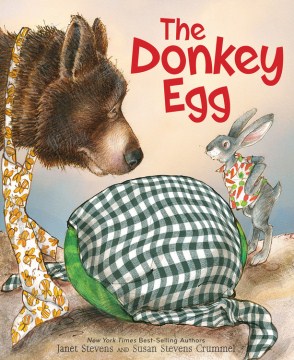
The Donkey Egg
Bear and Hare are back after their escapades in Tops and Bottoms. Fox stops by Bear’s ramshackle home and sells him a $20 watermelon, convincing him that it is a donkey egg. Well, Bear takes care of that “donkey egg” for quite awhile. He does a great job caring for it, keeping it warm and playing with it. Hare stops by occasionally (he seems to be training for a race against a tortoise) to give bear encouragement. One day, Bear falls asleep and the “egg” rolls away from him and crashes, breaking into several large pieces of watermelon (surprise!). Bear and Hare decide to make the best of it, after Bear realizes he was fooled by the Fox. They plant the seeds and end up with so many lovely watermelons! They take some to town to sell and buy …a donkey! Fox sees the trio and the book ends with Fox scratching his head and climbing up on a watermelon.
The story moves smoothly along, with some interesting facts about time along the way. This might distract some readers, but most won’t be bothered. They will be busy moving on to the next page to find out what will happen with Bear, Hare and the ‘egg’ on the next pages. The illustrations are wonderful. It is like seeing old friends again after several years away (24 years since Tops and Bottoms). Highly recommended.
The Royal Rabbits of London :Escape From the Palace #2
Just six weeks after little Shylo left his mother and family out in the country warren, he is being called upon by the Royal Rabbits of London to help save the Queen’s reputation. If the reader has not read the first book in this series, never fear, the highlights are recapped in chapter one. (The Royal Rabbits are true rabbits that protect the royal humans in England and have been doing so undetected for centuries.)
In this story, the nasty, foul Ratzis (no ordinary rats, but rats just the same) are out to humiliate the the President of the United States (POTUS) and the King and Queen of England at their state dinner in London. The head Ratzi – Papa Ratzi- has numerous TV stations and Internet web sites. He will destroy both of these world leaders and their countries’ alliance to each other in one embarrassing event on live TV. BAD NEWS SELLS!!
Papa Ratsi wants small, meek- mannered, brainy Shylo caught for ruining their last attempt to humiliate the Queen. Papa Ratsi wants Shylo interrogated to get all the information he knows about their nemicus the Royal Rabbits of London.
Meanwhile, the Royal Rabbits do not want to work with the Rabbits of the United States (ROTUS) in their mission to protect these two leaders on their home soil. And the ROTUS do not want to work with the Royal Rabbits to protect their president. Thank goodness the two leaders of these two groups insist both sides work together.
In a diversion, the Ratzis grab Shylo. Once this is known, the Royal Rabbits and ROTUS decide that their mission to protect their leaders comes before trying to rescue Shylo. Shylo, being the smart bunny that he is, figures this out for himself. He is on his own to escape. Shylo outwits his guard, escapes his prison, and succeeds in stopping the Ratzis plot.
Shylo, the small, smart, unassuming ‘bunkin’, saves the day, once again! Time to celebrate with the finest carrot juice and dancing down in The Grand Burrow beneath Buckingham Palace!
Meanwhile, Papa Ratzi , AKA Nibbles, is off in America “with his plans to cause havoc in the world, and neither was he finished with his plans for a weak but troublesome little bunny called Shylo.” (201)
After the story ends, the readers will have the chance to test their knowledge on 1) London Landmarks, 2) make a recipe from the story, 3) take a personality quiz, and 4) read ‘Top Ten Facts about the US President and the White House’.
Illustrator Kate Hindley’s illustrations (one per chapter) add to a rabbit’s point-of-view, how the reader will relate to the rabbits’ point-of-view, how stylish the Royal Rabbits are, and how foul the Ratzis are with great charm.
“The text of this book was set in Aged Book” which adds to the allure of British charm this book strives to present to the reader.
Passover
Passover is an introduction to the Jewish holiday. The book explains what it is, its traditions and origins, who celebrates and when they do so. There is a nice pronunciation guide for unfamiliar words and a recipe typical to the holiday. There is also a glossary, which defines the bolded words that are throughout the text. This is part of the Celebrating Holidays series and is very appropriate for early readers. While the text is spare, the photos also do a great job of illustrating the different aspects of the holiday. Purchase this book to update your collection.

Got to Get to Bear’s!
I really enjoyed this one. The illustrations fill the animal characters with personality and spirit. The story opens with a chipmunk receiving a note from Bear to “Please come at once!” Imagining Bear in distress, since Bear never asks for anything, little Izzy sets out to brave a coming storm in order to help her friend. When she finds herself unable to continue, a squirrel comes to her aid, and they continue on until the storm is even too much for the two of them, when a duck in a knit cap and scarf try to fly them through, but eventually the three must accept the help of a sweater-clad raccoon too. As they persevere through each new struggle, we read again and again the refrain, “No matter how steep or tough the climb, a friend is worth it, every time.” When they finally reach their destination, it turns out Bear wasn’t really distressed — he just wanted to wish his small chipmunk friend a happy birthday.
Day at the Beach
On the one hand, the book got my hackles up right off the bat when it begins by telling about Gideon and Audrey’s tradition of building a sandcastle together every summer: “Gideon made sure each tower stood straight, every wall was level, and all the castle sides were smooth. Audrey made sure the castle sparkled with shells, sea glass, ad a starfish on the top.” Seriously? Are we still allowing children’s picture books to blatantly pass on gender stereotypes that the boy cares about the engineering of the castle and the girl is all about decorating? And yet if it wasn’t for that one page, I like how the story continued with Gideon deciding one summer that he was going to build one all on his own, and after many attempts that get destroyed by waves or wind or others on the beach, he does indeed succeed in building a structurally impressive sand castle, admired by many strangers, only to discover his success is a bit hollow when he sees his sister and parents joyfully laughing together over a much more lopsided structure. I like the message of valuing togetherness and joy over independent glory. I feel like the publisher let the author down here: if it had been big sister v. little sister or big brother v. little brother, it could have avoided the whole sexist flaw easily enough.
Mary Poppins
As a general rule, I am not really a fan of abridgments and adaptations. I find it a bit disrespectful to the original work of the author. That being said, this one does have really charming illustrations that invite the readers in. Since the original work has sat on my library shelves for years without circulating, this may be a good way to introduce students to the idea that the story came before Disney, even if the picture book format allows for only a taste of the full story.
Goodbye Brings Hello
The text is in phrases, rather than sentences — a rhyming poem describing a series of transitions in a small child’s life, from saying goodbye to last year’s favorite coat that’s now too small and moving on to a new one that fits just right, to a trip on an airplane which requires saying goodbye to the familiar in order to say hello to the grandparents at the other end of the journey; from giving away one’s preschool trike in favor of a big kids’ bike, to saying goodbye to velcro-covered toes when one learns to tie their own shoes. It culminates with saying goodbye to mom and dad in order to head out for the first day of school and all it holds. The illustrations are vibrant and simple and graphic, offering support to the limited text to make the meaning clear.
Ojiichan’s Gift
It’s a lovely glimpse into Japanese culture, as well as the sharing of traditions across generations, and the transformation of traditions as life changes. It begins with Mayumi as a young child, describing her annual visits to her grandfather who lived half a world away, and the time they spent together in the garden he built when she was born. She describes his garden as unlike any other gardens with which she was familiar: instead of flowers or vegetables, it is a rock garden. She shares what she learned as they worked together, and how much she enjoyed raking patterns in the small stones. She describes the small tin of souvenirs she kept from the garden to remember her visits when she was back at home. And then she tells of the year they visit, and find the garden overgrown and untended; the illustrations show her parents packing boxes and grandfather in a wheelchair as she learns he cannot live there anymore. Remembering how her tin of souvenirs comforted her when she was far away, she makes both her grandfather and herself miniature rock gardens in bento boxes so they can take a piece of their memories with them when they must move away.