Reviewer: OHS Student, Ffiona
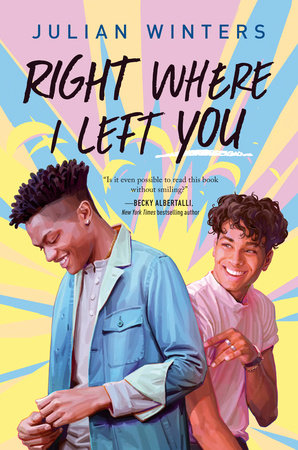
Right Where I Left You is a fantastic book by Julian Winters (Who is a WONDERFUL LGBTQIA+ author.) It shows a great bond between an introverted gay boy, and his outgoing bisexual best friend. It emphasizes the vast difference between expectation versus reality in a friendship. And shows the difficulties of the next finding your path in life, and the people you want to share it with. Right Where I Left You is 5 stars and a 10/10 in my book.
Category Archives: Reviewer’s Library Type
Kiss & Tell by: Adib Khorram
Reviewer: OHS Student, Ffiona
Kiss & Tell was a cute book but could be a bit cliche at times. It highlights the struggles of being out of the closet, but staying true to yourself. It shows the difficulty of being seen for more than your sexuality, and skin color. Kiss & Tell shows examples of a healthy, and unhealthy relationship between two boys, and the importance of having friends and family to support you.
Kiss & Tell is a boy band on its first major tour. The main character, Hunter, goes through his first breakup with a boyfriend. The details of Hunter’s personal life are leaked and put in the lime-light.

Otto: a Palindrama, by Jon Agee
A silly graphic novel adventure told in palindromes, this crazy tale had me reading forwards and backwards! Every piece of text in the book, from dialogue to signs in the background, is written in palindromes (200 of them!) The plot is a very loose wandering adventure of a boy, Otto, looking for his dog, Pip. I was amazed at the many ways the author conveyed silly palindromes in a logical, if fanciful, manner in the story. Illustrations are boldly & simply drawn and softly colored. Certainly, this is a great book for teaching palindromes. Short episodes of the adventure could be shared with whole classes. It had me wanting to write some of my own or share some of the more clever ones with others. The appeal may not be as broad as some, but it would be a solid purchase for upper elementary or middle school libraries.

Last Laughs: Prehistoric Epitaphs
If you have that one elementary reader who lives and breathes dinosaurs, but it is poetry month at school, Last Laughs: Prehistoric Epitaphs just might be the book for them.
The rhythm and rhyme of these short epitaphs (twenty-one entries) give whimsical tales from creatures of the Paleozoic, Mesozoic, and Cenozoic Eras. The epitaphs would not be nearly as enjoyable without the silly illustrations by Jeffrey Stewart Timmons.
There are facts about the prehistoric creature beneath each epitaph because the epitaph itself is not factual. I doubt any of the young readers will have any idea of whom the comic paleontologist Prof. M. Piltman, illustrated throughout the book, references dealing with the anthropological hoax of a “human skull” known as the Piltman Man.
The far left and right margins of each page turn provide the scientific Era and Period for each prehistoric creature being written about on that page.
What’s on My Plate?
Getting young people to eat healthily is presented through the use of bright colorful photos of fresh foods and examples of the daily amount of each food that should be eaten.
The five food groups: fruits, vegetables, grains, proteins, and dairy are each given two or three pages including a photo of nutrient rich foods and two of three sentences in large font. The photos will stir the reader’s senses to want to eat something almost immediately. Examples of appropriate daily amounts each food group include: 32 grapes, 18 baby carrots, 1 cup of corn flakes, 1 egg, and 2 cups of milk.
Sometimes Foods suggests foods with too much sugar and/or fat to be eaten very often. They include: candy, soda, French fries, ice cream, and cake. It states, “Some foods are not very healthy. These foods have few nutrients.” (23) It also states, “People need to make good choices to have a healthy diet. Eating a healthy diet gives you energy to work and play!” (27)
This is followed by Try This! suggesting the reader keep a food log for a few days and the Fun Facts, Glossary, Further Reading, and Index.
Math at the Art Museum
This series deals with math and how math can be found everywhere. The math this time, at the art museum, is not as straight forward as younger children might need. This book would best be used as a group read.
“This book is not intended to analyze art from a mathematical perspective. Instead, the intent is to highlight how math often informs art and also influences our daily lives.”
Geometry is the often the easiest form of math to see visualized is the art presented within this book.
Artworks by : Jasper Johns, George Seurat, Wassily Kandinsky, Fernand Leger, Pablo Picasso, Edgar Degas, Rene Magritte, Kim Jae-hong, Henri Matisse, Giuseppe Arcimboldo, and Salvador Dali are presented in connection with math vocabulary.
So why is it that reindeer are the animals who pull Santa’s sleigh? This story answers that question by filling us all in on the interviews and test runs that Santa conducted in the days leading up to his first Christmas deliveries. Sloths would never have been up to getting around the world in a single night, elephants were too heavy for the integrity of the rooftops, and monkeys very nearly got the job, if it hadn’t been for all their monkey business. It’s fun, imaginative, and really makes perfect sense. The silly illustrations do a great job of adding personality to each animal group, and helping show why some were ill-suited to the task. A great December read aloud.
Yours in Books
An absolutely charming delight. Written as a series of letters back and forth between an owl and a book-shop-owning squirrel, we see the form of the letters gradually change from formal business correspondence to casual notes as a succession of book recommendations build more than one friendship and shift our main character from a seriously introverted crotchety curmudgeon to a willingly involved member of his neighborhood community. The illustrations are sweet and inviting and full of personality. Highly recommended.
Pura’s Cuentos
This is an absolute must have for (I think) all libraries! It’s the story behind the name behind the award given out every year by the ALA. And not only that, but it’s also just a celebration of story. For years I’ve sought out winners of the Pura Belpre award to include in my collection, and I knew they were books that celebrate Latin American heritage and culture, but I didn’t know much about the person for whom the award is named. This is a beautifully illustrated book that shares Pura’s story, and confirms it is right and just that such an award should be given in her honor.
Toucan with Two Cans
It’s a controlled-text early reader that plays a bit with sound-alike words and homonyms. It basically tells the story of a juggling toucan juggling cans. It has a certain element of the tongue twister about it that makes it kind of fun, but sometimes the use of the same words in different contexts makes building meaning from the story a bit confusing.