
The Global Ocean

Just as a penny drive can produce vast monetary rewards, young people are asked to help save the world’s oceans and in turn the human population on Earth. All of Earth’s water flows in the water cycle. “The water cycle is the constant movement of water between the ocean, the land and Earth’s atmosphere…”(6) All of Earth’s oceans are connected. The oceans are in danger from carbon dioxide, warming waters, acidification, pollution, plastic, and overfishing. No matter where you live on earth you can help the ocean (and the earth in doing so) by doing something to help alleviate one or more of these problems.

In addition to HELP SAVE THE GLOBAL OCEANS propaganda (of the positive kind), there are eight insets entitled “Ripples of Change” telling of actions that are already taking place. There are six pages of “Waves of Change” to help the reader choose a starting point for them to beginning helping our planet.
Days Like This

Points of view and vantage points make this book unique. The opening page consists of the poem – Days Like This. When you the turn of the page, the first line of the poem is printed on the bottom of the left hand page in black ink and again on the right hand page in brown ink. The first illustration (left side) is from inside a house looking outside, the opposite page’s illustration (right side) is from outside the same window looking in the same direction.

This re-picturing of the same scene from different vantage points continues throughout the book. Can the reader find the various objects from the left hand picture in the right hand picture? How have they changed? Are there some things missing from the first picture to the second picture? What is in the second picture that is not in the first picture?

On the very last page spread the reader discovers the left side of the book is from the point of view/vantage point of a little boy and the right side of the book is from the point of view/ vantage point of a squirrel.

Beautiful Useful Things: What William Morris Made

I would have liked more information about this complexed man – William Morris and his works to truly find this book worthwhile. The text barely scratches the surface of who this man was and his life’s works. The illustrations by Melodie Stacey meticulously engage the eye, going from reality to past historical times to fantasy.

“The older William grew, and the more he saw, the more he wanted to honor beauty by making beautiful things.”

“Have nothing in your houses that you do not know to be useful or believe to be beautiful…”

William Morris was a very artistic man of means, living during a time when factories were beginning to churn out mass produced household items. Morris wanted handmade one-of-a-kind items, not mass produced items.

William Morris was an idealist which most people cannot afford to be.

The Hidden Knife

Not since Harry Potter have I enjoyed a magical book this much! The protagonist is 12 year old Vicky or Victoria once her emotions have been removed to ease the pain over her family’s murders. Victoria is bound and determined to find who murdered her family and why.

Vicky’s mother, Kat, had once been the chief guard of the Glass Queen, but the loving queen changed years ago. Kat’s friends from her younger days, will help Vicky achieve her goal.

Oh, did I mention, there are gargoyles and kelpies in this story to help Vicky, along with the use of protection spells.

Victoria is one formidable young lady. She does not mince words in dealing with those who try to keep her from her goal. Victoria does acquire some help from a few students who have been instructed to watch out for her, but she does not make working with her enjoyable, at first.

Enjoy the murder mystery, the friendships, the personal strengths, and the magical animals from the Netherwhere – “Small acts of love, of loyalty, of justice were adding up…like ripples. A small act flowed into a towering wave–and that was true in any world.” (256)

Our Dogs, Ourselves: How We Live with Dogs – Young Reader Edition

Dog scientist, Alexandra Horowitz, provides background on the relationship between dogs and humans. Basically A. Horowitz tells us people like to have dogs around them and people often thrust their own feelings and wants into thinking that is what their dog is feeling/ thinking. “As a scientist, I don’t yet have a way to test what a dog is feeling. Instead, I can observe what a dog does.” (138) Scientific method is outlined with an example from one of her studies. No amazing results revealed. I understand that science is slow, too slow though for what I would have liked to have learned from spending my time reading this book. There are a few themes repeated several times through the course of this book: breeding pure bred dogs more often than not is harmful to the dogs’ health and well-being. A second one, being as much as we like to think of our dog as a member of our family, under the law, a dog is a piece of property having no rights. The first time through these themes are thought provoking, but then become redundant.

I can only hope the adult version of this book has more weight to it.

“We must figure out if some of our ideas about dogs are out-of-date or simply wrong.” (165) I felt the time I spent on this book was simply wrong for the amount of wishful thinking for new information I hoped would be revealed.

Of a Feather

This is the super deluxe version of the plot- tween girl gets placed with unknown relative because her own mother is currently not capable of caring for her.

Super deluxe because there are two similar parallel plots lines taking place simultaneously and intertwined between the two main characters, Reenie and Rufus. This is a gourmet read.

The first plot line begins in the Prologue with a hatchling Great Horned Owl. The second plot line deals with Reenie who is being placed with her father’s aunt (there is no other mention of a father in the entire book). The chapters go back and forth between Reenie and Rufus (a Great Horned Owl hatchling) who have both temporarily lost their mothers.

Rufus’s chapters are written from his point-of-view using such words as: wing-toes for fingers, human nest for house, monster for motor vehicle, furless creatures for humans, and Brown Frizz for Reenie.

Along the way, Reenie must move to a new school where she very cautiously makes two friends, something she has not had, due to trust issues, in quite some time. The new friends are grouped together on a research project. Here the two plots intertwine in a new way when Reenie’s Great Aunt Bea, a falconer who works as a vet tech, rescues a young injured great horned owl, and Reenie’s portion of the project will involve falconry, and Rufus.

“I’m smiling and crying, happy and sad, so many feelings, all real, all at once.” (272)

Thanks A Lot, Universe

Middle school is a tough time for many students, but especially if they have problems with social anxiety. Mix that in with having a father who just began running from the police for dealing marijuana (this story is set in Halifax, Nova Scotia) and a mentally unstable mother who entered the hospital, both on your thirteenth birthday. Oh, so sorry Brian. Now Brian and his younger brother are being put into foster care, at least for the time being.

Brian and Ezra were on the same basketball team last winter. They think they can call each other a friend, but Brian is so quiet, shy even, that it is difficult to tell. Ezra does say, “Hi,” to Brian and Brian will try to give a response back.

Then, there is Ezra who is figuring out his sexual orientation is different from his other friends from grade school. How will Ezra’s friends react if-and-when Ezra tells them. One of these friends is all about having a girl friend and wants Ezra to notice a specific girl who is interested in him. Oh, Ezra.

Fate has put Brian and Ezra together just as author Chad Lucas has by assigning all odd numbered chapters to Brian and all even numbered chapters to Ezra. Fate has been kind to both Brian and Ezra in doing this.

When foster care is extremely difficult to handle, especially because of Brian’s past birthday and Brian stands up for himself to a school bully, Brian finally takes matters into his own hands. Brian and his younger brother run away. While Brian’s running away is on a ‘need-to-know’ basis at school, the police officer and his social worker, are involved. Brian’s mother, Brian’s father’s good friend, and eventually Ezra round out the team who convince Brian to return ‘home’.

“A little kindness goes a long way” (p. 124) and this story will definitely have readers wanting kindness to win!

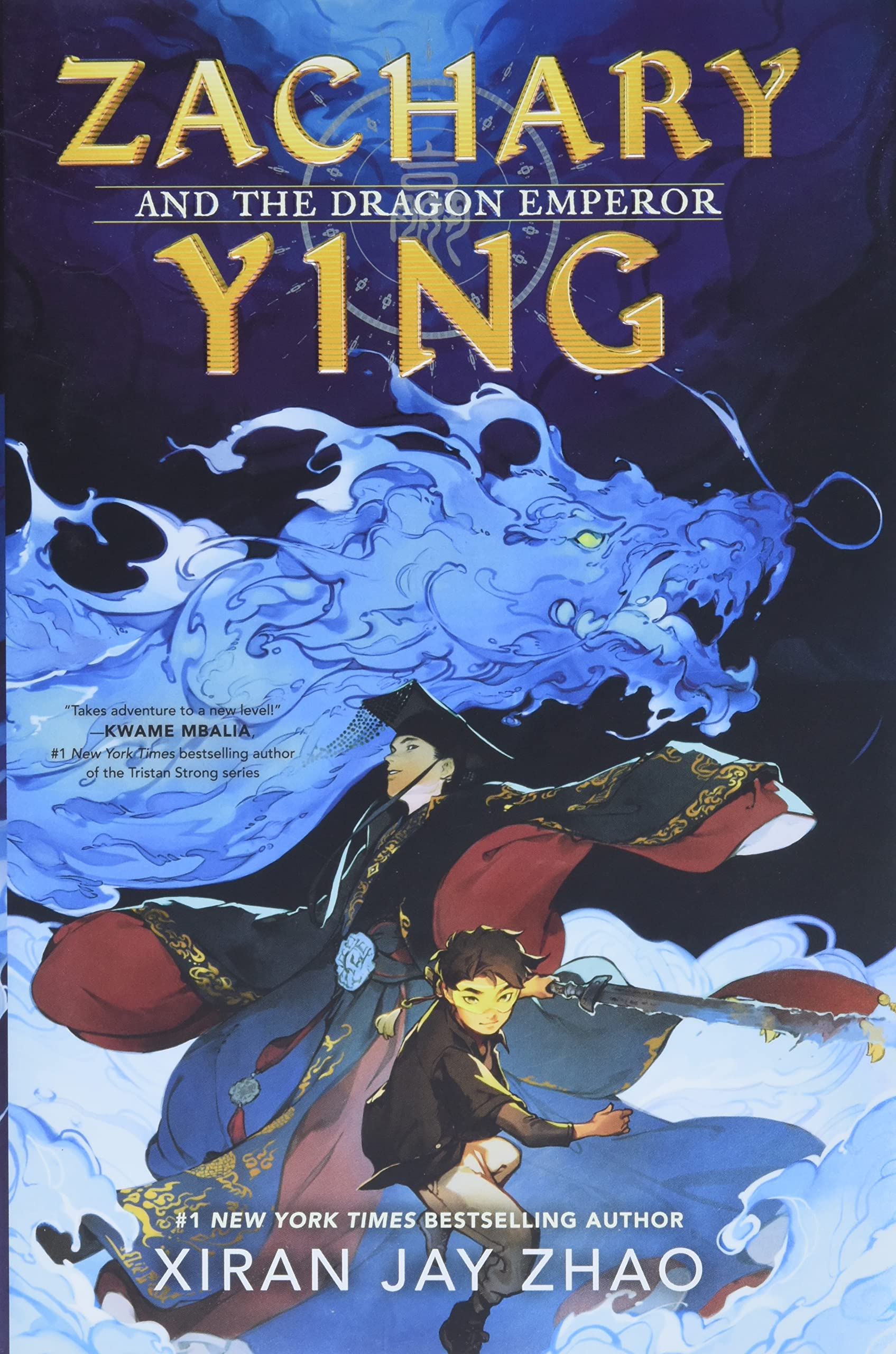
Zachary Ying and the Dragon Emperor

by Xiran Jay Zhao

This middle grade story is a beautiful mix of Chinese history, fantasy, mythology, and science fiction technology. It has all the adventure of a Rick Riordan gods & goddesses mythology book, but using the stories of ancient Chinese Emperors and their complex machinations as the myths. These are the stories of China that have been passed down and have been woven into modern Chinese and world culture, including manga & video gaming. The story centers around Zachary Ying, a modern Chinese American kid who loves to play the video game Mythrealm using his special portal goggles. Things go awry when the ancient Chinese emperor Qin Shi Huang, tries to possess Zach, but ends up stuck fused to his portal goggles. They embark on an epic adventure with several others to try to stop the spirits from breaking more completely into our world from the spirit realm. The book is sprinkled with history lessons to help familiarize students with Chinese history they may have never learned – like Zack and me. Water dragons, crazy battles between immortals, and trying to find one’s moral compass make this action-packed adventure worth the read. Those unfamiliar with Chinese names, may mentally destroy & horribly mispronounce some of the names of characters or could find it a stumbling block. It’s worth reading despite that and might be an opportunity to share the audiobook version as a way of learning how to pronounce some of the names. (It helped me!) I think students who love mythology adventures will probably love this addition to the genre. This appears to be a first book in a series as it leaves a major cliffhanger at the end of the book.

Wingmaker

Two little ants, Leaf and Lou, learn from their friend Gramma Tinker the second half of a Lappert Moth’s life cycle from caterpillar to adult moth. (So this is not your typical gorgeous butterfly getting all the ‘ooohs’ and ‘aaaahs’.) The WINGMAKER in the title refers to the metamorphosis, inventor and caterpillar, Gramma Tinker is about to undergo on her way to becoming an adult moth. Illustrator David Huyck helps fill us in on the information Gramma Tinker learns along the way from her guests a fly, a hummingbird, and a bat in the notes she is writing down in her notebook. The facial expressions are cute but I was not always quite up to speed on the silk weaving Gramma Tinker was doing do prepare herself for her two week sleep into mothhood.

Different Kinds of Fruit by Kyle Lukoff

From the author of the Newbery Honor book “Too Bright to See” and the picture book “When Aidan Became a Brother,” Kyle Lukoff presents us with a novel on the queer community through the eyes of sixth grade Annabelle. When a vocal, cool binary student, Bailey, joins her class, Annabelle is instantly infatuated with them, and begins to wonder if this is actually a crush. When she brings Bailey home, Annabelle’s parents instantly act awkward and seem to be discouraging their friendship. Misreading their attitude about Bailey’s gender identity, her parents share with Annabelle that her dad is not only transgender, but a seahorse father. (He was the one who birthed Annabelle when it was discovered that her mother was unable to have children). Once this is out in the open, Annabelle, Bailey, and their families get involved in the Spectrum Families chapter in Tahoma Falls and Seattle, WA. Annabelle continues to try to “figure out which letter in LGBTQ+ applied to me, now that I know that I was something.” National Coming Out Day (NCOD) is quickly approaching and Annabelle feels pressured to figure it out soon.

From the very beginning, I saw this is as an “instructive manual” on how to “they/them” and teach terms such as butch, femme, seahorse, pan, and more. While I respect this possible motive by the author, for me, it drove the book rather than an interesting plot. I believe there are better books out there on questioning your sexual and gender identity, but if you’re looking to add to your collection, this may appeal to lower middle school students.