
It’s not surprising that this sequel to the award-winning Beasts of Prey is also getting starred reviews, or that the story has been optioned by Netflix already. Ayana Gray’s depth of description, the interweaving of emotions with magic, and tension between characters let Beasts of Ruin feel so solid as a story. Koffi and Ekon are now separated as this part begins. Koffi, basically a slave to the god of death, is intuitive enough to be looking for her path out of captivity, even if it through mystical and “mist-ical” ways. Ekon will challenge what he knows of himself on his path back to Koffi. And as we all learn and grow over time, the two will reunite to find things are not exactly the same as they were, as is true in all of life. Action, beauty, wonder —Gray’s series will continue based on the last line, hopefully in print before Netflix.
Category Archives: Reviewer’s Library Type
Nugget and Dog: S’more than Meets the Eye!
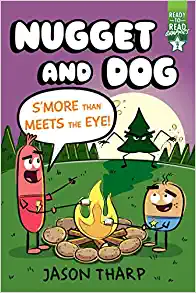
Nugget (a chicken nugget) and Dog (a hot dog) are so excited to have some fun at summer camp. Unfortunately, Dijon (yes, he’s mustard) has an evil plan to scare everyone! He and his sidekick, Crouton (self-explanatory) mess up their plan to scare everyone with the Mean Green Pine Thing, which ends up being Honey Dijon (Dijon’s cousin), who just wanted a little attention herself. Rounding out the cast of delicious campers is Fry and the grumpy camp counselor, Grizzle.
This beginning graphic novel begins with some simple information about panels, thought bubbles and speech bubbles as well as how to follow the story on a page. This is very helpful for those readers new to graphic novels. Illustrations are bright and text is simple. This is a nice introduction to graphic novels and is really humorous. How can it not be funny with a hot dog and chicken nugget as main characters? highly recommended.
Judge Kim and the Kids’ Court: The Case of the Missing Bicycles
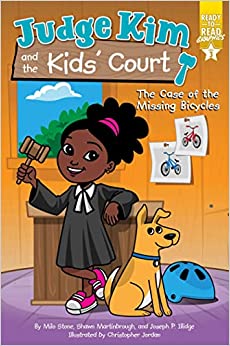
Bicycles are missing from Kim’s school and rumors are flying. Kids start accusing the new boy, Corey. So, Kim takes matters into her own hands and assigns her friends to gather facts and evidence. She convenes a “Kids’ Court” in the tree house that her dad just built, overcoming her fear of heights to climb the ladder for court. Kim handles the case with unusual maturity, which is not surprising since her mom is a judge and Kim’s been to her courtroom. The story ends happily with Corey’s explanation that he wanted to fix up his peers’ bikes in order to make friends and apologizing for stealing them to do so. His classmates forgive him and are thrilled with their newly fixed bikes.
The book begins with a short explanation about the correct way to read a graphic novel. This is helpful, because readers new to graphic novels will now know the difference between a speech and thought bubble and the direction of the story on each page. The story itself is fairly short and the text is very accessible. Illustrations are bright and characters are diverse. Highly recommended for those new to graphic novels.
Izzy’s Tail of Trouble
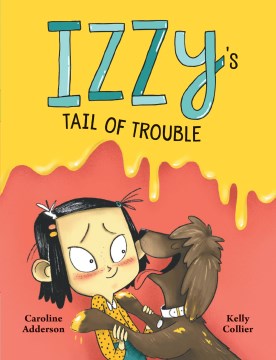
Izzy and her friend, Zoe, love to dress up her dog in baby clothes and play “baby stealer” with Zoe’s older brother. It’s typically a giggle-filled screamfest when Izzy and Rolo are at Zoe’s house. Unfortunately, things are changing and it’s hard for Izzy. Rollo is growing into a big dog and the baby clothes are getting too small. He’s also getting into some big doggy trouble. Lionel, Zoe’s brother, is becoming a teenager. And, he is the epitome of a teenager – surly, pimply and no fun at all.
Izzy doesn’t like these changes and is determined to find out of there is some kind of cure for these two maladies. She and her mom take Rollo to obedience school and he doesn’t do well. Izzy works hard with him and uses some of what she learns to engage Lionel, which turns out surprisingly well.
Through some gently comedic adventures, Izzy works on these problems, realizing along the way that change is inevitable. But, the fun doesn’t have to end, it’s just different.
Readers new to chapter books will enjoy this story. Accompanying illustrations in black and white break up the text and provide extra giggles. Add this to your collection along with the first book, Izzy in the Doghouse. Recommended.
Dia de Disfraces
This is the Spanish translation of Dress-Up Day. It’s a sweet story of a young girl who is all excited, anticipating a school costume party, but after helping her mom make a fabulous bunny costume, she is disappointed to wake up ill on the day of the party and has to miss the party. When she’s feeling better the next day, mom suggests she where her rabbit costume that day instead, and her joy is restored. Until she gets to school and the other kids stare and laugh, and she begins to doubt. Joy is restored once again when another classmate who was ill the day before also turns up in his costume, and by the end of the day he has become her best friend. The next day all the kids show up in costumes, convincing our protagonist that she’d had a great idea all along. The illustrations are charming, and the dilemma, as well as its solution are very relatable for young children: the difficulty of being all alone, and the power of a single friend to turn things around.
Cultivando a un artista: la historia de un jardinero paisajista y su hijo
This is the Spanish language translation of Growing an Artist. I like this book for a lot of reasons. It’s a very personal book for the author/illustrator, sharing how his own experiences working alongside his dad in the family landscaping business as a child nurtured his own interest in art, while showing him how he could use is art to contribute to his community. It shows readers that their own stories are worthwhile, even if they seem ordinary. It shares experiences that may be familiar to a lot of readers, validating those experiences. It’s a feel-good book, celebrating and honoring ordinary life and work and relationships.
Kings of B’More
Remember when you felt such big emotions as a teenager, big enough to flood every moment of your day and take you from euphoria to tears and back in thirty minutes? Linus and Harrison are best friends who are not only navigating life as black, gay kids but have come to the last day before Linus is moving to South Carolina. Harrison wants to make the perfect “Ferris Bueller” type of day where they skip school, take a train from Baltimore to DC, meet up with Linus’s crush, and experience something unique before he moves. But part of growing up is learning that there is no perfect day. You have to grab the day that comes before you and make it the best it can be. Linus and Harrison have an epic day together, that’s for sure. And there is a huge amount for the reader to unpack, from all-out racist interactions to exploring the purpose of Pride, to family relationships, to the meaning of love. Eric Thomas brings the heart of hearts out in one day in the life of Linus and Harrison. This will get checked out by kids. My hope is that they hang on for the end. There is so much activity in the day, it felt a little overwhelming to keep track of the new acquaintances/few side characters. But this is right on par to relate with Linus and Harrison’s emotions as they know that their tomorrow will be the end of everything that was normal in their lives before.. and they are scared because their limited and sheltered life hasn’t allowed them to see beyond the day.
Growing an Artist: the story of a landscaper and his son
I like this book for a lot of reasons. It’s a very personal book for the author/illustrator, sharing how his own experiences working alongside his dad in the family landscaping business as a child nurtured his own interest in art, while showing him how he could use is art to contribute to his community. It shows readers that their own stories are worthwhile, even if they seem ordinary. It shares experiences that may be familiar to a lot of readers, validating those experiences. It’s a feel-good book, celebrating and honoring ordinary life and work and relationships.
Rube Goldberg’s Simple Normal Definitely Different Day Off
I’ve heard of Rube Goldberg Machines, and I know the super-over-complicated type of thing to which the term refers. I’ve seen some in action at science museums and such. I only realized from reading the flap of this book that Rube Goldberg never actually built any of his creative, inventive machines — he was a cartoonist; he drew things that his training as an engineer told him should work in theory, but he never put those theories to the test. Yet his work inspired many others to design and build contraptions in the spirit of his drawings. This book is a series of cartoons starring a young Rube designing incredibly complicated ways to fake being sick and then do all sorts of things a kid might want to do one a day off from school, always in the most complicated, absurd, silly way possible. The steps of each contraption are labeled with alphabet letters, and the text describes in sequence how each is theoretically designed to work. It’s fun. It’s silly. It may trigger readers’ inner inventors and engineers. A website in the back directs those kids who are intrigued to where they can learn more about such designs.
When the Wind Came
We talk about books serving sometimes as windows and sometimes as mirrors. Depending on where a reader this lives, this book could do either. I’ve never lived in a place where there are tornadoes, or other wind storms so strong they destroy homes while families hide in storm cellars. For me, this book is a window, showing me in simple straightforward terms, from a child’s perspective, what that might be like. For students who may have experienced such things, it may serve as a mirror, validating their own experiences, letting them know they’re not alone. The book offers a sense of hope in the face of devestation: when the family rise from the cellar to find their home destroyed, they are still able to find enough in the rubble to fix themselves a meal and wash dishes and blow bubbles. Despite the somber story, it ends with laughter: “Those laughs didn’t change anything. They made no difference. Those laughs changed everything. They made all the difference in the world.” It’s a powerful book.