
We Are Not Free by Traci Chee is a powerful, poetic historical fiction novel for young adult readers. This book goes through the perspectives of many Japanese-American teenagers starting in 1942, during World War II, as they are forced by the American government to leave their neighborhoods for camps, complete loyalty forms, and join the army. I really liked the variety of perspectives in this book, and through those different perspectives, you are able to see how different people deal with their situation. Some are consumed by anger, some try to look upon it as positively as possible, and many different reactions in between. If I had one criticism of this book, it would be that the characters can be a little hard to follow at times, since some characters have a real name and a nickname, and it switches to a completely new perspective every chapter. The way the book is laid out, and the perspectives of teenagers around our age, makes this book far more relatable and interesting than many others in the historical fiction genre. I think fans of historical fiction will definitely enjoy this book, and I encourage anyone who is not a fan to also try it, as it is non-traditional and refreshing. Fans of diverse novels and stories will love this book, as it provides many different perspectives from a group of people heavily discriminate against in America. This book is an intense look at what Japanese-American teens and their families had to go through during World War II and is sure to stir up many emotions for readers. I highly recommend this book. – Reviewed by Avian, CHS Student and voracious reader.
Our Favorite Day of the Year by A.E. Ali, illus. by Rahele Jomepour Bell
What is your favorite day of the year? Is it a holiday? Your birthday? The first day of school? Musa’s teacher’s favorite holiday is the first day of school. He and his new classmates wonder why because there are so many other great days of the year! They each have their own favorite day: Eid, Rosh Hashanah, Las Posadas, and Pi Day. As we follow along in the book, Ms. Gupta (their teacher) invites each student to introduce their own favorite day of the year to their classmates. Together with their families, they bring in food and decorations and tell share with their friends the joys of their favorite days.
As you follow these four new friends on their journey sharing with each other and their classmates, you are reminded how sharing small or big parts of ourselves can help create lasting memories and friendships. This is a perfect back to school book that shows how we may all start out differently, but in the end, we share in the togetherness that is a classroom community.
In addition to a wonderful story of friendship and the beginning of the school year, this book is exquisitely illustrated and has fantastic end papers.
You Should See Me in a Crown by Leah Johnson
“High school is complicated, and the lines of demarcation that The Breakfast Club said divided us aren’t quite so clean-cut…..But there’s still those outliers. The people who are everywhere but fit nowhere. People who are involved but not envied — present but imperfect — so the scrutiny pushes them out of the race. People like me.”
Liz Lighty is Black in a mostly-White high school. She’s smart and driven and fatherless and now motherless. She’s poor and she’s musical and she rocks at community service. Oh, and when she meets the new girl, Mack, she realizes she’s queer.
A high school senior, Liz knows exactly what she wants: she wants to attend her mother’s alma mater, Pennington College, play in their orchestra and go on to medical school. With her excellent grades and extra-curricular activities, she’s confident she’ll get the scholarship needed to make her dreams a reality. But when she doesn’t get the scholarship she had counted on, there’s only one thing to do: run for prom queen and earn the generous scholarship for “outstanding service and community engagement.” As an outlier, what are Liz’s chances of rising to the top of the 25 girls in the run for prom queen? Does the title of the book give away the ending, or set the reader up to wish good things could happen to good people? This book tackles tough teenage angst in a book that is a laugh a page.
The Circus Rose by Betsy Cornwell
The Circus Rose is a queer re-telling of Snow White and Rose Red fairy tales told in the alternating perspective of twin teen sisters, Ivory and Rose. Ivory writes in prose; Rose writes in verse. The girls have been raised in the circus by their single mother, the ringmaster of a circus. The girls each have separate fathers but were born within two minutes of each other. Rosie and Ivory have spent their lives in the circus, and have been traveling on tour for years. When they finally return to Port End, the town that is the closest place to home, something has changed: there are flyers all over posted by the Brethren, a fundamentalist religious order. Brethren preachers are seen throughout the community, including in front of the circus ticket booth. When the circus presents its big homecoming show, disaster strikes. From that moment on, the themes darken, circus staff disappear, and despair builds. Ivory is left to salvage the circus with the help of her transgender Faerie sweetheart, Tam.
Faeries have historically been persecuted by the Brethren and this complicates the plot even further. (This novel is a fantasy set in an unknown time period and undetermined location. It is a time before electric lights as gaslights were used in the circus. People travel by ship, wagon, and airship reminiscent of the steampunk Finishing School series by Gail Carriger).
As Ivory and Tam frantically try to track down the missing circus members, including Ivory and Rose’s mother and Rose herself, the battle becomes pitches against the religious extremists. The ending of the novel is reminiscent of thrilling, other-world scenes found in various books in the Miss Peregrine’s School for Peculiar Children series.
For those who enjoyed author Betsy Cornwell’s 2015 steampunk version of Cinderella, Mechanica, those who like Steampunk or Miss Peregrine’s School for Peculiar Children, The Circus Rose is an excellent choice.
~
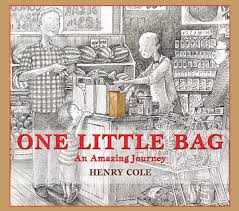
One Little Bag, by Henry Cole (author & illustrator)
An absolutely charming wordless picture book describing that long life of our main character – a paper bag! Henry Cole, at his best, delights us with the very beginning of a life of a bag, as a tree. The picture shows the tree looking vibrant and content in a forest, and then through the logging process, milling, manufacturing, and into a grocery story.From there, it really becomes loved in a family home and used as a lunch bag for a young boy to carry his sandwiches to school.His father draws a small red heart on the bag, which is later used with the boy’s flashlight at night, goes camping and holds the marshmellows, follows him as he ages and holds a ring he gives to his love, ect. By the end of our story the bag is appropriately used to hold a small seedling which is planted back into the earth by our main character and his son.
A lovely story for earthday, recycle/reuse, over consumption, generational stories, lifecycle and more. Recommended book for your library!
Here is Henry Cole’s website: https://www.henrycole.net/main.php
Addy’s Cup of Sugar, Based on a Buddhist Story of Healing By, Jon J. Muth
A beautifully written and illustrated story designed to assist a grieving child. The plot centers around a girl who experiences the death of her cat and wishes that the effects could be reversed. She was instructed by Stillwater, her wise friend, to assemble the right ingredients needed to assist her. She then walked around her neighborhood and asked for a cup of sugar from any house whose occupants have been immune from grieving a death. Further and further into the day, she realizes that there wasn’t one house that hadn’t experienced the loss of someone they love.
This is a compassionate story intended to explain and soften the feeling of loss and grief. It is based upon the Buddhist legend called “The Mustard Seed”, from a collection of sayings called the Dhammapada (first century BCE). A woman who loses her infant to death is instructed by Buddha to search for a household and receive a mustardseed from anyone not touched by death. This leads to her acceptance of death and the normalcy of this aspect of life.
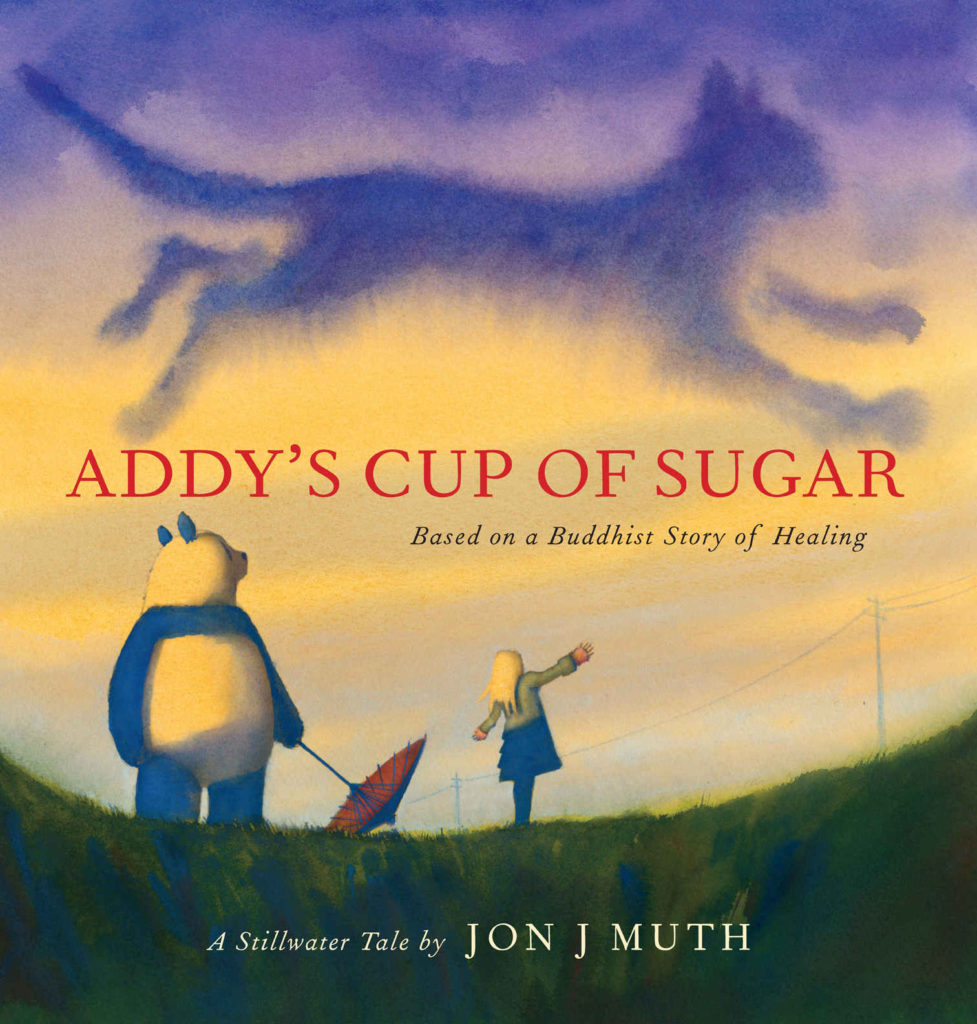
Beautiful illustrations and lovely emotional expression. Recommended book.
Island Endurance by Bill Yu
Could you survive if you were washed overboard and marooned on a deserted island? This is not a new concept for a story, but it is a new modern version of survival for intermediate readers who enjoy graphic novels.
When a snobby entitled teenage girl (Valerie) gets washed off of a resort’s new yacht with a young teenage girl (Merissa) member of the yacht’s crew during an upcoming storm, the two must work together to survive. Merissa knows all of the survival skills and many of the dangers of the island they land upon. Merissa is more than willing to show Valerie the ropes. By the time they are rescued, the reader has gained important real life survival skills, and Valerie has learned an important lesson about respect for others, as well as survival skills.
This book includes: three true short tales of survival, an “Island Survival Guide”, “What Do You Think?”, “Island Survival Trivia”, nonfiction network resources through abdobooklinks.com and a QR code.
Thank You, Garden by Liz Garton Scanlon, illus. by Simone Shin
People of all ages taking care of their individual plots in a community garden. Planting, cultivating, watering, weeding, and playing in the garden over the long weeks before an edible enjoyment of the garden’s success.
Written in short phrases, the word garden makes 24 appearances. Two of my personal favorites are, ” Garden hardly makes a sound growing, slowly, underground” and “Garden growing like a child, rosy, leggy, fresh, and wild _”
Simone Shin’s illustrations are full of the pride and joy of gardening from the work of being hands-on in the soil.
It’s My Tree by Olivier Tallec
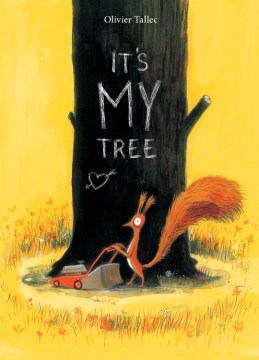
Squirrel is very possessive – “This is MY tree” and “Those are MY pinecones”. His obsessive greed leads him to wonder about others taking possession of HIS tree and HIS pinecones. In order to protect HIS things, he builds a wall (a very large and long wall). But, he begins to worry anew. What if there is a better, more beautiful tree on the other side or bigger pinecones? Is he missing something that could become HIS? The story ends with him climbing the wall to look over and seeing an entire forest a swarm with happy squirrels.
Short sentences and vivid illustrations make this an attractive read. The squirrel is engaging and the colors are warm. While this story is a fantastic conversation starter about possessiveness and greed, it does seem to end rather abruptly. There is no resolution to the squirrel’s problem and students might be left with more questions than answers. We all want to know – does the squirrel learn that sharing is better? We just don’t know…
Wherever I Go, by Mary Wagley Copp and illustrated by Munir D. Mohammed
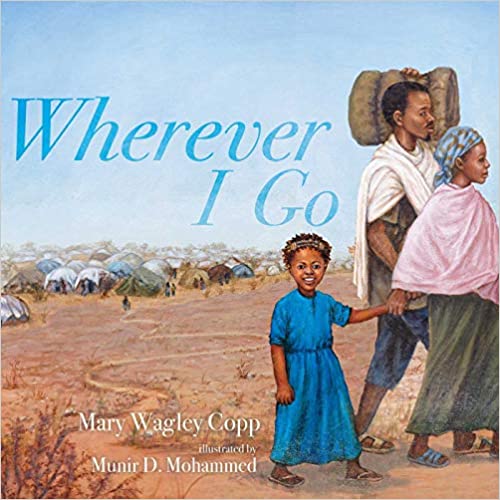
Beautifully illustrated picture book of a refugee family from who has been at the Shimelba Refugee Camp the longest — seven years! In spite of having to flee their humble home and community, the main character Abia (elementary aged) has been told by her father as she plays imaginary games, that she is a queen. He makes her a crown of the Acacia tree crowns and she feels like she has super powers while helping her mother with chores, or simply walking the perimeter of the camp with other kids. Eventually this family makes their way to the United States, where Abai can still howl to the hills.
This picture book concludes with resources and additional information in the back of the book. Such as informing the reader that there are 68 million displaced people in the world right now. About 25 million are classified as refugee status. Relevant books to further your reading are suggesting in a list in the back as well as middle grade and young adult list. Recommended+ for your library!