
This is an easy to read, larger sized print, chapter book for younger readers. Very appealing with a colorful jacket and black and white illustrations on the inside. This series was modeled after the version of Goddess Girls for intermediate readers, and makes a great introduction to the series for it’s reader base. Artemis is the main character and is joined by Athena, Medusa, Zeus and others. I appreciate how the authors retain the integrity of the character traits of each mythical goddess or creature introduced into the story. It’s a great way for children to learn about Greek Mythology through the adventures of the relatable characters in our story. Recommended for readers in the primary grades and even intermediate struggling readers will very likely enjoy this series!
Someday we will fly
Someday We Will Fly is the story of a Jewish family, as told through the eyes of 15 year old Lillia, as they escape Poland, without Lilla’s mother, and find refuge in Shanghai. Lillia, her young disabled sister, and her heart-broken father learn to fit in as best they can in a foreign culture. The father struggles to find work and the reader is moved to see a once-proud parent reduced to the beaten down hopelessness that settles over him.
Lillia works hard to learn English and to help her little sister whose disabilities and malnutrition weigh on Lillia. Desperate times make people act in ways they might otherwise never consider, as when Lillia takes a job (unbeknownst to her father) as a dancer in a gentlemen’s club.
The reader is impressed by how hard Lillia works to learn Chinese and to achieve in school. She makes friend with Wei, a Chinese boy in her school. Lillia has less supervision in Shanghai than she ever had in Warsaw, but this benefit is greatly overshadowed by the suffering of both the Jewish and the Chinese communities under Japanese occupation.
For a Young Adult novel, there is a pleasantly surprising lack of romance. The ending is a bit contrived and seemed unrealistically optimistic. But it was plausible.
Someday We Will Fly is unique from other WWII historical fictions, covering the little known history of Jewish refugees in Shanghai. The reader learns that 23,000 Jews escaped from Europe and found refuge in Shanghai during the Nazi Regime.
Author Rachel DeWoskin spent much of her life in China, including the past six summers in Shanghai where she researched and wrote this book. She teaches fiction at the University of Chicago, and is an affiliated faculty member in Jewish Studies and East Asian Studies. Her scholarly background is evident in the Author’s Note and the extensive Sources Consulted at the end of this novel.
Extraordinary Warren’s World
This darling beginning reader chapter, picture, graphic novel book was written by Sarah Dillard. She masterfully blends a picture book with beginning reading book, and a graphic novel which will appeal to all readers and ability levels. The pictures are charming and will be appealing to younger readers who need the visual cueing and enjoy the illustrations of “Everybody” books. The organization of a beginning reader chapter book with features such as chapters, should appeal to the reader who wish to identify with the format of older students. But, just as appealing is the graphic novel fusion, where reluctant readers usually choose to reside. This book has it all, almost creating a new genre’ which I suspect will appeal to a wide range of readers.
The story is light hearted adventure featuring our main character, Warren, who is a young chicken hoping to learn to fly so he can go to the moon. Supporting characters include the coach, who helps Warren practice flying utilizing activities such as yoga. Once he learns and acquires a “side kick” who was an egg and then a chick. Warren becomes both a role model to the young chick and also a hero as he realizes that rat and fox have nefarious plans for the chicken barn. Very cute book in a boutique series collection! https://www.simonandschuster.com/books/Extraordinary-Warrens-World/Sarah-Dillard/PIX/9781534463462
Eels: the superpower field guide; by Rachel Poliquin ill. by Nicholas John Frith
This is the fourth book in a non-fiction series “The Superpower Field Guide.” I confess I’ve never been a big fan of eels, but this book really held my interest. I wanted to know about Olenka’s migration. Black and white line drawings and more realistic colored illustrations help tell the story of “Olenka, migrating mistress of mystery.”
Olenka is a freshwater eel and her saga is divided into her ten “superpowers.” The author prefaces the superpower section with an introduction to eels in general and hooks the reader with the mystery of European eels, specifically one named Olenka. Having a specific eel to follow engages the reader in a story rather than just providing a list of facts.
A true-false quiz (with answers) adds some facts about a third of the way through the book. A second quiz at two thirds is a ‘Where’s the Eel?’ picture with the answers at the end of the book. The end of the text also includes a glossary and bibliography. Sadly there is no Table of Contents or Index provided.
Descent by Roland Smith
This is Bk. 4 in the Peak Marcello Adventure series and the final installment. The “outdoorsy” cover will attract readers who love climbing / survival stories. Welcome into the novel, also, those with an interest in international politics. Peak’s famous mountaineering father, Josh, and his climbing partner, Zopa, are on the run from Chinese government, wanted for questioning by the People’s Liberation Army. The setting is Tibet, the goal is to safely descend while not being discovered, while at the same time facing the usual survival challenges of avalanches, food and drink scarcity, and unpredictable weather.
Having not read the previous three books in the series put me at a disadvantage, especially in the lack of character development, probably established in the earlier books. The pacing was sometimes slow, typical for a survival story, but often action-packed as well.
Bad Brows by Jason Carter Eaton
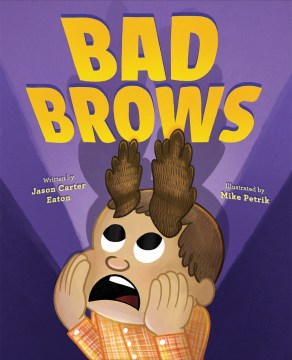
Children’s books can be silly, sad, serious or goofy. But, it is not often that you can call a picture book “absolutely weird”! This story is just that – weird! Bernard wakes up one morning and his eyebrows have taken on a life of their own. He tries to smooth them down, but to no avail. They bunch up, grow to crazy lengths, bush out, tie in knots and all sorts of other strange activity ensues. Bernard has no control over his brows and those around him are offended, angered and stumped by their unruliness (and place a bit of the blame on Bernard). Fortunately, things calm down for Bernard when his real eyebrows return. Apparently, they were on vacation. Hmmm…where did the substitute brow go? The answer is on the last page on his baby sister’s forehead. Oh, no!
Cartoon-like illustrations match the weirdness of the text. Characters are diverse, which is one normal part of this book. Hand this to your readers who like some of the stranger cartoons on television, like Gravity Falls or Steven Universe. They’ll understand this book.
I Got You a Present! by Mike Erskine-Kellie & Susan McLennan
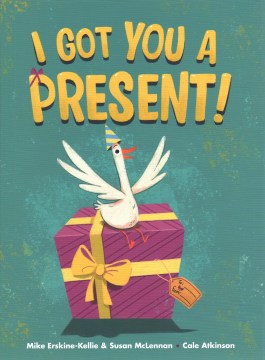
It’s a birthday party and Duck comes bearing…nothing! He tells a story of his search for the perfect gift, from socks that took six months to make (and still look pretty bad) to a a really cool rocket ship that some lost aliens needed to use to fly home. But, all is not lost! Duck has the perfect gift – this story! What could be better than a story about your favorite things and your good friend, Duck?
Fans of silly friendship stories like Elephant and Piggie will enjoy this zany duck and his mishaps as he tries to find the perfect gift for his friend. Illustrations are bright and cartoon-like. Duck is animated and engaging as he moves from gift to gift in his search for the perfect one. Recommended.
As Many Nows As I Can Get by Shana Youngdahl
From looking at the attractive cover, one may predict that this will be a cute love story. The cover is deceiving. While it is the love story of two teens,Scarlett and David, during the summer before they leave for college, there are much deeper themes. Note: there are mature topics that may be triggers for some students.
LGBTQ Service In the Armed Forces by Duchess Harris, JD, PHD
LGBTQ Service in the Armed Forces by Duchess Harris, JD, PhD. looks at enlisted LGBTQ people and legislation that made their experience in the US military difficult. It also discusses how LGBTQ soldiers served during times of war but were often discharged for their gender identity or sexuality after the war. The book includes include a glossary, further readings, websites, source notes, sidebars, and an index. Period and modern photographs put faces to the historic characters and modern service members discussed in the text. LGBTQ Service in the Armed Forces is appropriate for use in school curriculums and is aligned to Common Core Standards and correlated to state standards.
LGBTQ Service in the Armed Forces is part of a series which includes Being Transgender in America, Growing up LGBTQ, LGBTQ Discrimination in America, LGBTQ Rights and the Law, and LGBTQ Social Movements in America.
Just One Itsy Bitsy Little Bite / Solo uan mordidita chiquitita
Written by Xavier Garza with vibrant illustrations by Flor deVita, this bilingual picture book is fun both for young children as well as older student learning Spanish. It is a cute Day of the Dead counting story: one skeleton, then two, and more and more, come to the Joaquin’s door wanting his mother’s traditional pan de muerto. They eat it all up, not leaving even one itsy bitsy little bite for Joaquin.