This story is a graphic novel twist on the gothic novel that mixes in a bit of science fiction with lots of adventure. It delivers a great deal of farcical fun and zany adventure. Our intrepid gothic novel-loving heroine falls out of our world and into another when she tries to save a handsome stranger in the river. She ends up at Willowweep Manor which appears, on the surface, to be right out of her favorite novels. Much more is going on beneath the surface as she soon discovers. She must help not only their world survive, but her own as well. This story is full of surprising twists, over-the-top humor, exaggerated eyes and hand motions, and lots of action. I enjoyed the bold colors of the artwork. During moments in the story where time/place distortion is happening, an interesting layered, blurring effect is used to help the reader understand that something odd is taking place. The book feels finished at the end, but also leaves itself open to a sequel. This sometimes irritates me as a reader, but because I was intrigued by all the various characters, I’m also excited to see what might happen next for Haley as she pushes through the boundaries of other genres. Because it is a more complex storyline, this is a graphic novel for middle and high school readers looking for more depth from a plot. I’m looking forward to sharing it with my students.
Linked, by Gordon Korman
Gordon Korman’s latest book is another one I can’t wait to make available for middle school readers. The story blends the past, present and hope for the future of a small Colorado town as it struggles with its racist past, swastikas appearing in the middle school, and a group of middle school students trying to change the message for their town for the future. After having tolerance education following the appearance of the first swastika and watching in dismay as the swastikas keep showing up, the students hatch a plan similar to the famous paperclip project to make a paper chain of six million links to represent the 6 million Jewish lives lost in the Holocaust. Whether or not they can complete the massive chain and where to store it are just part of the problems the students encounter. The story is told in multiple voices of students around town which helps the reader see the issue from many lenses. Korman’s masterful hand creates a story that is both funny and heartrending at the same time. He has a true understanding of what makes middle school kids tick and his characters are layered and believable. I also liked that he threw in a bit about how social media can complicate, and perhaps help, a problem once the scope of an issue is no longer just local but spread to the whole world. It is a story of facing our past -even the one we may not be very proud of – and using the present to help heal, forgive, and move forward into a better future.
The Girl from the Sea, by Molly Knox Ostertag
This graphic novel is a sweet LGBQT+ romance perfect for middle and high school readers. It tells the story of Morgan and the selkie she meets again, Keltie, and their new romantic relationship. Their romance is complicated by Morgan’s fears of coming out, a recent separation of her parents, and an ecological subplot involving Keltie’s concern for her seal friends’ safety with new environmental hazards on the horizon. I enjoyed the colorful graphics and the sprinkled text format used by Morgan and her other school friends. The combination of styles was an interesting change of pace. Morgan’s worries about coming out and her secret relationship with Keltie felt believable. I was really rooting for them to figure it all out. The ecological sub-plot felt a bit contrived and less believable, but ultimately, I was oohing and ahhing over the sweet ending of the book. The illustrations are well done, bright, and energetic. I enjoyed the multi-ethnic cast of characters, including the selkie. Middle school and high school readers looking for a sweet, gentle, gender-bending romance will be charmed by the tender connection Morgan and Keltie have, along with feeling sympathy for the concerns they both have that complicate their relationship. Even though the ecological sub-plot is not really believable in its outcome, the human (human-selkie) connection absolutely is believable and worth the read – right down to the surprise twist at the end. I can see myself handing this book to many middle school readers!
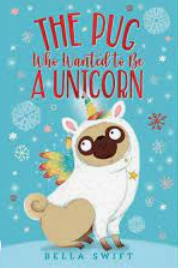
The Pug Who Wanted to be a Unicorn by Bella Swift
Peggy the pug is abandoned by her owner at a dog shelter when she is too much to handle. When there is no room for her there she is put in a foster home over Christmas. Chloe loves flying unicorns and thus starts the adventure of Peggy trying to become one. This is a great December story that can be read all year around. I would recommend it to students who are not quite ready for a full on chapter book. The story was sweet and fun. Anyone who likes dogs and warm family stories would enjoy this one.
Space Explorers: 25 Extraordinary Stories of Space Exploration and Adventure by Libby Jackson
I chose this book because I currently have a space display in the library. It’s a perfect addition to the display but I have to admit, I didn’t want to put it in the display — I wanted to keep it for myself. Back and forth it went, from the display book stand back into my hands. The writer, Libby Jackson, writes in a very compelling way, telling such interesting facts about space and those who have traveled there. Some examples:
- While the Soviets successfully launched Sputnik the U.S. was still struggling to send their first rocket to space. The problem: they didn’t have fuel powerful enough to lift the rocket into space. The person who finally came up with the right fuel to launch the first U.S. rocket into space was a woman named Mary Sherman Morgan from my home state of North Dakota!
- When Yuri Gagarin, the first human space traveler, completed his journey around the world, he was thrown off course in his spacecraft when it was time to land. His parachute opened and he landed in a large field. Yuri had no way to contact Mission Control to tell them that he landed safely. Yuri borrowed the phone of a nearby farmer to let Mission Control know that he was safe and alive.
- While stuck in a traffic jam in 1990, Helen Sharman of Slough, England, heard on the radio that they were looking for astronauts to fly into space — no experience necessary. She jotted down the phone number and requested an application, along with 5,500 other people. Helen kept making the cuts until they were down to 150 applicants. She took part of a G-force test in which candidates were spun around at incredible speeds. While most people had to stop after 5 minutes, Helen made it to 15 minutes. Eventually the final two candidates were announced line on televisions from the Science Museum in London. Helen became the first British astronaut.
These and 22 other missions are discussed. While all illustrations are drawings, the book is brightly colored and beautiful to page through.
My Name is Bana by Bana AlAbed
This book is based on the words of a Syrian child refugee and human rights activist. Bana talks about what her name means in her native Arabic language – strong. She shows how she is strong and is a survivor. How war came to her home land and her family had to flee. She flies to a new place where she has to learn the language and make friends all over again. This is a very powerful picture book written from the voice of a 12 year old now living in Turkey with her family. I would STRONGLY recommend this book for students. As I once lived in Beirut, Lebanon, I saw many refugees from Syria. This book truly resonated with me.
Llama Glamarama by Simon James Green and Garry Parsons
Larry the Llama LOVES to dance. He is part of a herd and is “grey and unexciting”. He hides his love of bright colors and dancing from the rest but is sad as he cannot share this love with others. When others find out his secret he runs away and feels very alone and sad. After a while he finds a group hosting a carnival event where they dance and sing and have fun. He immediately feels at home. He wants to return home but what will the rest of his herd think? Find out when you read this book about how being different is exceptional.
Dog Man: Grime and Punishment by Dav Pilkey
As with the first 8 of the books in the series, book 9, Grime and Punishment will be popular with students who enjoy goofy humor and overall silliness. We meet up again with the half policeman, half dog only to find he has been fired from the police. With the help of his friends will he be able to become part of the again? With the creation of a personality amplifier helmet getting in the wrong hands of the evil Petey the Cat all chaos ensues. The entire town is attacked by not only Petey but a crazed, out of control, giant lunch sack!
This book is great for students who may not enjoy reading. It is an obvious must purchase if the series of popular at your school. With the multiple endings and flip animations elementary students who love graphic and comic books will enjoy this one.
Only the Cat Saw by Ashley Wolff
When a family has their dinner and prepares for bed, what does a farm cat see and do? This picture book with rich colors, clean lines and pages where you see something new every time you read it is a lovely depiction of what a nocturnal pet can see while one is asleep. It also shows what an average family might do at night as well. With a clear progression from evening to bedtime, nighttime to morning, the author shows that life continues after one goes to sleep.
This book is another lovely, quiet, bedtime story. Parent will enjoy reading it to their student. Students will enjoy the readability and beautiful images.
The Secret Rhino Society – Written by Jonathan E. Jacobs, Illustrated by Samantha Cotterill
Three good friends, a hippo, a worm and a lightbulb band together to form a secret society dedicated to their favorite animal, the rhino. They create a clubhouse and have meetings in order to work on becoming more “rhino-like” until one day Ivy knocks on the door with a plant delivery. Ivy is not the type of CHARGING, STRONG AND POWERFUL rhino they expect and they are surprised. When they invite her into the clubhouse for lunch they realize that what they truly enjoyed about their secret society was the making and sharing of snacks and sandwiches so they decide to open a sandwich shop instead.
This is a sweet story about three friends who realize they are creative individuals as they are and do not have to try to become something else in order to have fun and be successful.