Chirp! Chipmunk Sings For a Friend

Chipmunk lives on a rock and sings her songs everyday. Sometimes her songs are happy, sometimes bittersweet, and sometimes very sad. Rock is a very good listener, but Chipmunk longs for a friend to sing with her. So Chipmunk sets off to find a friend. First she tries a pinecone, but Pinecone ends up getting along with rock. Then she tries a log which then leads her to finding other friends.

The illustrations complement the text, especially the illustrations about the songs. The message that it is okay to express emotions and also a message of perseverance is important.
I Don’t Want to Read This Book

I Don’t Want to Read This Book by Max Greenfield starts off with the narrator declaring that they do not want to read this book. Books are full of words, sentences, and paragraphs. On each page, the narrator explains why they do not want to read the book. Even at the end of the book the narrator the narrator says the changes of reading the book again are infinitesimal.

Bisa’s Carnaval

Bisa’s Carnaval by Joana Pastro is a delightful picture book about Clara who is so excited to celebrate her favorite holiday, Carnaval, with her family. Her Bisa (great-grandma) helps Clara make her costume for the parade, but says she is too old to take part in the parade. Clara decides to take the parade to her Bisa.

The vibrancy of the illustrations and the different font sizes bring the feeling of excitement and joy of the Carnaval to the reader. The author and illustrator note’s at the end give personal perspective to Carnaval and the glossary at the end translates some of the Brazilian Portuguese words.

The Barking Ballad: A Bark-Along Meow-Along Book

The Barking Ballad by Julie Paschkis is an interactive picture book. The author has used a stanza from Oliver Goldsmith’s poem “An Elegy on the Death of a Mad Dog” to build her own poem. The book starts out with a cat that was left behind when someone moved away and she is wandering around alone and hungry. One day a dog is hit on the head by a falling rock and the cat takes care of the dog. Soon the cat and the dog are friends and are inseparable.

Throughout the book, the reader will find red dots which mean the readers should bark and yellow diamonds which mean the reader should meow. In a read-aloud, the reader would need to figure out a way to demonstrate when the audience should bark or meow. This book is geared towards pre-readers but there is some vocabulary that would need to be defined for them (bereft).

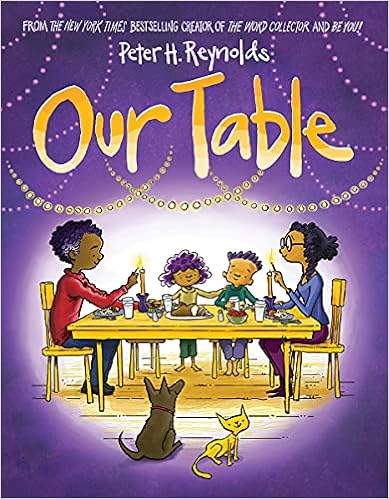
Our Table

Violet remembers when her family used to sit around the table sharing about their day and making memories. Now her family is distracted by other things and has been too busy to sit around the table. One day Violet notices that her table is beginning to shrink until it disappears completely. How can Violet get her family back to spending time together?

This picture book by Peter H. Reynolds is beautifully illustrated. The scenes where her family are together and connected are in full color. The scenes where they are distracted and isolated are illustrated only in purple. This story would resonate with many readers as we become distracted by technology and busy with life and may lose some connection with each other.

The Pug Who Wanted to Be a Reindeer by Bella Swift

Peggy the Pug’s family is not feeling very cheery this Christmas. Business is slow, Ruby doesn’t like her teacher, Chloe feels like she is losing her friend, and Finn has lost his bandmate. Peggy wants to help them be happy again. She decides that she needs to talk to Santa and to do that she needs to become a reindeer. She tries to give herself antlers, she eats carrots, and finally decides to talk to the reindeer at the school Christmas fair. Each thing that Peggy tries seems to make more work for her family at home.

This is short chapter book with sketched illustrations and is a part of an 8 book series. The book was originally published in Great Britain.

Wishes by Muon Thi Van

This story about a family searching for a new home is told through the perspective of a young girl. The entire story is only 75 words, but the illustrations by Victo Ngai and the simpleness of the words make a powerful story. So much of the story is told through the illustrations. This is based on the author’s life and shows the family packing up and fleeing in a bote. The author’s note at the end tells about the author’s family’s escape from southern Viet Nam in 1980 and ways that we can help refugees today.

My Two Border Towns by David Bowles

A young boy and his father cross the border to Mexico every Saturday. Each week they cross the Rio Grande. On this visit they go to Tio Mateo at his jewelry store, plays soccer, has a sweet treat from the paletero, and visits the pharmacy. On their way back home, they make one more stop, they check in with and drop of supplies for friends on the bridge who are refugees and stuck between the United States and Mexico. The watercolor illustrations by Erika Meza are colorful and eye-catching.

Chicken Little and the Big Bad Wolf by Sam Wedelich

In the 2nd Chicken Little book by Sam Wedelich, Chicken Little still asserts that she is not afraid of anything and definitely not a big bad wolf especially because she has never seen a wolf. One day Chicken Little and the wolf collide and Chicken Little runs away. While trying to decide what she saw and if she is afraid, the rest of the flock is debating fight or flight. Chicken Little decides to investigate why the wolf is always running and discovers that the wolf is just misunderstood and wants to belong.

A Song of Frutas by Margarita Engle

Written in Spanish and English, a young girl recounts her visits with her abuelo in Cuba. On her visits they sell fruit in the street while singing the names of the fruit. Other vendors are singing about their wares as well. The girl’s favorite visit is on New Year’s Eve where she wishes for friendship between the two countries and more visits with her family. When she returns home she misses her abuelo, but knows that they can continue to sing rhymes through the letters they send each other. The colorful illustrations by Sara Palacios are vibrant. The author’s note at the end talks about Spanglish, travel restrictions between Cuba and the United States, the singing vendors in Cuba, and New Year’s Eve in Cuba.