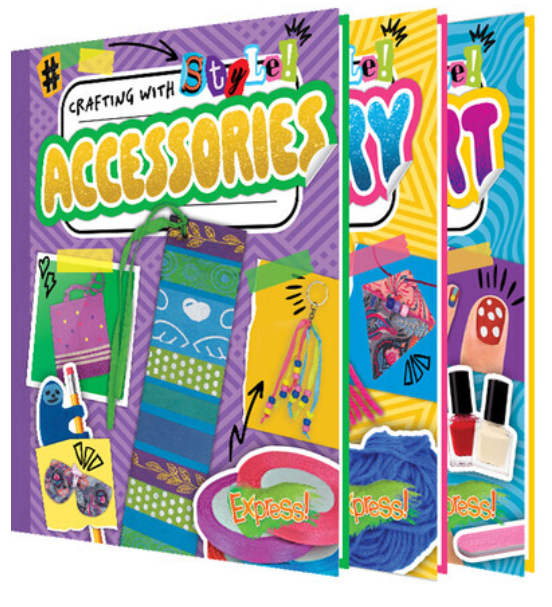
This series encourages readers to express their style through crafting. Whether they are creating their style through accessories, room decor or nails, this series has step by step instructions on crafting and creating their style. Each book focuses on a different style element and includes eight crafts with instructions. The crafts use common items around the house and encourages the reader to reuse things when crafting. Material and tips are included with the step by step instructions as well as factual information pertaining to the craft. A glossary, index, and resources to learn more are included at the back of the book.
Books reviewed in this series: Fashion, Accessories, Nail Art, Room Decor, Jewelry, and Hairstyles.
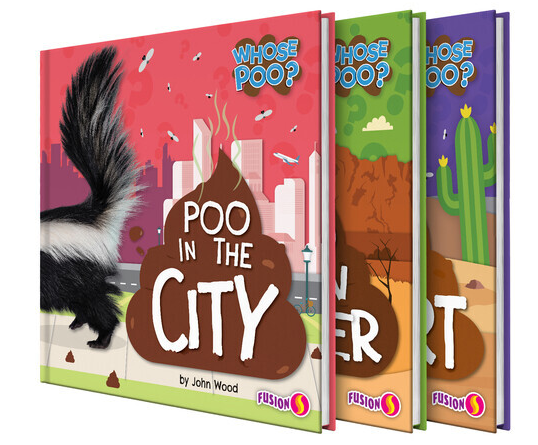
A guessing game about poo? Each book in the series features a different biome and has pictures of scat and has the reader guess the animal the scat belongs to. Turn the page to find out the answer and facts about that animal and what it eats. The photographs give you an up close look at the poo. There are several facts on each page inside different text boxes and captions. Vocabulary that may be unfamiliar to the reader is in bold and is included in the glossary at the back of the book. This is a humorous, fun look at animal scat. The warnings to not touch poop is an appreciated addition. Geared towards 1st – 3rd graders, this is sure to fly off the shelves.
The titles reviewed in this series: Poo Down Under, Poo In the Desert, Poo At the Zoo, and Poo in the City.
As a fully functioning, banking adult, I must admit I learned something from this book! It was fascinating to see some of the banking options that are available now that, admittedly, I do not use. Checks, I get. ATMs, no problem. On-line, digital payments, yes. I’ve even learned to Venmo. I’d never heard of neobanks, and cryptocurrency is the one I have not quite figured out. I found it interesting to read about all the pros and cons of various banking methods. And while cybersecurity often makes me nervous, this book had some good suggestions for ways to keep yourself and your money safer with strong passwords or even payment tokenization. Even two-factor authentication, which I sometimes get irritated with having to use, does make it harder for thieves to steal what is on line. For young readers in my library today, so much of what seems futuristic will feel like it’s just what is natural to do. Understanding how we got to the digital age may put some of their options in perspective. The book was well-organized in 5 clear chapters and included a table of contents, glossary, index and additional resources.
Having enough sports books to satisfy my middle school readers can be a challenge! This book on the Washington Mystics is sure to pull in basketball players and fans. I love that it is on one of the women’s teams in basketball. The book is well organized with clear, readable text with only 1-2 paragraphs per page. The four chapters highlight their championship winning season, the team’s history, their winning coaches and some of the famous players. The book includes a table of contents, a glossary, an index, fun trivia facts, and resources to dig further into the topic. I also liked that the more challenging vocabulary was highlighted & those words corresponded to the words in the glossary. Photos are included throughout the book, with identifying captions. Also included are “Fun Facts” scattered throughout the pages adding extra information to the main text.
A well-organized non-fiction book about and for students navigating medical conditions of their own or others. Various sections of the book cover topics like the kinds of health issues students might encounter, how to care for oneself or others, and strategies for taking control when medical needs might make one feel out of control. Each section has clear, easy to read text suitable for a middle school student. I appreciated the notes at the beginning of the book with tips for reading non-fiction. The book includes a glossary of terms, an index, and additional resources students can use. Most pictures did not have captions, but rather many had “Did you know” text nearby that enhanced the main text on the page. I found the text approachable and factual with the illustrations being very inclusive of many races and genders.
written by Judith Henderson and illustrated by Sara Sarhangpour
Willa the ostrich and Wade the penguin discover a shiny golden button on the ground and proceed to gather more treasures (a rock, toy dinosaur, artwork by Wade) for a museum (a box). They are so excited about their collection that they invite the other animals to their museum (Museum of Willa and Wade – MOWW). The Grand Opening of MOWW was a success, especially the snacks. And, would it be possible to borrow a rocket ship for the MOWW? Hmmmm..
This simple story of enthusiastic friends, imagination and a few treasures is wonderful. Add in the bright and bold illustrations and you have a winning combination. Readers will enjoy this book and look forward to Book #3 in the Willa and Wade series. Hopefully, we won’t have to wait too long! Recommended.
Elvis and Romeo are back in another sweet adventure. This time, Elvis is not excited at all about a visit to the vet. Romeo tries to encourage him by telling him all the good things that happen there, including making sure he’s well and checking his eyes. It isn’t until Romeo mentions the treat at the end that Elvis decides the vet office will be a fine place to visit!
This early reader is perfect in its combination of spare text and sweet, silly illustrations of two doggie friends. The story is short and somewhat predictable, making it a nice choice for young readers.
Doggie pals Elvis and Romeo head to dog school to learn some new tricks. While Elvis is open to the idea, Romeo experiences some anxiety when the lesson is about catching a ball. Elvis does a great job of working through it with Romeo and gives him concrete steps to follow. Ultimately, Romeo is successful and enjoys dog school with his good friend.
Simple text accompanies digitally rendered illustrations that are sweet and expressive. Young readers will cheer for these newfound canine friends and eagerly await the next adventure. Recommended.
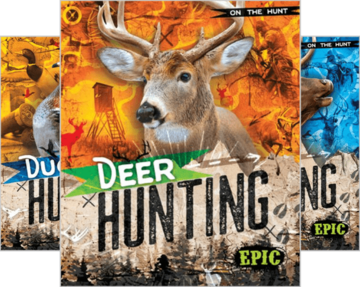
Accessible books about hunting for kids are rare and when a good series comes along, it’s time to buy! Epic’s On the Hunt series introduces six different animals that are typically hunted, discussing gear, safety, laws and preparation. Each book is visually appealing and well-organized and should be high on your library wish list.
Nonfiction text features are abundant in these books, starting with a clear table of contents and ending with a glossary, index and a page of print and web resources for further exploration. Spare text with bold words pairs nicely with the clean, crisp photos. Headings help with organization. Diagrams and maps are clearly labeled and sidebars impart interesting tidbits of knowledge to enrich the more basic text on the pages. Students will love the information and teachers will appreciate the nonfiction text features so clearly presented.
Books include hunting of the following animals: ducks, deer, elk, pheasant, turkey and wild hog. All these animals are hunted somewhere in North America, giving the series a wider appeal. The range of each animal is presented on maps and a favorite spot is highlighted. Hunters are portrayed as young and old, male and female. One hunter (Pheasant Hunting) is in a wheelchair, which is an encouraging and appropriate inclusion.
This highly engaging series is a definite purchase option, especially in areas where hunting is part of the culture. It is also a useful introduction to those that may not have any experience or prior knowledge, because of its very accessible text and highly visual presentation. Highly recommended.
Who would have thought that a picture book about measurement could be so fun? Blue Whale and Supersaurus are arguing over which of them is longer. Inchworm comes in and offers to help with the winner buying lunch. It takes inchworm (who is an inch long) 12 hours to measure Blue Whale, who is 1,300 inches long. Inchworm can’t measure Supersaurus, because he has to go into his cocoon. So, in comes centipede (who is a centimeter long) and he measures Supersaurus. It also take 12 hours and Supersaurus is exactly 3302 centimeters long. Wait! What does that mean? Dragonfly saves the day by doing the math and determines that the two behemoths are the same length!
This wonderful melding of math and science into a picture book is hilarious and educational. Readers learn the difference between the customary and metric systems as well as some cool science and end with some little known math terms (check out “zeptosecond”). Accompanying illustrations are cartoon-like and fun. Buy this book and start measuring. Your students will love it! Highly recommended.