If one reads the title too quickly you might think it’s about wandering around, and in a way it is, but really it’s about seeking wonder in one’s wandering. It’s written in a rather poetical style, and has a beauty to it, both in text and illustrations. The illustrations are soft and rather muted, and almost seem to have a vintage look to them. It might appeal more to adults who appreciate the wonder of childhood than to the children it’s targeting.
Category Archives: Additional Purchase
Pages of Music
It’s a republication of a book from the 80s. The illustrations are classic dePaola, and the story is very much in line with other familiar dePaola books: it takes place in the Italian countryside and offers subtle ties to the Christian Christmas story. It tells of a boy who visits a poor island as a child and is so impressed with the generosity and joy of music that he experiences there, that when he grows up to become a famous composer, he returned to the island with a full orchestra to share a Christmas concert he’d composed just for them. It’s a nice story, but not sure it’s going to resonate with a wide audience of children.
Puppy Bus
It’s cute. It’s about a boy who’s not excited about the first day of school, but then when he gets on the bus, he realizes he got on the wrong bus. All the other passengers are puppies, and he finds himself at puppy school. Though he doesn’t speak Bark, he goes along with things and finds himself having a rather good day, learning how to play fetch and dig and howl. The next day he’s all excited to return, but this time finds himself on a bus filled with kitties.
Bright
Rachel Kim knows what success feels like. She’s been in a famous K-pop group, Girls Forever, for several years, establishing herself as one of its stars. Rachel has traveled the world and given everything to the group but is intrigued when approached with a few independent job opportunities. With the entertainment group’s blessing, Rachel embarks publically into the fashion design of purses while also privately dating a very connected young gentleman. But not all group members are happy with Rachel’s success. Girl drama mixed with suppressed passion and a little bit of paparazzi scandal propels this semi-autobiographical story. Rachel will learn that sometimes being on a new path is scary, with the unknown around the corner, but you have to try something new to get new results. Anyone who follows K-Pop will enjoy this Bright romp.
Tim Possible & the Time-Traveling T. Rex
Written by Axel Maisy
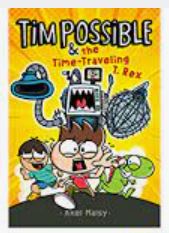
The main character, Tim Possible, is an adventurous boy who worries a lot. He and his best friend, Tito, run into a time traveling T-Rex whose time machine has turned evil. This humorous and adventuresome book will be a great addition to a library that may see a need for more books along the vein of “Captain Underpants”, “DogMan” or “Diary of a Wimpy Kid”.
The Moon from Dehradun: a Story of Partition
Written by Shirin Shamsi Illustrated by Tarun Lak
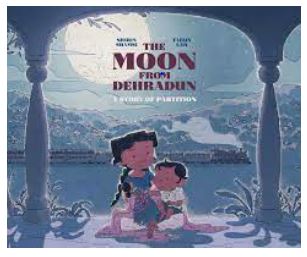
This is a beautifully written and illustrated picture book about the partition of India in 1947. It follows a family that suddenly has to leave their home and move to what is now Pakistan where they find an empty house and move in (presumably because that family had to move to what is now India). While recommended for ages 4-8, this book would be a more relevant purchase for intermediate grades. The story will be relatable to individuals who have an understanding of refugees and individuals that flee from their homelands due to fear. This book also contains maps, a glossary as well as the author’s family experiences in the back that would better explain the story to more advanced intermediate readers.
Pig Makes Art
Written by Laura Gehl Illustrated by Fred Blunt
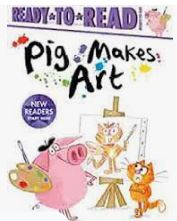
This book is an “emerging reader” book about a pig who creates art but leaves out the cat from the picture. The cat gets bored and takes a nap so the pig makes art on the cat while it’s sleeping. This makes the cat angry. In the end, pig and cat both make art together as friends. This book contains a list of word families, sight words and bonus words. It also has questions about the book on the last page.
Clementine and the Lion
It’s okay. It’s a version of the classic “kid thinks parents are ogres and would rather live without grown-up interference” trope. In this case mom got snatched by dragons and dad is lost at sea in a bottle. When an aunt shows up and tries to take over, Clementine invents an invisible paint to hide the house and get rid of the aunt. When she accidentally leaves the door open one day she ends up with a lion as a houseguest and must find a way to make peace with it and carry on in case her parents come back some day. On the one hand, a lot of kids can relate to the living-without-adults fantasy, on the other hand, it seems a bit disjointed.
I am Malala Yousafzai by Brad Meltzer
Another book in the Ordinary People Change the World Series, I am Malala Yousafzai, starts out with Malala introducing herself as an ordinary girl who likes pink, cupcakes, and pizza. The narrative quickly turns to how girls in her country are not treated the same as boys. It discusses the school started by her father and her quest to seek education. It does depict when she was shot and does show someone holding a gun. The illustrations show Malala as a young girl throughout the entire book. The end includes a timeline and photographs of Malala.
Different Kinds of Fruit by Kyle Lukoff
From the author of the Newbery Honor book “Too Bright to See” and the picture book “When Aidan Became a Brother,” Kyle Lukoff presents us with a novel on the queer community through the eyes of sixth grade Annabelle. When a vocal, cool binary student, Bailey, joins her class, Annabelle is instantly infatuated with them, and begins to wonder if this is actually a crush. When she brings Bailey home, Annabelle’s parents instantly act awkward and seem to be discouraging their friendship. Misreading their attitude about Bailey’s gender identity, her parents share with Annabelle that her dad is not only transgender, but a seahorse father. (He was the one who birthed Annabelle when it was discovered that her mother was unable to have children). Once this is out in the open, Annabelle, Bailey, and their families get involved in the Spectrum Families chapter in Tahoma Falls and Seattle, WA. Annabelle continues to try to “figure out which letter in LGBTQ+ applied to me, now that I know that I was something.” National Coming Out Day (NCOD) is quickly approaching and Annabelle feels pressured to figure it out soon.
From the very beginning, I saw this is as an “instructive manual” on how to “they/them” and teach terms such as butch, femme, seahorse, pan, and more. While I respect this possible motive by the author, for me, it drove the book rather than an interesting plot. I believe there are better books out there on questioning your sexual and gender identity, but if you’re looking to add to your collection, this may appeal to lower middle school students.