Bright, vivid illustrations accompany this cajun version of the folktale of The Fisherman and his Wife. Something about the text draws one into feeling the urge to attempt a cajun accent while reading the story of the poor but happy fisherman and his wife who one day catch a magic catfish. Though the fisherman is content enough, his wife comes up with more elaborate wish after another to ask of the magic fish, each granted wish leading to more wants, until having all her wishes granted land her in ruin and she realizes there’s nothing she really needs. A brief glossary at the end offers explanations for the Bayou lingo sprinkled throughout, though context is usually sufficient to make the meaning clear. It’s a fun read, which gives the reader something to ponder.
Category Archives: Reviewer’s Library Type
The Unexpected Crocodile
It’s a rather odd little story about a family having guests to dinner in the middle of a rain storm. When a crocodile arrives unexpectedly, he is invited to join the party, and proceeds to calmly eat each of the guests (who, granted, were not terribly polite), and then goes away again. The illustrations do not particularly enhance the strange story, as they appear half-finished.
Ruby Learns to Swim
Definitely a book for the very youngest students. It’s got lots of repetition and rhythm and the illustrations support the text, which makes it useful for beginning readers. It would also be helpful for building enthusiasm for a reluctant swimmer about to face lessons: it consists of repeated phrases describing different aspects of swimming, interspersed with the mantra, “Learn to swim!”
Counting Money
A small book, written for early learners, it’s got color photos illustrating the two sentences per page which describe what coins the child in the picture has, and how much cents that equals. It’s broken into chapters by type of coin. It’s got other text features of non-fiction books (table of contents, glossary, index). It’s not that it’s a bad book. It’s just that there’s not much practical point to it: no child is going to choose it for the fun of reading, and it’s not particularly necessary as a teaching tool, as actual money that children can handle would work better, so I don’t know that teachers would find the book particularly helpful.
The Great Balloon Hullaballoo
The illustrations are fun, and the colors are bright and rich. The text is written with good rhythm and rhyme, telling the story of a young squirrel whose mother sends him off with a shopping list, insisting that the most important item on the list is cheese, as she’s planning to make pizza for dinner. When Simon Squirrel and his friends see the moon, they declare that everyone knows it’s made of cheese, so they borrow a hot air balloon to go fetch some, but a comet blows them off course, so they end up shopping for the other items on their list at various planets. After a meteor shower punctures their balloon they head home, but realize they still forgot the cheese. Though it lacks enough purpose or cohesion to rate a recommendation, it’s silly and fun and kids would enjoy it.
Snow Dog, Sand Dog
I thought it was really rather lame. It didn’t really seem to flow very well. It’s about a girl who really wants a dog but can’t have one because she’s allergic. In the winter she makes a dog out of snow (and for some reason kids laugh and tell her there’s no such thing as a snow dog, but they don’t seem to have any kind of reaction when it comes to life and starts following her around). Similar scenarios repeat each season as she makes a dog out of flower blossoms in spring and sand in the summer and leaves in the fall. For some unknown reason, although the snow and sand dogs look pretty much the same in their live forms as they started out, the leaf and flower dogs stop looking like they’re made from leaves or flowers when they come to life.
Down the Rabbit Hole: the diary of Pringle Rose, Chicago, Illinois, 1871
It pains me to say it, as I’ve really enjoyed other books in this series and other books by this author, but I was disappointed with this book. It’s like it never really committed to deciding what it was meant to be about. It’s a little about labor unrest of the time, a little about attitudes towards the mentally handicapped, a little about the rights of women and animals, and a little about the great Chicago fire. It’s got good characters and I started out enjoying it, but it never seemed to develop any kind of focus or purpose; it just sort of rambled on for a bit, and then there was an epilogue tacked on the end to wrap up the loose ends, but there was never any kind of actual conclusion.
The Mouse with the Question Mark Tail
A delightful story of the hidden world of mice that mirrors that of humans. Set during the jubilee celebration of Queen Victoria, the basic premise of the tale supposes that for every human job, there is a mouse with the same job, scurrying about in the hidden spaces, staying away from human eyes. The hero of this story grew up in the Mews outside Buckingham Palace, but has never been given a proper name, as no one seems to know his parentage: he is simply called according to the distinctive shape his tail falls into. A series of scrapes and adventures amidst the flurry of castle preparations for the grand celebration eventually lead the the revelation of his true identity.
Eye to Eye: How Animals See the World
Steve Jenkins knows how to rivet readers to his books, gazing at the gorgeous, large -format cut-paper illustrations. This particular volume explores eyes in the animal kingdom and how they use them to see the world. Twenty animals are presented…from the well known garden snail, to the lesser known brownsnout spookfish…from the small stalk-eyed fly, to the enormous hippopotamus. Each two-page spread includes two animals accompanied by a brief explanation their eyes. Young children will be drawn to this book, however, they will need scaffolding by an adult to understand the complex vocabulary and concepts, which seems to be more appropriate for an older audience. Back matter, in Steve Jenkins’ fashion, includes much more information, such as a chart explaining the evolution of the eye, as well as more facts about the animals in the book. This is the place where you can find the relative size of the animal, which is hard to conceptualize from the illustrations. Bibliography and glossary are there, as well.
The No-Dogs Allowed Rule
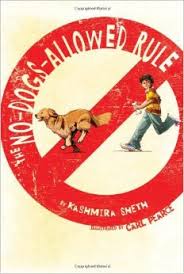 Ishan (pronounced E-Shan) a third grade boy and his brother Sunil, a fourth grader, desperately want a dog. However, Mom has a “no dogs allowed” rule. Ishan goes to great lengths to try to persuade his Mom into a “dogs allowed” rule. He helps his elderly neighbor walk his dog to prove he can be responsible (ok and to also get his dog fix for the day). He tries to cook a special meal to please his mom and try to win her over. He even changes all the family pictures in the house to dog pictures. Each well intentioned act becomes more of a disaster than a gift. So much so, that Ishan is grounded to the house during a neighborhood block meeting held at his home. During the meeting an emergency involving his neighbor occurs and Ishan saves the day. Will this be the action that changes mom’s mind to allow a dog to enter the family home?
Written with realistic speech patterns and plausible scenarios this multicultural novel introduces readers to foods of India, Hindi words and social interactions of Indian culture and family life.