Last Free Cat, The

This sci-fi/fantasy novel begins with a feline epidemic, a disease that cats can acquire and become fatal to humans. Because of the disease, the government has put a regulation on felines; one must have a cat from a government breeder and have a permit, both of which are incredibly expensive. The story begins with a teenage girl, Jade, who finds a cat in her backyard. This cat and a boy named Finn change her life and take her on an adventure to find out about the truth of the disease and the cats.

This fast-paced novel has strong main characters. The plot was well-written and deeply thought-out; it gives the readers questions and will later answer those questions. It leaves the readers entertained and will keep the reader wanting more. Cat lovers will especially enjoy this book. A fascinating read for teenagers and adults alike.

— Kellyn S.
How To Rap 2

For the library that has How To Rap, adding How To Rap 2 is a natural and worthwhile purchase.  How To Rap 2 is a technical manual for the aspiring rapper.  Author Paul Edwards details out rhythm and vocal techniques as well as rhyming techniques.  Precise examples from real rappers clarify what can’t be explained in words or reinforce what is said.  Interwoven into every page are items of advice, information, and inspiration from rappers around the world.  The rapper just looking for ideas and “how-tos” will gloss over these parts and the reader who can’t get enough of the world of rap will soak in each idea. For the lay person who knows nothing of rap, the words of wisdom from specific artists will get ignored but they could make their way through Edwards technical explanations, much like one does with most college textbooks — it’s that technical.  As said, if How To Rap is checked out by patrons already, this will be a further lesson in the art of rap to enjoy.  High school audiences and above.

Pink

This installment in Abdo Publishing’s Contemporary Lives Series, Pink, is an easy to read, fun pick for students in grades 6 and up.  Rowell’s writing is formulaic, but with Pink as the center of attention, the content is still very interesting.  Even the chapter titles amuse a reader:  “Glitter in the Air”, “A Yummy Life”, and “Channeling Heartbreak”.  From this biography, a reader will learn that Alecia Beth Moore was born into a home that was “World War III” every day.  She spent time with kids who were considered druggies and punks.  At 13, her focus on music and natural instinct landed her jobs in clubs singing and being further exposed to drugs.  All of this, as well as dropping out of school, shaped the hard core, intense artist she became.  The 3rd chapter and beyond catalog the climb Pink would make between 2000 and 2013.  Chalked full of glossy pictures, text boxes of quotations from Pink, asides from the author of interesting tidbits, decorative background imagery of reflective lights on every page and less than 200 words per page because of the larger font used, this is a visual feast for pop-culture fans.  Still, the depiction feels honestly representative of a woman who had made a huge impact on the music industry.  As Pink compares herself to Cher, the reader knows Alecia will be in the business for a very long time to come.  Student researchers will appreciate the timeline, data page, and selective bibliography in the back of the text, as well as the author’s note for writing about credibility in their annotations.  This reader will be looking at more books in this set, including Lil’ Wayne, Bruno Mars, and Rihanna.

Stingray

Through the use of their very sharp spine and venom, plus camouflage and nerves that sense the electrical fields of prey, stingrays are excellent survivors in the wild.  Being ovoviviparous, their young hatch from eggs inside the mother, then are born live and self sufficient.  Having first developed around 200 million years ago, stingrays have close relatives in the sea world.  Stingrays live close to shore and thus are heavily  affected by human pollutants.  These topics and more fun facts are covered in this amazingly informative text, which is also full of equisite photos.  Front Matter includes a fact file list of Class, Order, Families, Genus, Species, World Distribution, Habitats, Distinctive Physical characteristics, Habits, and Diet…helpful to elementary researchers.  Back Matter includes, Glossary, Habitat Map, Find Out More, Index and About the Author.  If all of the books in this Nature’s Children series are this quality, I’m going to be purchasing others.

Tin

In a world of robots, who act like humans (the Jetsons, without the people), Tin is asked to babysit his little sister Nickel with the help of their dog Zinc. All is well until Nickel floats away holding onto the string of a balloon. Tin and Zinc follow in hot pursuit. Eventually, Tin and Zinc return Nickel home just before their mother arrives home. The plot is cliche, the artwork carries the story.

The artwork is very geometrical with straight lines, angles, and minimal curves. The artwork appears to be simple on first glance. But then , the use of multiple shades of one particular color per object draws the eye in for a more in-depth look.

Too Cold for a Tutu

I fell in love with the cute hand-knit stuffed toy dogs [Barry & Stella] in their little hand-made clothes as they hop and jump through the Adobe Photoshopped pages of this book.

The story line hops and skips through the pages, as well, just like the young children they portray. Barry and Stella don’t stay on any activity for too long.

Barry and Stella have just received a hand-made gift of a sweater and tutu from their grandmother. Their imaginations go wild as they play outside in their new clothes in the crisp fall air. After a child’s disagreement over climbing a tree, they begin to pretend they are elephants. The story ends, after Barry and Stella have eaten a snack and the tutu has now become a lion’s mane.

Bugs in my Hair!

Author, illustrator – David Shannon can make any topic cute and adorable! The cover of this 2013 book (11.5″ X 9″) has a rumbled insect looking out at the reader from what might be a bunch of shredded carrots, if only the title were not Bugs in my Hair!  It is still cute.

It all begins when “One day, my mom made a terrible, awful discovery… Head Lice!” Shannon’s over dramatic illustrations lighten-up the topic of what is often a common childhood maledy – head lice.  Oh the itching, the blood sucking, “the humiliation”, and the not knowing exactly where the lice came from.  A few ‘treatments’ are comically illustrated [child with his entire head looking out from inside a mayonnaise jar] while mom researches for “battle-tested anti-lice weapons.” Finally, the lice are gone. BUT they come back. And “so we went through the whole thing again…”    Closing illustration of a child’s head inside a knight’s helmet is captioned, “I’m not taking any chances!”

The reader comes away with the idea that “Lice-a-palooza” are not the end of the world, but it is a relief when they are gone.

Bad Dad

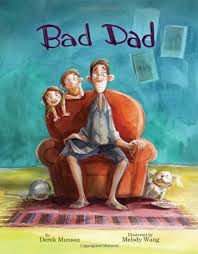
Oh no!  Dad did it again.  He drank from the milk container, ate the last cookie, played with the toys in the toy department and played ball in the house!

“Sometimes we think he gets into more trouble than we do!”  But is Dad all that bad?

He helps with homework, knows tons of games, tells lots of jokes and he’s the best hider during hide-and-seek.  As dad’s virtues are extolled the narrator realizes how great Dad really is.

The word play, at the last sentence in the book, is a perfect ending that children will enjoy.  It  ties the story up in a nice neat little package.

Children and adults alike will enjoy this fun story that takes a look at all Dad’s good and bad attributes.  Readers may even see their dad reflected in the story somewhere.

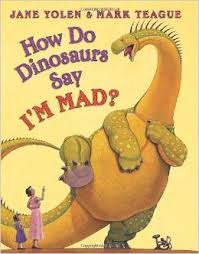
How Do Dinosaurs Say I’m Mad?

How does a dinosaur act when he’s mad?  So begins the eleventh book in the “How do dinosaurs” series.  Jane Yolen and Mark Teague team up to create an inviting book. Teague’s illustrations are spot on as they capture the physical and emotional characteristics of a temper tantrum in all its glory: stomping, kicking, throwing, pouting, sticking out tongues, ignoring and dirty looks.  Yolen takes the reader through the storm of a tantrum to a self-controlled calming end.

A good read aloud to prompt open discussion on proper behavior when we get mad.  Children will giggle as they see themselves reflected in some of the scenarios, but may listen intently to learn how to overcome those out of control feelings.

The Quayside Cat

I absolutely love the illustrations in this book:  they evoke the mood, create the setting, and give personality to the characters.  The story itself is a nice tale of a young harbor cat who listens to the stories of the old cat who’s travelled the sea.  When young Jim insists he wants to share in such adventures, the two set off together to stow away on a sea-going boat.  And adventures they find, including seasickness and rats and waves and storms.  When they do make it safely back to the harbor young Jim is ready to return to the safety and familiarity of the harbor, but the old cat says he’s had enough of land and is setting out on one last voyage.  By the end of the story Jim has become the old cat telling of stories of adventures at sea to the younger kittens on shore.  My biggest gripe with this book (keeping it from getting a better rating) is not with the author or the illustrator, but with the editor/publisher — whoever it was who decided on the text layout.  Someone made the decision that the lines of text should be aligned along their centers, giving it the look of poetry, though it’s not, which interferes with having any proper paragraph indentations to show when their is a change in speaker: the result is that there are times when confusion over who is speaking interrupts the flow of the dialogue and the story.