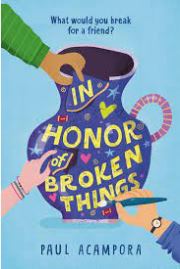
Three middle school students from differing backgrounds become friends when they are seated together in pottery class. All have recently experienced a traumatic event in their lives: a sister’s death due to Cancer, a drastic move from the big city to a very small town and leaving the homeschool life to be in public school where everything is different and unknown. All are feeling like the broken pottery they have seen/experienced in their class but find solace from each other. Will they come to realize that it is okay when some things stay broken? This wonderful middle level book is appropriate for 5th through 8th grades but could also be recommended for more mature readers at a younger age who may be experiencing trauma and could relate to the characters.
Alicia Z. Klepeis explores the 35,918 square miles Central Europe’s Hungary. Klepeis uses snapshots of Hungary’s location, landscape, wildlife, people, school and work, play, and food. The 32 pages just give a quick overview of what this country has to offer with two or three paragraphs of text per topic accompanied by half a page-spread of color photos.
I continue to find the TIMELINE in this “Country Profiles” series confusing to the eye with its segmented lines stating facts above and below the actual timeline leading to the events’ locations on the timeline. It might be better to print the statements on a slant with a single line segment drawing the eye to the timeline location.
The HUNGARY FACTS on pages 28-29 provide good visual graphics to show the flag, where people live, their work, important cities, main exports, and unit of money.
Factsurfer.com provides more information with safe internet.
Alicia Z. Klepeis explores the 8,867 square miles Central America’s Belize. Klepeis uses snapshots of Belize’s location, landscape, wildlife, people, school and work, play, and food. The 32 pages just give a quick overview of what this country has to offer with two or three paragraphs of text per topic accompanied by half a page-spread of color photos.
There is a problem with text boxes set on top of photos that do not match the picture in the photo, though the photos follow along with the information in the main paragraph on the page. On page 14 the photo is of a thatched house while the box talks about Mennonite communities. On page 17 the photo is of a painted mural, while the box talks about colorful clothing. On page 19 the photo is of a guided tour by horseback, while the box talks about Belizeans working in other countries. And on page 25 the photo is of a dance group on Garifuna Settlement Day, but the box talks about Maya Deer Dance. The photos are labeled correctly. It is the inset text boxes that are problematic and could cause confusion on the part of the reader.
I continue to find the TIMELINE in this “Country Profiles” series confusing to the eye with its segmented lines stating facts above and below the actual timeline leading to the events’ locations on the timeline. It might be better to print the statements on a slant with a single line segment drawing the eye to the timeline location.
The BELIZE FACTS on pages 28-29 provide good visual graphics to show the flag, where people live, their work, important cities, main exports, and unit of money.
Factsurfer.com provides more information with safe internet.
Alicia Z. Klepeis explores the 29,120 square miles Central America’s Panama. Klepeis uses snapshots of Panama’s location, landscape, wildlife, people, school and work, play, and food. The 32 pages just give a quick overview of what this country has to offer with two or three paragraphs of text per topic accompanied by half a page-spread of color photos.
I continue to find the TIMELINE in this “Country Profiles” series confusing to the eye with its segmented lines stating facts above and below the actual timeline leading to the events’ locations on the timeline. It might be better to print the statements on a slant with a single line segment drawing the eye to the timeline location.
The PANAMA FACTS on pages 28-29 provide good visual graphics to show the flag, where people live, their work, important cities, main exports, and unit of money.
Factsurfer.com provides more information with safe internet.
Nicole E. Rodriguez Mata explores the 352,144 square miles South America’s Venezuela. Rodriguez Mata uses snapshots of Venezuela’s location, landscape, wildlife, people, school and work, play, and food. The 32 pages just give a quick overview of what this country has to offer with two or three paragraphs of text per topic accompanied by half a page-spread of color photos.
I continue to find the TIMELINE in this “Country Profiles” series confusing to the eye with its segmented lines stating facts above and below the actual timeline leading to the events’ locations on the timeline. It might be better to print the statements on a slant with a single line segment drawing the eye to the timeline location.
The VENEZUELA FACTS on pages 28-29 provide good visual graphics to show the flag, where people live, their work, important cities, main exports, and unit of money.
Factsurfer.com provides more information with safe internet.
Indigenous Peoples’ Day by Rebecca Sabelko is part of a Blastoff Beginners series of the Happy Holidays. This set is geared towards kindergarten, with sight words, short sentences, and bright color photographs. Each book is 24 pages and starts with the sight words for review before beginning the book content. As a parent of a kindergartner, I like that they provide a list of sight words to review before we begin reading the book together.
This book includes a table of contents, headings, bolded words, glossary, index, and labeled photos – perfect for introducing a holiday to preschool through second grade and working with them on identifying non-fiction text features.
Each section includes a few sentences and a photograph describing when Indigenous Peoples’ Day is (p. 6), and a variety of ways you could celebrate the holiday (p.10).
This book is a good, quick overview of Indigenous Peoples’ Day. The photos show different aspects of the holiday really well, from people reading books about indigenous cultures, to celebrating the art, and their Native history. I love the Facts page (p. 22) as it summarizes the activities talked about in the book with simple photos, labels and key words.
This series also includes a page referring you to Factsurfer (factsurfer.com) for additional kid friendly web sources. I liked this website and feel like it would be a great place for your beginning researchers to find online sources, or broaden their knowledge base. At the website you type in the title of your book, click the picture of the book cover that pops up, and then are given three age appropriate sites to go to for more information.
I find these Blastoff Beginners a go-to in my library because I know I can count on them for their eye-catching covers and photos, their quality, and their consistency in content and readability.
If you need books for primary students about holidays or books that provide a simple to understand overview of a holiday, I recommend adding this book to your library collection.
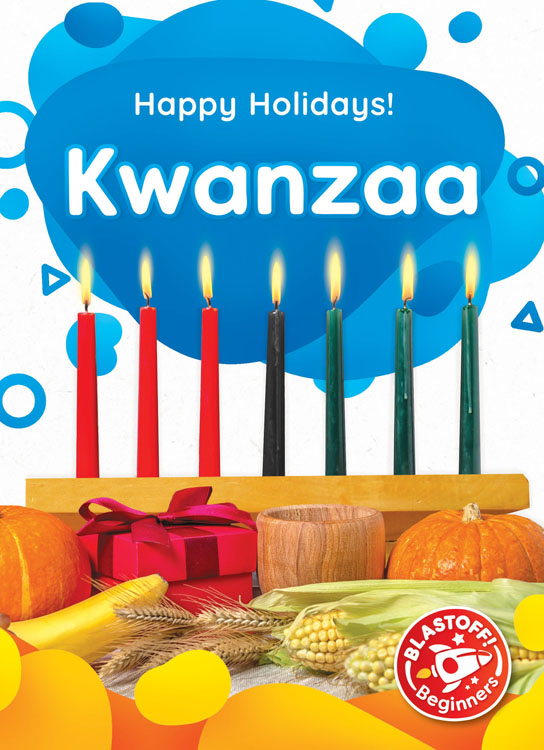
Kwanzaa by Betsy Rathburn is part of a Blastoff Beginners series of the Happy Holidays. This set is geared towards kindergarten, with sight words, short sentences, and bright color photographs. Each book is 24 pages and starts with the sight words for review before beginning the book content. As a parent of a kindergartner, I like that they provide a list of sight words to review before we begin reading the book together.
This book includes a table of contents, headings, bolded words, glossary, index, and labeled photos – perfect for introducing a holiday to preschool through second grade and working with them on identifying non-fiction text features.
Each section includes 2-3 sentences and a photograph describing when Kwanzaa is (p. 6), and how to celebrate the holiday (p.14).
This book is a good, quick overview of the Islamic holiday Kwanzaa. The photos show different aspects of the holiday really well, from lighting candles to celebrating with family. I love the Facts page (p. 22) as it summarizes the traditions talked about in the book, with simple photos, labels and key words.
This series also includes a page referring you to Factsurfer (factsurfer.com) for additional kid friendly web sources. I liked this website and feel like it would be a great place for your beginning researchers to find online sources, or broaden their knowledge base. At the website you type in the title of your book, click the picture of the book cover that pops up, and then are given three age appropriate sites to go to for more information.
I find these Blastoff Beginners a go-to in my library because I know I can count on them for their eye-catching covers and photos, their quality, and their consistency in content and readability.
If you need books for primary students about holidays or books that provide a simple to understand overview of a holiday, I recommend adding this book to your library collection.
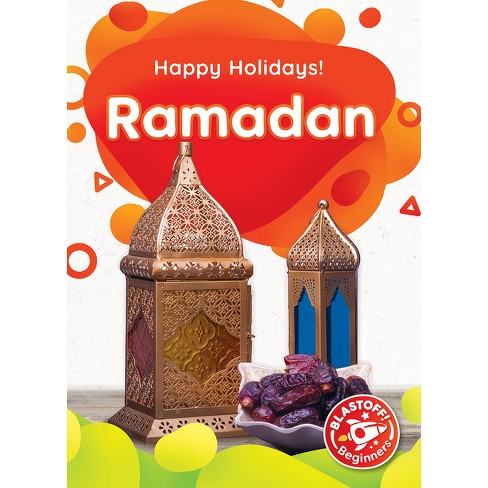
Ramadan by Betsy Rathburn is part of a Blastoff Beginners series of the Happy Holidays. This set is geared towards kindergarten, with sight words, short sentences, and bright color photographs. Each book is 24 pages and starts with the sight words for review before beginning the book content. As a parent of a kindergartner, I like that they provide a list of sight words to review before we begin reading the book together.
This book includes a table of contents, headings, bolded words, glossary, index, and labeled photos – perfect for introducing a holiday to preschool through second grade and working with them on identifying non-fiction text features.
Each section includes 2-3 sentences and a photograph describing when Ramadan is (p. 6), and how to celebrate the holiday (p.12).
This book is a good, quick overview of the Islamic holiday Ramadan. The photos show different aspects of the holiday really well, from fasting and praying to celebrating Eid-al-fitr. I love the Facts page (p. 22) as it summarizes the traditions talked about in the book, with simple photos, labels and key words. The one adjustment I would make in this book is a pronunciation guide for Allah and Eid-al-fitr.
This series also includes a page referring you to Factsurfer (factsurfer.com) for additional kid friendly web sources. I liked this website and feel like it would be a great place for your beginning researchers to find online sources, or broaden their knowledge base. At the website you type in the title of your book, click the picture of the book cover that pops up, and then are given three age appropriate sites to go to for more information.
I find these Blastoff Beginners a go-to in my library because I know I can count on them for their eye-catching covers and photos, their quality, and their consistency in content and readability.
If you need books for primary students about holidays or books that provide a simple to understand overview of a holiday, I recommend adding this book to your library collection.
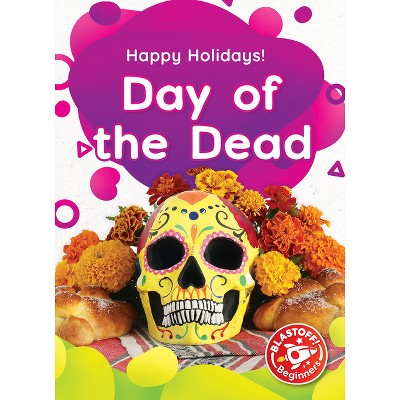
Day of the Dead by Betsy Rathburn is part of a Blastoff Beginners series of the Happy Holidays. This set is geared towards kindergarten, with sight words, short sentences, and bright color photographs. Each book is 24 pages and starts with the sight words for review before beginning the book content. As a parent of a kindergartner, I like that they provide a list of sight words to review before we begin reading the book together.
This book includes a table of contents, headings, bolded words, glossary, index, and labeled photos – perfect for introducing a holiday to preschool through second grade and working with them on identifying non-fiction text features.
Each section includes 2-3 sentences and a photograph describing when Day of the Dead is (p. 6) and how to celebrate the holiday (p.12).
This book is a good, quick overview of the Mexican holiday Day of the Dead. The photos show different aspects of the holiday really well, from celebrating to remembering your lost loved ones. I love the Facts page (p. 22) as it summarizes the traditions talked about in the book, with simple photos, labels and key words.
This series also includes a page referring you to Factsurfer (factsurfer.com) for additional kid friendly web sources. I liked this website and feel like it would be a great place for your beginning researchers to find online sources, or broaden their knowledge base. At the website you type in the title of your book, click the picture of the book cover that pops up, and then are given three age appropriate sites to go to for more information.
I find these Blastoff Beginners a go-to in my library because I know I can count on them for their eye-catching covers and photos, their quality, and their consistency in content and readability.
If you need books for primary students about holidays or books that provide a simple to understand overview of a holiday, I recommend adding this book to your library collection.
Nicole E. Rodriguez Mata explores the 278 square mile urban city-state of Singapore. Rodriguez Mata uses snapshots of Singapore’s location, landscape, wildlife, people, school and work, play, and food. The 32 pages just give a quick overview of what this city-state has to offer with two or three paragraphs of text per topic accompanied by half a page-spread of color photos.
I continue to find the TIMELINE in this “County Profiles” series confusing to the eye with its segmented lines stating facts above and below the actual timeline leading to the events’ locations on the timeline. It might be better to print the statements on a slant with a single line segment drawing the eye to the timeline location.
The SINGAPORE FACTS on pages 28-29 provide good visual graphics to show the flag, where people live, their work, main exports, religion, and unit of money.
Factsurfer.com provides more information with safe internet.