
Twinkle Twinkle Little Kid, by Drew Daywalt

While the title suggests the childhood song Twinkle, Twinkle Little Star, the story is instead built around the nursery rhyme, Star Light, Star Bright. A young boy wishes on a star while at the same time a star is wishing on a little kid. Both are disappointed when their wishes don’t come true.Each wonder about the other’s wish. Did they wish for checkers? A tent? A frisbee? Walkie-talkies? Clyde cannot figure out what the star wished for. Finally both realize they each wished for a friend. Together they enjoy checkers, a tent, frisbee, and the walkie talkies; never having to worry about a lack of a friend again.

Twinkle Twinkle Little Kid is a sweet story with charming illustrations that would do well as a bedtime story, but lacks the humor and kid appeal of Daywalt’s other books.
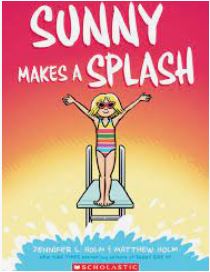
Sunny Makes a Splash by Jennifer and Matthew Holm

In book four of the Sunny graphic novel series, our main character anticipates a boring, unexciting summer after finding out her friends are going to be out of town but things change after she gets a job at the Golf and Swim Club snack stand. She makes friends that are older than her and sees others start relationships. This book is a light, fun graphic novel about friendship and being a tween. I would recommend it especially if you already have the first 3 books of the series.

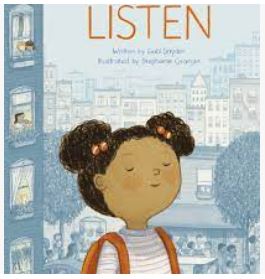
Listen by Gabi Snyder, Stephanie Graegin – Illustrator

This picture book discusses how even in a loud and overwhelming world if you take a moment to stop and listen you can hear the individual things around you. This book would be a great reminder to students to close their eyes and use their ears to move past the full force of one large cacophony of noise and give your full attention to something. This book has some very nice reference notes about listen.

Orca Rescue! : The True Story of an Orphaned Orca Named Springer by Donna Sandstrom

A engaging true story for young nature lovers. When a young orca is seen all alone near Vashon Island without any pods nearby, it got the attention of both orca enthusiasts and scientists. A baby orca will not survive without a family to protect and teach it. Scientist and volunteers use her distinctive call and markings to identify her family. Since she was alone, it was assumed that her mother was dead, but her grandmother, aunts, and cousins were still alive in Canadian waters. In Orca Rescue! the story of Springer’s capture, transport, and release, and subsequent reunion with her family is described.

The nonfiction narrative of Springer’s story is interspersed with well researched, age appropriate information on Orcas in general and Puget Sound resident pods in particular. Sarah Burwash’s lovely watercolor illustrations portray the complicated steps in the rescue. The endpapers include photographs of Springer in different stages of her life, a matrilineal family tree of the A10 pod, a summary of some of the threats to whales and dolphins, glossary, and a list of the individuals and organizations that were instrumental in Springers safe rescue.

We Shall Overcome by Bryan Collier

Bryan Collier’s breathtaking illustrations of the Civil Rights protest song make this book an important addition to any elementary library. Each refrain is supported by the visual portrayal of the text with the current day children of color living and dreaming beside a black and white portrayal of historical events and figures important to the Civil Rights movement. The message is thought provoking and uplifting and celebrates progress while recognizing there is still change that needs to happen.

Since the text is based on the lyrics from the original gospel hymn, the breadth of the message is broadened beyond the repeated refrain most often part of Civil Rights protests.

The endpapers explain the origins of the hymn and provides details on the significance of the black and white historical events.

Keep Your Head Up

It’s a good book for helping kids think about and talk about and process their reactions to the world around them. It’s about a kid having a rough day. From the moment he woke up late, everything seems to go wrong all day long, and as he describes how the day is going, he also describes how he feels, and how those feelings build. At the beginning, he makes a conscious decision to walk to school with his head up even though he feels a little scrunch, because he knows any day can be a good day if you try. But as more problems pile up, his bad day face slips out, even though he’s trying not to let it. He reminds himself that his principal would tell him to keep his head up, so he does, but eventually he has a meltdown. When he’s sent to the principal’s office, he expects her face to be scrunchy, but it’s not. When his parents come to get him, he asks if this day is going to get any better, and his mom says it might, if asks him what he can do if it doesn’t, and he knows the right answer is to keep his head up, but he confesses that he doesn’t really want to, and his principal says he just has to want to try. I like that it’s a very believable, and relatable tale for a lot of kids, and it doesn’t offer a sugar-coated ending that everything’s turned around or he has overcome his feelings. I like that it reminds kids they just have to want to try. The illustrations are full of feeling, too, that support the story nicely.

Mr. Complain Takes the Train

Well, it is pretty much exactly as the title describes: an old codger opens the book by complaining that the train is late, and then he proceeds to continuously complain about absolutely everything. Luckily the ostrich/emu? taking tickets has a never ending supply of patience as he continuously adjusts things in an attempt to accommodate Mr. Complain. In the end, the train goes through a loop-de-loop that delights Mr. Complain so much he doesn’t want to get off when it reaches his destination. The pictures are cute, and it does invite a certain amount of interaction with the reader, but I guess I don’t have as much patience as our ticket-taker, because I just found it rather pointless. It’s not bad. It’s just not that great.

Moo-Moo, I Love You!

It’s one of those books for reminding children that they are loved unconditionally. Mama cow is telling her little cow how much she loves it, when she loves it, and what she loves about it, and to keep it silly instead of sappy, it plays on “moo”s throughout. She loves it no matter it’s moo-d, when they’re grooving to moo-sic, and when it’s sch-moo-zing with friends, etc. No child can be told too often how much they’re loved.

1, 2, 3, Off to School!

It’s the kind of book that invites children in to spend time with it. The illustrations are so full of small detail with lots happening on each two-page spread. The story is a simple one, that of a gnome child who is disappointed to be told he s/he won’t be starting kindergarten for another year, so s/he sets off to spend the first day of school visiting all the forest animals in their different schools, watching how their school day progresses. Each two-page spread shows a cross-section of another school, full of details (both pictorial and small word blurbs) showing all that’s happening at the mouse school, the bunny school, the hedgehog school, etc. At the end of the day Pom returns home to tell Momo about all that s/he is looking forward to in Kindergarten, and Momo asserts she will be right there waiting to hear about those adventures. The one editorial adjustment I would have wished for was more distinction in the font between the paragraphs on each page that tell the through story and the blurbs that share the details. The reader is unlikely to read all the words on every page every time they peruse the book, but for read-aloud purposes, it would be better if the continuing story stood out a little better, as it sometimes gets lost among all the other words on the pages.

Blueberry Cake

It’s a sweet story, told mostly in pictures, with limited, repeated text. When a young bear asks his mom to make blueberry cake, she points out that they need blueberries. He sets out very excitedly and finds and picks and eats blueberries, until he is distracted by a butterfly to a field of flowers, which he picks to fill his bucket. Upon returning home, he asks his mom again about blueberry cake, but when she asks again about blueberries, he has only flowers to offer. The next morning he rises early, picks blueberries, and leaves the bucket full for his mother to find, and they enjoy their blueberry cake together alongside a beautiful bouquet, until he asks about applesauce… Its simplicity makes it great for emergent readers, and in particular, the way the same words are used with varying punctuation makes it great for teaching about punctuation and context as clues for reading with expression.