About Kim Matthews

Teacher-librarian at Komachin Middle School in Lacey, WA

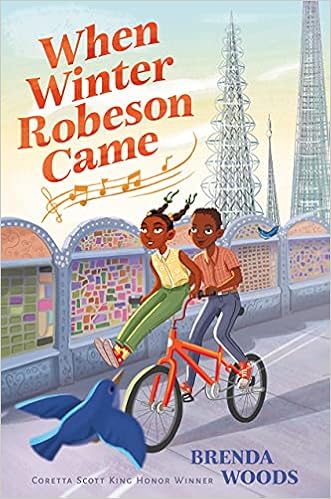
When Winter Robeson Came, by Brenda Woods

During the summer of 1965, Eden gets to hang out with her cousin from Mississippi in Los Angeles where she lives. Winter is on a secret mission to find his father who went missing many years ago. With Eden’s help, they investigate his old neighborhood in the Watts area of LA for clues. In the midst of this, the folks in the Watts neighborhood and the police clash for 6 horrible days and much of Los Angeles goes into lockdown. This verse novel is a sweet story of cousins investigating their own family history while intense history is playing out around them. It’s especially interesting for today’s young readers living in new times of racial clashes with modern day police around the country. As the mystery of Winter’s father unravels, readers come to see that all is not what was assumed. As it is often the case, there is so much more to the story.

Piece by piece: the story of Nisrin’s hijab, by Priya Huq

This graphic novel is a powerful story of friendships, tragedy, inclusion, nationalism, multi-generational trauma, and hope. It packs a lot into its pages and, because of that, it sometimes feels rushed. Some of the most traumatic scenes flash by in harsh, bold colors that might confuse some readers. This is the story of Nisrin’s decision to wear an orna, or scarf, to cover her head, as she explores what it means for her to follow Islam. It is a complicated decision because her family does not follow the practice of an orna or hijab. Her decision also brings up old family wounds from a regime change in Bangladesh and the reason for the family’s immigration to the United States. It’s also a story of changing friendships and the ways we sometimes reconcile conflicts.  Raw and compelling, Piece by Piece would be a graphic novel that might be a mirror for some readers and a window for many others willing to take on a challenging story.

Piece by Piece: The Story of Nisrin's Hijab

Otto: a Palindrama, by Jon Agee

A silly graphic novel adventure told in palindromes, this crazy tale had me reading forwards and backwards! Every piece of text in the book, from dialogue to signs in the background, is written in palindromes (200 of them!)  The plot is a very loose wandering adventure of a boy, Otto, looking for his dog, Pip. I was amazed at the many ways the author conveyed silly palindromes in a logical, if fanciful, manner in the story. Illustrations are boldly & simply drawn and softly colored. Certainly, this is a great book for teaching palindromes. Short episodes of the adventure could be shared with whole classes. It had me wanting to write some of my own or share some of the more clever ones with others. The appeal may not be as broad as some, but it would be a solid purchase for upper elementary or middle school libraries.

Otto: A Palindrama
Otto: a Palindrama, by Jon Agee

Crazy Horse and Custer: Born Enemies, by S.D. Nelson

A double biography about two imperfect men who were born within a year of each other, lived on opposite sides of historical issues, and died within a year of each other. Both are flawed because of the prejudices from which they were raised. Both were leaders for their respective cultures who were both celebrated and reviled at different times in their lives. They had much in common though they despised the other.  I found this book interesting and hard to read because of the biases of each of the historical figures. In that way, I think the author did a splendid job of helping the modern reader see both sides of the westward movement – from the Eurocentric, white point of view to the Native American perspective. I appreciated the map of the region placed in the center of the book and referred to it often. Photographs and sketches were well placed to help the reader visualize the historical events. The book also includes a timeline, an index, and an extensive bibliography of many of the historical details included in the accounts of these men’s lives. It’s an important book to have on library shelves to give youn modern historians perspective on the westward expansion in this country.

Crazy Horse and Custer: Born Enemies

Witch for Hire, by Ted Naifeh

This graphic novel features some dark & difficult subjects including bullying, cyberbullying, and verbal and physical abuse. Naifeh handles it well and I think it will be enjoyed by mature middle school or high school readers. The book seems to be the first in a new series, setting the main character up as a problem-solver of the magical variety for people in need. In this first book, she reigns over the losers table in the lunchroom at school and reluctantly gets involved with halting a cyberbully called “shy_shelbi” who is encouraging & blackmailing for chaos in the guise of helping. Underlying storylines feature families with abuse secrets which give the whole book an edgy feel. I appreciated that even though some problems are solved, the characters realize that there are always consequences and unsolved issues – even with some positive outcomes. Life is not easy. The graphics are colorful and facial expressions are very expressive. Light & dark help handle the mood and the seriousness of some scenes.

Witch For Hire

Kaleidoscope, by Brian Selznick

Like an ever-shifting scene in a kaleidoscope, the stories in this book have fragments in common – characters, themes, settings, objects. Each story starts with a kaleidoscopic image from a full drawing on the next page. Each image is related in some way to each story. Each story could be read separately. Taken together, they’re like a strand of unique beads on a very strange necklace. They go together, but it’s hard to find a common message. I enjoyed reading the stories. They were fantastical and strange and mysterious- each a little gem. I kept feeling like I was missing the bigger point of all of them put together however. The author’s note at the end explains that he had been working on a different project prior to the pandemic and then deconstructed it into these loosely connected stories during the quarantine. This makes sense, but in terms of handing this book to a middle schooler… I’m just not sure it’s going to make much sense. It might be an interesting book for a book group to discuss since the overall book still feels very mysterious & unexplained to me.

Kaleidoscope

Earth’s Aquarium: Discover 15 Real-Life Water Worlds

By Alexander Kaufman; illustrated by Mariana Rodrigues

This oversized book is both beautiful and informative. This book begins with the important aspects of many watery worlds and defines each: salinity, density, light penetration, currents, pressure, waves, water acidity, and tides & oxygen concentration. 15 different water ecosystems are highlighted from all parts of the planet. Within each, 8-10 species are illustrated and discussed, as well as the importance of each unique type of watery ecosystem. Each ecosystem features a two-page spread of the ecosystem “in action” followed by 2 pages of information about specific species. While the reader may never see the fast-moving freshwater of the Amazon River in South America, they can certainly see similar ecosystems near their own homes.  The illustrations are gorgeous and are worthy of time spent just swimming around the pages. This book would be a great addition to a science class involved in water quality testing or any school library where water issues are studied. This is a highly recommended picture book for older audiences since the text is geared toward older students!

Earth's Aquarium: Discover 15 Real-Life Water Worlds

Muddle School

Based on Dave’s own middle school experiences, the main character, Dave, moves to a new middle school and has to start all over trying to establish his “cool-factor”. He is not very successful initially. Eventually, he and a science lab partner build a time machine and he tests it out. The results allow him to learn from his mistakes and get a do-over – sort of. Poignant and real, students will be able to relate to many of Dave’s experiences and will perhaps find ways out of their own struggles. I did find the exaggerated leadership trophy scene a bit over-the-top, but liked the subtle empathy he finds in the parking lot afterwards.  Illustrations are all in calm, neutral blue tones, but the drawings are full of energy and humor. I also liked the occasional page that appears to be doodles on notebook paper. Included at the end is a short author biography that draws comparisons between the fictional Dave and the real one.  Overall, a solid, must-have in a middle school library.

Muddle School
Book Cover

Little Mermaid: (Or, How to Find Love Underwater)

This two-sided book is no Disney version of the Little Mermaid. On one side of the book the reader will find the 1930s translation of the original Hans Christian Anderson story. (Spoiler: a very different sort of “happily ever after” ending in the original!) The flip side of the book is a blackout poem of the original story that modifies the ending to one of female empowerment. The pages are lovely with simple designs in addition to the blacked out parts. The poem reads like poetry magnets on the page. The complete poem is also included outside of the blacked out pages.  If a teacher were teaching blackout poetry, this would be a perfect book to demonstrate how it can be done – beyond just crossing out the parts one didn’t want. In the author’s note, she speaks of finding our own story in another – of creating a new version that speaks your truth. I thought this was a lovely little book. It was interesting to read the original version and delightful to see the “hidden” story beneath the surface. 

Front cover of the book
Little Mermaid Black-out poetry page.

The Many Meanings of Meilan, by Andrea Wang

This is a lovely gem of a middle grades story about Meilan, a Chinese-American girl living in Boston who then moves with her family to a small town in Ohio. It is woven through with Chinese legends and language since she and her family have kept their heritage alive and she is bilingual. Moving is hard, always, but especially so when she is thrust into a town that is very White and very small town – a switch from living in Chinatown in a big city. The family is still coping with the loss of the family matriarch, her grandma, and now must cope with new jobs, an increasing need to use English, new people at school, lack of access to the familiar foods they used to buy in Chinatown… so many changes. One of the worst for Meilan is that her new school wants to call her Melanie, and she feels like she’s losing her identity. The book weaves Chinese myth and and family legend into the realistic narrative in a meaningful way. I loved the explanation of Meilan learning to write in Mandarin/Pinyin and the multiple meanings & characters for similar sounding words, as well as including idiomatic expressions in both English and Chinese. Students who enjoyed Front Desk by Kelly Yang will love this book, as will anyone who can empathize with the struggles of being different in a new place. I highly recommend this book.