About Kim Matthews

Teacher-librarian at Komachin Middle School in Lacey, WA

Kaleidoscope, by Brian Selznick

Like an ever-shifting scene in a kaleidoscope, the stories in this book have fragments in common – characters, themes, settings, objects. Each story starts with a kaleidoscopic image from a full drawing on the next page. Each image is related in some way to each story. Each story could be read separately. Taken together, they’re like a strand of unique beads on a very strange necklace. They go together, but it’s hard to find a common message. I enjoyed reading the stories. They were fantastical and strange and mysterious- each a little gem. I kept feeling like I was missing the bigger point of all of them put together however. The author’s note at the end explains that he had been working on a different project prior to the pandemic and then deconstructed it into these loosely connected stories during the quarantine. This makes sense, but in terms of handing this book to a middle schooler… I’m just not sure it’s going to make much sense. It might be an interesting book for a book group to discuss since the overall book still feels very mysterious & unexplained to me.

Kaleidoscope

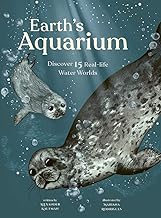
Earth’s Aquarium: Discover 15 Real-Life Water Worlds

By Alexander Kaufman; illustrated by Mariana Rodrigues

This oversized book is both beautiful and informative. This book begins with the important aspects of many watery worlds and defines each: salinity, density, light penetration, currents, pressure, waves, water acidity, and tides & oxygen concentration. 15 different water ecosystems are highlighted from all parts of the planet. Within each, 8-10 species are illustrated and discussed, as well as the importance of each unique type of watery ecosystem. Each ecosystem features a two-page spread of the ecosystem “in action” followed by 2 pages of information about specific species. While the reader may never see the fast-moving freshwater of the Amazon River in South America, they can certainly see similar ecosystems near their own homes.  The illustrations are gorgeous and are worthy of time spent just swimming around the pages. This book would be a great addition to a science class involved in water quality testing or any school library where water issues are studied. This is a highly recommended picture book for older audiences since the text is geared toward older students!

Earth's Aquarium: Discover 15 Real-Life Water Worlds

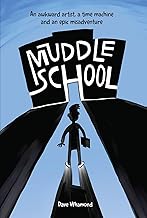
Muddle School

Based on Dave’s own middle school experiences, the main character, Dave, moves to a new middle school and has to start all over trying to establish his “cool-factor”. He is not very successful initially. Eventually, he and a science lab partner build a time machine and he tests it out. The results allow him to learn from his mistakes and get a do-over – sort of. Poignant and real, students will be able to relate to many of Dave’s experiences and will perhaps find ways out of their own struggles. I did find the exaggerated leadership trophy scene a bit over-the-top, but liked the subtle empathy he finds in the parking lot afterwards.  Illustrations are all in calm, neutral blue tones, but the drawings are full of energy and humor. I also liked the occasional page that appears to be doodles on notebook paper. Included at the end is a short author biography that draws comparisons between the fictional Dave and the real one.  Overall, a solid, must-have in a middle school library.

Muddle School
Book Cover

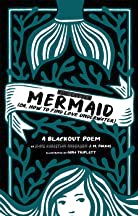
Little Mermaid: (Or, How to Find Love Underwater)

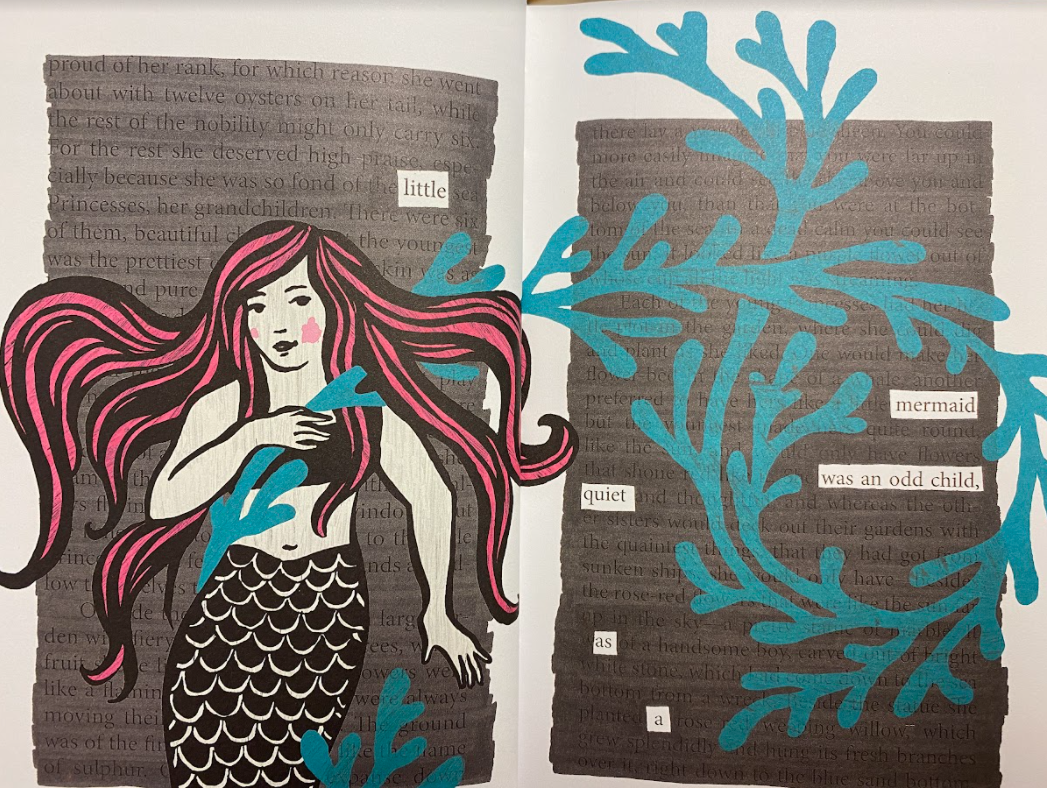
This two-sided book is no Disney version of the Little Mermaid. On one side of the book the reader will find the 1930s translation of the original Hans Christian Anderson story. (Spoiler: a very different sort of “happily ever after” ending in the original!) The flip side of the book is a blackout poem of the original story that modifies the ending to one of female empowerment. The pages are lovely with simple designs in addition to the blacked out parts. The poem reads like poetry magnets on the page. The complete poem is also included outside of the blacked out pages.  If a teacher were teaching blackout poetry, this would be a perfect book to demonstrate how it can be done – beyond just crossing out the parts one didn’t want. In the author’s note, she speaks of finding our own story in another – of creating a new version that speaks your truth. I thought this was a lovely little book. It was interesting to read the original version and delightful to see the “hidden” story beneath the surface. 

Front cover of the book
Little Mermaid Black-out poetry page.

The Many Meanings of Meilan, by Andrea Wang

This is a lovely gem of a middle grades story about Meilan, a Chinese-American girl living in Boston who then moves with her family to a small town in Ohio. It is woven through with Chinese legends and language since she and her family have kept their heritage alive and she is bilingual. Moving is hard, always, but especially so when she is thrust into a town that is very White and very small town – a switch from living in Chinatown in a big city. The family is still coping with the loss of the family matriarch, her grandma, and now must cope with new jobs, an increasing need to use English, new people at school, lack of access to the familiar foods they used to buy in Chinatown… so many changes. One of the worst for Meilan is that her new school wants to call her Melanie, and she feels like she’s losing her identity. The book weaves Chinese myth and and family legend into the realistic narrative in a meaningful way. I loved the explanation of Meilan learning to write in Mandarin/Pinyin and the multiple meanings & characters for similar sounding words, as well as including idiomatic expressions in both English and Chinese. Students who enjoyed Front Desk by Kelly Yang will love this book, as will anyone who can empathize with the struggles of being different in a new place. I highly recommend this book.

Last Gate of the Emperor, by Kwame Mbalia & Prince Joel Makonnen

I was prepared to really like this book. I enjoyed Mbalia’s Tristan Strong books and assumed I would also like this one. While I grew to like it more than the beginning, it was not my favorite read. The story is about young Yared competing in a virtual/real world competition to locate an obelisk that turns into a desperate battle with a  warring alien race. I struggled at the beginning of the book with the skimpy world-building needed to understand the setting of the story. Many invented words are thrown at the reader so quickly that it’s hard to get a sense of the story. Once I got far enough into the action-packed plot, the story picked up & moved through many action scenes with thrills & plot twists. While I enjoyed the action, I wonder how many readers will stick with it long enough to get there. The afterword was interesting when it was revealed that this sci-fi world and battle are actually based on real Ethiopian history.

Call and Response: The Story of Black Lives Matter, by Veronica Chambers

This non-fiction book puts the recent events of history concerning the Black Lives Matter movement in the larger context by showing it as a continuing part of the Civil Rights movement of the 1950s and 60s. The author approaches the subject from many angles. She shows how #BlackLivesMatter took off & became a huge rallying cry reaching its peak in June of 2020. She shares the stories of many lives cut short by police violence, but also tells us about the people who fought back by marching, speaking out, and getting involved at the local level. The story looks at social media and its influence on the current movement – as well as how it was different during the Civil Rights movement. There is a section with the art and music that came out of the protests. It looks at politics and the small things people have done and can do to continue moving forward to a more just society. Even having lived through the recent events, I found it helpful to have it all condensed and shared in such a comprehensive way. I liked the comparisons and contrasts to the earlier movement for social justice. It is definitely approachable for middle and high school students with a nice balance of images, captions, and text. The timeline section was a clear way to review historic and recent events. The book also includes suggestions for further reading, a bibliography, and an index. This would be an excellent addition to secondary libraries.

Long Distance, by Whitney Gardner

Long distance friendships are always a challenge. When Vega moves away from her best friend in Portland, Oregon to face new challenges in Seattle, Washington her fathers try to ease the transition with a bit of time at a summer camp with the purpose of helping people find new friends. Camp life is awkward at times and mysterious at others. Not all appears to be what it claims to be at this unusual camp.  I found this to be a fun, surprising graphic novel. I like the author’s use of clues to some of the mysteries embedded in the illustrations. The reader really needs to pay attention to the images, not just the text in order to uncover what is REALLY going on at this odd summer camp. Eyes play an important role in hinting at secrets the characters are hiding. The artwork is crisp & bright. Students who like Raina Telgemeier’s style will enjoy this. The plot twists from a fairly standard realistic fiction story to one with sci-fi elements by the end. Even though parts of the book are fantastic & unrealistic, the larger message of the challenges of finding new friends will resonate with middle and high school readers.

The Dire Days of Willowweep Manor, by Shaenon K. Garrity & Christopher Baldwin

This story is a graphic novel twist on the gothic novel that mixes in a bit of science fiction with lots of adventure. It delivers a great deal of farcical fun and zany adventure. Our intrepid gothic novel-loving heroine falls out of our world and into another when she tries to save a handsome stranger in the river. She ends up at Willowweep Manor which appears, on the surface, to be right out of her favorite novels. Much more is going on beneath the surface as she soon discovers. She must help not only their world survive, but her own as well. This story is full of surprising twists, over-the-top humor, exaggerated eyes and hand motions, and lots of action. I enjoyed the bold colors of the artwork. During moments in the story where time/place distortion is happening, an interesting layered, blurring effect is used to help the reader understand that something odd is taking place. The book feels finished at the end, but also leaves itself open to a sequel. This sometimes irritates me as a reader, but because I was intrigued by all the various characters, I’m also excited to see what might happen next for Haley as she pushes through the boundaries of other genres. Because it is a more complex storyline, this is a graphic novel for middle and high school readers looking for more depth from a plot. I’m looking forward to sharing it with my students. 

Linked, by Gordon Korman

Gordon Korman’s latest book is another one I can’t wait to make available for middle school readers. The story blends the past, present and hope for the future of a small Colorado town as it struggles with its racist past, swastikas appearing in the middle school, and a group of middle school students trying to change the message for their town for the future. After having tolerance education following the appearance of the first swastika and watching in dismay as the swastikas keep showing up, the students hatch a plan similar to the famous paperclip project to make a paper chain of six million links to represent the 6 million Jewish lives lost in the Holocaust. Whether or not they can complete the massive chain and where to store it are just part of the problems the students encounter. The story is told in multiple voices of students around town which helps the reader see the issue from many lenses. Korman’s masterful hand creates a story that is both funny and heartrending at the same time. He has a true understanding of what makes middle school kids tick and his characters are layered and believable. I also liked that he threw in a bit about how social media can complicate, and perhaps help, a problem once the scope of an issue is no longer just local but spread to the whole world.  It is a story of facing our past -even the one we may not be very proud of – and using the present to help heal, forgive, and move forward into a better future.