National Intelliegence

“Freedom from fear is a basic human right… Intelligence agents play a key role in securing this freedom for all Americans.”  (p.7) Before reading this five chapter book with a skeletal* amount of information I didn’t know much , if anything, about the United States national intelligence system. It is so full of secrets, the general public only knows of its failures.

There are 16 separate agencies, with 200,000 employees spending $75 million / yr. on intelligence each year. Few of these employees are spies.

There are 5 steps in the Intelligence Cycle: 1) planning, 2) collecting information, 3 & 4) processing and analyzing , 5) delivery of intelligence to President.  “The IC [Intelligence Cycle] relies on analysts to make sense of the information it gathers.” ( p. 36)  Not all the information gathered makes it past the processing and analyzing due to its  inaccuracy, being incomplete, or being outdated.

Chapter 5 discusses the controversies associated with some of the methods used in collecting intelligence, such as – waterboarding.

Includes: Map of Events – What Happened Where?, The Story Continues – New Threats, Influential Individuals, Timeline, Living History*, Glossary, and Index.

more information at www.factsfornow.scholastic.com   keywords National Intelligence
You Wouldn’t Want to Work on the Hoover Dam! An Explosive Job You’d Rather Not Do

The Great Depression of the 1930s is underway when Herbert Hoover’s dream to build a hydroelectric dam on the Colorado River is finally realized. Out of work men from California, Nevada, and Texas are a major part of the 21,000 workers employed for the dam’s construction. They arrive to find NO town, desert heat, and NO water supply.

The unnamed main character is one of the many employed unskilled workers. His facial expressions amplify and personalize the hardships of: dysentery, muddy drinking water, ditch latrines,  living in a tent city in desert heat and freezing cold, and the dangers from blasting rock.

Amidst the graphics of the construction work there is an easily understandable diagram of how the water gets to the turbines to generate the power.

Robots

Author Maggie Rosier provides insight into the skill of drawing 8 different robots illustrated by Steve Porter.

The beginner should start by drawing from a picture before drawing from their imagination. Basic supplies include drawing pencils with both soft (B) and hard (H) lead, in addition to colored pencils, paper, eraser, and black ink pen.

Drawing each robot is broken down into 5 steps beginning with the rudimentary basic key shapes, secondary shapes / appendages,  robot specific appendages/ gadgets,  fine detail, and finally shading and coloring.

Each robot is introduced with a mini-bio description of its different skills, abilities, attributes, and how body follows function.

Along the way, insets provide tips: go from light to dark, highlights, break it down to basic shapes, and test color combinations before coloring actual drawing.

Includes: glossary, index, and www.factsurfer.com.

My Favourite Fairy Tales

These fairy tales are not too long, not too short, they’re just right! Seven fairy tales are retold and illustrated by London born and Liverpool School of Art trained Tony Ross. Ross’ pencil and paint strokes are simple, if not crude, yet the movement and emotions are well defined!

Of Ross’  seven favourite  fairy tales, I was only familiar* with three of them: The Hedley Kow, The Musicians of Bremen*, Sweet Porridge, Rumpelstiltskin*, Prince Hyacinth and the Dear Little Princess, Fairy Gifts, and Beauty and the Beast*. The stories’ length averages 10-14 pages long with the ratio of picture to text often 1:1 or greater.

I particularly enjoyed the characters not retelling their story numerous times by the narrative stating “the girl explained”.

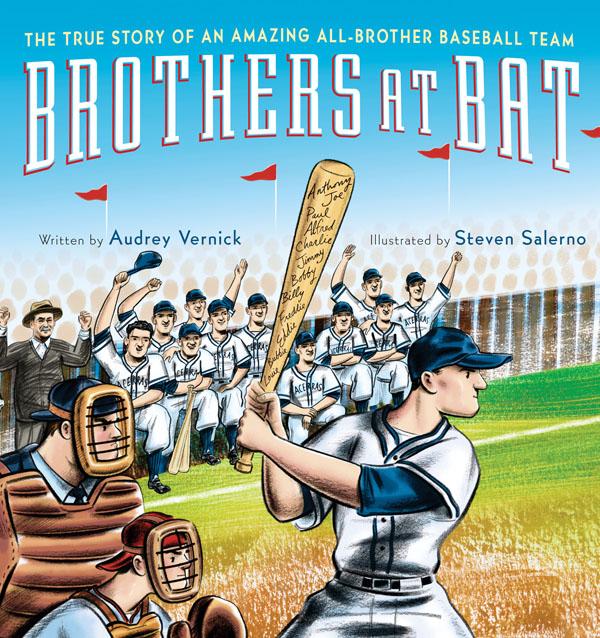
Brothers at bat: the true story of an amazing all-brother baseball team

Summary:  Here’s a story that seems almost impossible to believe, but yet it is a true story about an American family.  The Acerra family had 16 children.  Twelve were boys, just enough to field a baseball team!  This was the 1930s, and times were tough, but they stuck together as a family.   They had one passion: baseball!  It brought them a lot of joy and a lot of fun! And they were really good players!  In 1938, the brothers ranged in age from seven to thirty-two.  The oldest nine brothers formed a semi-pro team!  They played around on the East Coast and the always drew a crowd!   In the 1940s six of the brothers went to war, but they all came back and played in a baseball league another six years.  They played their last game in 1952.


What I liked about it: It’s a positive story about a family working together.  Salerno’s illustrations have a retro feel from the period from the 40s and 50s that match the time period perfectly.   Author and Illustrator add historical detail on the last page.


Who would like it:  The picture book format would suggest a younger audience:  K-3rd grade, but anyone would enjoy this all-American story.  Highly recommended.

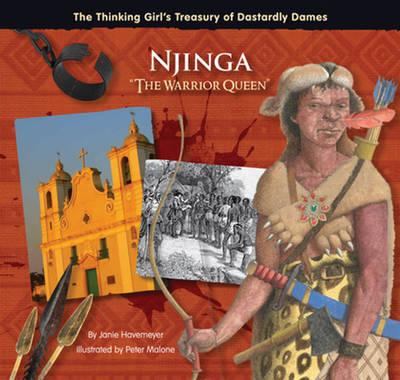
Njinga: The Warrior Queen. (The Thinking Girl’s Treasury of Dastardly Dames)

Summary:  As part of the series, “The Thinking Girl’s Treasury of Dastardly Dames,” Njinga, the Warrior Queen tells the story of a young girl growing up in West Africa.  Njinga was born into a royal African family in 1583.  When she was born, the soothsayers predicted she would not be an easy person.  Njinga was a clever girl and her father noticed and taught her how to be a ruler. After her father died, Njinga’s loyalty was always to her people.  She strived for sovereignty against other raiding tribes, the encroaching Portuguese and the slave trade.  To do this she had to be ruthless.  How dastardly was she?  Read on.


What I liked about it:  Drawings and paintings interspersed through the text make this period come alive.   The details of Njinga’s life add interest to the story, such as what she ate or wore.  (For example, she would dress like a man when she went into battle.)   .  Author Janie Havemeyer is a former elementary teacher and museum educator.  Illustrator Peter Malone has illustrated the entire series about “Dastardly dames.”

(Includes a bibliography for further reading.)

Who I would recommend it to: Recommend this series to girls in grade 4-8.   Recommended for schools and public libraries.

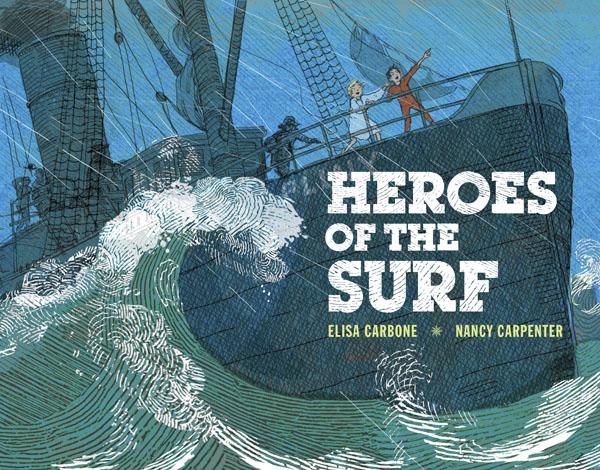
Heroes of the surf: A rescue story based on true events

Summary:   Two boys playing “pirate” on a steamship off the coast of New Jersey in 1882 find themselves in real danger when their ship runs aground.   Hope is almost lost when waves are too high to lower the life boats.  Someone spots something on the horizon.  Is it pirates?   No, there are rescuers in the surf!   Local people have prepared for ships running aground and are on their way to help!

What I liked about it: Introduces the history of the Coast Guard through a fictionalized story, but based on a actual event.   Illustrator Nancy Carpenter’s drawings vividly capture life on a steamship and the movement of the waves.

Who I would recommend it to: Grade 2-4.  This would be a great classroom read-aloud.

Claude Debussy: (First discovery – music)

Summary:  In an attractive “picture book” format, author Pierre Babin tells the story of musician Claude Debussy.  Claude was born in 1862 near Paris.  His early life wasn’t easy.  His parents owned a shop, but were not very good at business and they moved a lot.  Then Claude’s father is sent to prison for taking part in the revolution.  His mother sends him to live with his Godmother in Cannes.   Claude sees the ocean for the first time and wants to become a sailor.   But something else also interests him at his Godmother’s house – a piano. Claude is captivated by sound.  His Godmother decides to give him piano lessons.  When Claude returns to Paris he continues lessons with Madame Maute, who learned from the great Chopin.   By age 10 he has won a place at the Paris Conservatoire.  As a piano student, Claude is rebellious and fights with his teachers.  In spite of this, he goes on to win prizes and to compose many great compositions, including the beautiful “Claire de Lune.”

What I like about it:  This is an excellent addition to the “First Discovery –Music series”, that includes biographies of Mozart, Chopin, Beethoven and others.  The information is beautifully presented interspersed with vintage photos and illustrations by Charlotte Voake (Ginger).  The volume includes a CD with examples of Debussy’s compositions interspersed with narration by Michael Cantwell.

Who I would recommend it to:  Music teachers, student musicians age seven and up.   Highly Recommended.

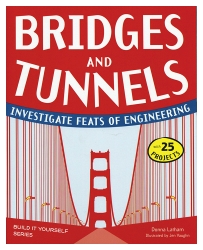
Bridges and Tunnels: Investigate Feats of engineering with 25 projects (Build it yourself series)

Summary:  Bridges and Tunnels: Investigate feats of Engineering with 25 projects by Donna Latham, is the latest edition of the excellent (Build it yourself series), which includes such titles as Backyard Biology: Investigate habitats outside your door with 25 projects and Robotics: discover the science and technology of the future with 20 projects by Kathy Ceceri.  “Bridges and Tunnels” explains in simple terms the social, scientific, natural and artistic forces behind the creation of bridges and tunnels.  Words that may be unfamiliar to young readers are highlighted and defined in boxes on the page they are discussed.  Several chapters cover the science (physics) of building bridges and tunnels and several cover well-known bridge and tunnel disasters and why they happened.   Each chapter offers clear instructions for experiments to demonstrate principles discussed in the chapter and instructions for a “build it yourself” project.  The volume is completed with a glossary, index and list of resources.  The author, Donna Latham has great credentials.  She is an award-winning author and playwright and the author of Amazing Biome Projects You Can Build Yourself, Deciduous Forests, Deserts, Garbage, Norah Jones, Oceans, Respiration and Photosynthesis, and Tundra.  She is also a librarian at the Schulz Graphic Novel Library, a muralist at Dartmouth College, and a staff writer for the comics journalism website The Beat (www.comicsbeat.com).

What I like about it:   Purchase this for the simple, explanatory writing style and the many project ideas it offers your students.  It was written for 4th through 6th grade students, but would work well in a middle school library.   As a basic text for understanding the physics and engineering behind building structures, this is an excellent introduction.  I loved the “build it yourself “ activities which extend the science in the book.  Students can enjoy building “Newton’s Rocket mobile,” or a “Craft stick beam bridge.”

Who I recommend it for:   Public libraries, school libraries, students in upper elementary and lower middle school, science teachers, science clubs for youth, boy scouts and girl scouts.   Excellent!


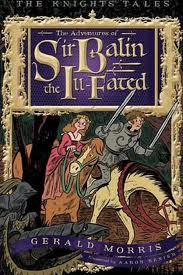
The Adventures of Sir Balin the Ill-Fated

Summary:  The night Balin is born in Norththumberland, the old woman of the mountain arrives and predicts greatness for the newborn!  “But wait,” the old woman exclaims!  “There’s a cloud over this!” “His greatness will bring calamity to all his companions and he will strike the dolorous stroke!” Thus begins the life and knighthood of Sir Balin, the ill-fated, alternately trying to avoid and fulfill his fate.

What I like about it:   This is another installment in “The Knights’ Tales,” a fun series for reluctant readers.  Readers will enjoy the twists and turns in the story, the wordplay, and humor, matched with clever illustrations by Aaron Renier. Gerald Morris is clever writer, who will win many fans with this series.

Who I would recommend it to:  Hook reluctant readers to this series in grades 3 to 5.  Recommended for school and public libraries!