
Glamourpuss lives with the “gazillionaire” Mr. and Mrs. Highhorsen. She has the best money can buy and is spoiled beyond belief. She doesn’t go downstairs, she descends. She doesn’t lie down, she reclines. She even changed the ordinary “me-ow” to just ME! One day, Mrs. Highhorsen’s sister, Eugenia, comes for an extended visit – with Bluebelle, a tacky Chihuahua. Glamourpuss is horrified. Bluebelle is taking all the attention. When the Highhorsen’s and Eugenia left for a while, Glamourpuss discovers Bluebelle has destroyed all her costumes. It was then Glamourpuss realizes Bluebelle just wanted to be more sophisticated like Glamourpuss. With a few helpful instructions, Bluebelle becomes not only more stylish, but a good friend. The ink and watercolor illustrations are humorous and depict the classy owners from the neck down – the perspective of a small pet. This would be a fun book to use when discussing adjectives.
Author Archives: SSBRC Former Member
Crystals
This book on crystals gives the reader more information than many introductory books. Starting with how crystals are formed from minerals, this potentially complex subject is presented in a very readable format. A variety of crystals are mentioned. One learns how crystal shapes are formed by their facets, how crystals grow, where they can be found in nature, and how people use them. The reader is encouraged to view websites, critique short articles, do experiments, reflect on what they know about crystals and defend their opinions. Glossary, index, bibliography, and websites are included. This book goes a step further than most resources by providing opportunities for the reader to contemplate, analyze, and/or appraise given information.
Peanut Butter and Brains : A Zombie Culinary Tale
Reginald is not your run-of the-mill zombie. Instead of brains to eat, he wants peanut butter and jelly sandwiches. As hard as he tries to get one, humans run or refuse to deal with him. As fellow zombies lurch through town in search of brains, Reginald tries to persuade them to try the enticing peanut butter and jelly sandwiches. One day he notices Abigail Zink, in a crowd of townspeople, holding a lunch sack containing the long sought-for sandwich. As he shuffles toward her, the other zombies enclose looking for brains. Reginald grabs the sack and tosses Abigail’s lunch into the gathering of zombies. As they devour the sandwich, they discover how delicious they are! The townspeople realize the zombies are just hungry. In no time, zombies are working for humans, being paid with PB&Js. Reginald, however, continues to be unlike the other zombies. He has discovered a new food – pizza! A fun zombie story with a twist for young readers.
Fish
Julie Murray has written another nonfiction book for young children. Beginning readers learn about having fish for pets. The photos are full-paged and colorful. The vocabulary is appropriate and the text is large. A variety of fish are shown although none are named. A simple glossary and index are included. The ABDO website offers further information and activities.
Horses
In this beginning reader’s nonfiction book, young children see photos of a variety of horses. Very basic information is provided. Photographs are full-paged and colorful. Although names of the different breeds are not included, the common features are described and shown. Glossary, index, and an ABDO website with additional information, videos, and activities are included.
Grizzly Bears : Huge Hibernating Mammals
Although this book is mainly about grizzly bears, other mammals are compared to them. The grizzly’s features are compared to the wolverine and the three-banded armadillo. Wild boars are also omnivorous and will dig to find roots and insects. Like bears, the skunk will hibernate during cold months. The American bison is large like the grizzly, inhabit similar places, yet remain active during the winter months. Both the grizzly and jaguars are solitary animals and share similar life cycles. The title is rather misleading. When selecting this book, one expects to learn about the grizzly bear. However, the focus is comparing the traits with a variety of other animals. While one learns a great deal, it is difficult to put it all together. A trait chart on page 30 finally clarifies the reasons each of the animals can be compared to the grizzly. Also included are a glossary, bibliography, websites, and an index.
Sidney & Sydney: Book 1 Third Grade Mix-Up
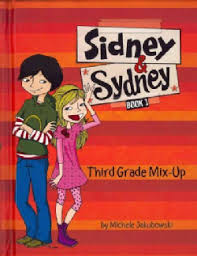 The start of a new school year and the start of third grade. What could induce more uncertainty and nervousness? How about stepping into the classroom on the first day and seeing that your teacher spelled your name wrong. Should you speak up? Perhaps it’s better to just sit down and not make a fuss about it. After all the teacher, Mr. Luther, is known to be grumpy.
Ah, the trials of third grade! Sydney (spelled with a “y”) meets her gender counterpart (Sidney with an “i”) on that first day. They soon find out they have a lot more in common than just a same first name. This is a story of friendship that elementary students will like to read about. The dialog is very realistic and the characters are well written and believable. The story line is engaging without being trite or overly predictable. Jakubowski seems to accurately understands her audience.
The story is heavily illustrated, in full color, by Luisa Montalto. Most of the illustrations are full page, centering on the characters with little to no background distractions. The opening pages give an illustrated bio of the characters and the end pages give further info and insight into the characters. I can envision many of my students trying to copy Montalto’s clean style and creating a Sydney or Sidney of their own.
Visit Capstone to have students read bios on Sydney and Sidney and there respective friends. Also there are two downloads: “How funny are you?” and “Are you a good friend?” Both of these quizzes are the type with no definitive right or wrong answers. They are the type that sum up your answers with “If you have mostly “A” answers you are….
Peanut and Fifi have A Ball
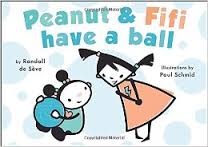 See what happens when two siblings only have one ball. The older girl, Fifi, tries desperately to get Peanut to share her new ball. But it is a new ball and Peanut isn’t ready to share it just yet. Fifi goes to great lengths to get her little sister to share but eventually gives up when she finds something even more entertaining.
Delightfully illustrated, by Paul Schmid, with muted tones of pastel red, blue and purple with a lot of white space. The pictures will engage children. The story will provide a nice springboard to the value and rewards of sharing. The open ending also provides a great story starter for students and highlights the double meaning of the title.
Chipmunks
A beautifully photographed non-fiction book intended for a very young audience, Chipmunks introduces children to their first easy-to-read science text and gently tells about the North American rodent. Habitat, age span, food, and raising of young are all included with accompanying photos. Young children will delight in the photos of these cute little animals, and a caution has been given to never try to pet or feed one.
Night Light
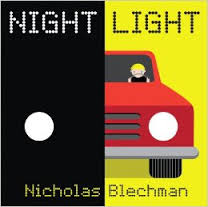
Bold colors and crisp graphics make this book a stand out. It opens with the line, “one light shining bright?” written on the left page. Over on the right page the reader sees what appears to be one ball of light. As the reader turns the page, the one bright light reveals as a train headlight.

“7 lights flashing red and white?” reveals to be lights on a fire truck. 
This interactive book is fun and visually appealing. Each page illustrates ascending numbers starting at one going through ten. At the end, where even the end pages are used for the story, the reader finds himself back at one.