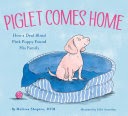
Piglet Comes Home :How a Deaf Blind Pink Puppy Found His Family

Based on the true life experiences of a blind deaf puppy (Piglet) rescued into a loving forever home of six dogs, turned seven dogs. The story is told from the point-of-view of the dogs. Each of the seven dogs had a key role in the dynamics of this loving family, and Piglet was no exception!

Make sure you read “The Story Behind the Story” at the end.

Written for Annette McQueen by M.K.P.

Anne and Her Tower of Giraffes: The Adventurous Life of the First Giraffologist

Before there was Jane Goodall, there was little Anne Innis who wanted more than anything to know everything there was to know about giraffes. Anne visited the Chicago’s Brookfield Zoo when she was four years old. It took Anne until she was in college to make her dream come true to learn all about giraffe. Anne was met with opposition all along the way. This was the 1950s — “A woman traveling the world on her own? A woman studying animals in the wild? Unheard of!” But Anne persevered and studied giraffe in South Africa. After her study, being a woman kept her from being hired as a university professor, so Anne turned to being a writer. “Eventually, Anne’s adventures caught the attention of someone who turned Anne’s story into…a movie!”

It was a long hard road but Anne Innis Dagg’s perseverance won out in the end to the world’s betterment.

Written for Annette McQueen by M.K.P.

Hiders Seekers Finders Keepers: How Animals Adapt in Winter

Three different ways in which different animals in the wild to make it through the winter are named and given very brief descriptions. The illustrations provide added details.

There are the animals which hide: snakes, snails, bumblebee queens, chipmunks, wood frogs and more.

There are the animals which seek warmer or different areas: Canada geese, elk, pronghorn antelope, Ruby-throated hummingbirds, green darner dragonflies and others.

There are the animals which find a way to stay throughout the winter: white-tailed deer, red foxes, mice, gray jays and more.

The Author’s Note includes definitions for diapause and brumation, as there is no glossary.

(M.K.P.)

When the Sky Glows

Ten celestial phenomenon which often emanate ooohs and aaaahs from viewers are presented and explained in the gorgeous vibrantly illustrated book. The phenomenon include: sunrise, sunset, lightning, rainbows, solar eclipse, volcanoes, fireflies, meteors, auroras, and the moon.

(M.K.P.)

Little Red and the Big Bad Editor

The Big Bad Wolf Editor actually saves Little Red from being eaten fives times in this retelling of Little Red Riding Hood. Who could have guessed the wolf, turned editor, cared more about the rules of good composition than in eating his prey? When Red runs into the Wolf on her way to Grandma’s house with her basket of goodies, topped off with a thank-you note, the editor in the wolf wins over time and time again. Wolf is compelled to correct Red’s composition mistakes: no finger spaces between words, no capital letter at the beginning of each sentence, and no greeting salutation or signature at the end of the note.

Combine that with the ‘cool as a cucumber’ similes, onomatopoeia, and colorful verbs the wolf with his pencil behind his ear are doomed to not enjoy a human meal today. Who would have guessed the IMPORTANCE of a great thank-you note!

Little Red and the Big Bad Wolf Editor

I AM NOT A TIN CAN!

When is a robot more than a robot and become more of a person? A little boy and Number 808 banter back and forth along the lines of what it takes to be more than a ‘tin can’ / robot. Number 808 can play music, do strange things with his arms, and do math. But Number 808 does not have a brain or a heart points out the little boy. The little boy is won over to Number 808’s point-of-view in the end.

Geraldine Pu and Her Lucky Pencil, Too!

So glad this is part of a series! Geraldine Pu is a cute rambunctious little Asian American girl with a story to tell. This time her story evolves around writing a story about her family for part of an assignment at school. She discovers her everyday family members have a history she does not know about neatly stored in boxes and scrapbooks down in their basement dealing with the family’s immigration from Taiwan.

Geraldine gives helpful instructions on to how to read a graphic novel ( from box to box), for first time graphic novel readers, Then at the end of the book, Geraldine gives readers helpful instructions on “HOW TO MAKE A SCRAPBOOK” like the ones she discovered in her family’s basement.

The Goody

The Goody, written and illustrated by Lauren Child, is an important book about both good and bad behavior being a little mixed up.  It’s a lovely story of siblings, one who always does what he is told (the goody) and the other who does whatever she likes regardless of ramifications to herself or others. Children in K-2 will appreciate this story as they can relate to not always being able to be good, and most importantly, having that uncomfortable-tummy feeling when one misbehaves. The book is a subtle laugh-out-loud using a narrator to emphasize an overall message that states “being nice when you can be nice can make you feel good”. Child’s use of the double negative, such as “he never forgot to remember this,” and “the least favorite of all his least favorite vegetables,” produces a nice rhetorical effect that young readers are sure to enjoy. The writing is quirky and humorous, creating a need to read and read again. The illustrations are composed of delightful paper cuts complete with patterns that look like fabric and create an interesting texture. The sweet life-lessons pointed out by the narrator and shown in red print are sure to capture the students’ attention and help them realize that when we are nice or when we share with others, it actually makes us feel better.

That’s Betty! The Story of Betty White

That’s Betty! The Story of Betty White by Gregory Borsignore is a quick and fascinating tale about Betty White’s remarkable 80-year career. The story begins with a student confidently wearing his Betty White t-shirt stating he will research her for his biography assignment about a trailblazing woman. One of his dads is supportive, but the other is not so sure, asking if maybe his son should pick somebody more traditional. But all along the reader knows a mysterious character appears on the pages with a big hat, dark glasses, pearls and a scarf who looks an awful lot like Betty White. It’s no surprise that the character is Betty herself and in true Betty fashion she is ready to tell her story with a confident flair. Together the two review all of Betty’s great accomplishments as the young boy discovers she co-hosted a live TV show in 1949 that ran for 51/2 hours a day and 6 days a week! Betty also wrote and produced her own show, The Betty White Show in 1954 when very few women were involved in TV. At this time, she casted talented Black singers and dancers and stood up to prejudice push back from the television studio. Betty simply  said  “live with it” and then gave performers such as Arthur Duncan twice as much air time as before and the audiences loved it! The illustrations are fun and colorful, taking readers on an extra special adventure in show business. The book ends with a timeline of Betty’s life, including a list of all her awards, honors and other extraordinary details about a woman with the courage to lead her life in a nontraditional way.

King of Ragtime, The Story of Scott Joplin

by Stephen Costanza, illustrated by Stephan Costanza

Oversized, rich warm illustrations, chronicling the life of Ragtime musical composer and artist, Scott Joplin. Born in 1868 or 69 in north Texas, to a father who was a slave, Scott was able to tag along with his mother who cleaned wealthy white people’s homes and practice the piano while mother traded for cleaning. He had a natural talent and no one could deny it.

As he become older and more skilled, he began to compose music, riffing from tunes already written and “jazzing” them up. He played at church socials, dances, and the annual Juneteenth celebrations. From there, he went to honkey tonks and ultimately the 1893 World’s Fair in Chicago. Because he was black, he was not allowed to play at the fair, but instead played in the surrounding cafes. Later he worked as a piano teacher and put himself through the George R. Smith College for Negroes. He famously wrote the OOM-pah with syncopated rhythms and called it, “Maple Leaf Rag.” He convinced John Stark to publish it, event though he was an unknown African American composer. It become famous! Just as he did.

The back pages of this book contain rich information about the story of his life in the form of an author’s note. Also Recommended Listening and a Bibliography.