The Thing About Leftovers

The cover of the book doesn’t begin to describe the story within. Following a middle school girl that has her own problems to deal with, it’s a story with depth hiding underneath the camouflage of a bright appearance. The Thing About Leftovers by C.C. Payne followed Fizzy Russo, a girl with dreams of winning the Southern Living Cook-off. However, recent turmoil in her own family has her feeling like a leftover. Now she lives with her mom and attends a new school. There, she finds new friends in Miyoko and Zach, and along the way learns that sometimes things change, but it can be for the better. I enjoyed the realism and emotion in the story. It was very personal with how Fizzy felt about these events that were happening in her life, and I was swept up in the story immediately. My only frustrations were that it didn’t last longer! I would’ve enjoyed a much more closed resolution, but an open ending is always open to imagination. The conflict and setting were very relatable from a middle school standpoint. Divorce and moving are both very real events that can happen and affect students, especially in the middle school years. Overall, the pace of the story was great and I was left satisfied when I put the book down. Personally, I would recommend this book to anyone who is passionate about a hobby or sport. Fizzy’s pursuit of her dreams are relatable to anyone who aspires to do the same, and her nonstop work can be an inspiration to those with their own ambitions. It was an entertaining read.

-Review by B.W.
Yours Truly

Truly Lovejoy is back in this second installment of the Pumpkin Falls Mystery series. Readers do not need to have read book one, Absolutely Truly, in order to follow the storyline of this book.  The author references elements of book one, but provides context so book one details do not detract from this story. In the second book, Truly learns about her namesake and the history of the house she now calls home in Pumpkin Falls, New Hampshire. As the story develops, there are multiple mysteries that interconnect to reveal the rich history of the area and the founders of the town. Truly and her friends call themselves the Pumpkin Falls Private Eyes, and they work together to crack a maple syrup crime and settle a town feud. Along the way, Truly also investigates her family’s history, uncovering a local connection to the underground railroad and uses her quick wit to find her younger sister when she goes missing. With a complex mystery to solve, historically accurate details, and engaging and realistic family and friendship complications, this book will be a winner with mystery, historical, and realistic fiction readers.   

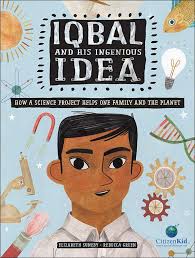
Iqbal and His Ingenious Idea: How a Science Project Helps One Family and The Planet

At first glance, I wondered if this book was about Muhammad Iqbal who was a philosopher, poet, and politician, respectfully dubbed the “Poet of the East”. Or if it was about Iqbal Masih, 12 year old child rights activist. The story was about neither. It is a fictional tale about Iqbal the inventor.

Iqbal needs an idea for his upcoming science fair. He wants to win the prize money so he can buy a propane stove for his family. He has one month to create something that is sustainable. After much thought and some computer research, Iqbal sets out to create a solar cooker.

Highly recommended

What I like about this book: The story is one of perseverance, creative thinking and family unity (sister is involved in the work).
It is very approachable for many grade levels. There are so many jumping off points for discussions on similarities and differences (family structure, schooling structure, home arrangements…).
The back matter gives more information about clean cooking stoves and there are even directions to create one. This would be great as a STEM activity. Also included is information about Bangladesh and a brief snapshot of Bengali home life.  Included in the glossary is pronunciation and meaning for the Bengali words used in the story. Children love to learn to count in other languages (ēk, dui, tin…one, two, three)!
The majority of the colored pencil drawings cover a two page spread with the text condensed and highlighted on one page. This will engage young readers.
Lastly, this would be a great story to use before introducing students to their first science fair.

I also appreciate the fact that the story is a collaborative work of two women, author Elizabeth Suneby (Razia’s Ray of Hope) and illustrator Rebecca Green.

Publisher stated: 3rd – 7th grade.
This could be used as a read aloud beginning as early as late Kinder, especially if tying into the STEM project.


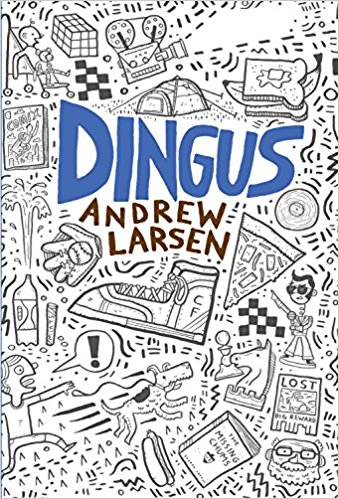
Dingus

It is almost summer break and fifth grader, Henry, isn’t looking forward to it at all.  His best friend Max is going off to Chess camp leaving Henry with no one to hang out with. However, even if Max weren’t going to camp, Henry might still be alone.  Max and Henry have been friends since Kindergarten, but this year their friendship is strained by Max’s new circle of friends and life in general. Henry feels lost and confused which expresses itself as anger towards Max. Henry begins to realize that sometimes you have to give a little to maintain a friendship.  Will Henry be able to do that?

A coming of age story that both boys and girls will enjoy and relate to.

The story would benefit from a few illustrations.

When Friendship Followed Me Home

When Friendship Followed Me Home is a story about friendship and growing up. Ben Coffin spent many years in the foster care system. Finally finding a home to call his own, his life progresses steadily. He mostly keeps to himself and enjoys spending time at the local library. Books are his friends; the library his domain. The librarian knows his reading preferences and suggests books to check out. One day, a small dog follows Ben into the library and then home. On that same day, Ben meets the most amazing girl he has ever met, Halley – like the comet. A friendship blooms and a creative partnership is born. Together Ben and Halley embark on a journey to write a story. Then, when life is progressing smoothly, Ben’s adoptive mother dies, Ben and his four-legged friend, Flip, find themselves living with his aunt and her husband. Unfortunately, this is not an ideal situation as Leo doesn’t have the temperament to be a father. Halley’s family ends up opening their home and hearts to Ben and Flip.The relationship that develops between Ben and Halley’s family is heartwarming. Halley is sick, and the Lorentz’ are struggling with Halley’s physical decline. Ben learns that unlike writing a story, you cannot write a new ending to life. You can, however, choose your path and the people you call family.  This was a touching story that is a great choice for realistic fiction lovers.

Wolf Hollow

In this historical fiction, we meet two young girls who are as different as night and day living in rural Pennsylvania in 1943. Annabelle is a sweet, responsible, compassionate twelve year old who lives with her parents, grand parents, aunt, and siblings on the family farm. Betty Glengarry, an older girl, moves to town to live with her grandparents. Annabelle and Betty have many run-ins and each run-in escalates with Betty revealing herself to be more and more of a bully.  Annabelle typically would turn to her family for help, but since she is getting older, she attempts to handle the situation on her own. One day, Betty plays a nasty trick on Annabelle and her brothers and Toby, a WWI veteran, intervenes. Toby lives alone and is a wanderer. He isn’t from Wolf Hollow and few people know much about him. Living a life of solitude, he soon finds himself on the cruel end of Betty’s antics. Annabelle must find the courage to stand up for what she believes and speak the truth about Betty’s actions. Life lessons are not always sweet and charming, as Annabelle learns, some lessons are heartfelt and bitter.Highly recommended.

Invisible Fault Line

Callie, a teenaged girl who plays in a rock band, has her life turned upside down when her father goes missing. In addition to school and band practice, her days are spent trying to comfort her distraught mother, enlisting her friends to hang up posters, and reliving past conversations she had with her dad. But no leads turn up until Callie sees a photo of the great San Francisco earthquake and recognizes a familiar face.

This young adult novel will appeal to readers who enjoy relationships (parent / child, friend / friend, and a tiny bit of romance), and mystery. It’s an engaging story that is hard to put down.

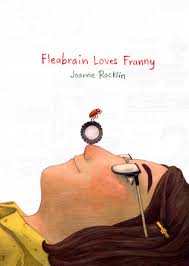
Fleabrain Loves Franny

Fleabrain Loves Franny, by Joanne Rocklin, portrays the unlikely friendship between a young girl and a flea.
Set in Pittsburgh, 1952, Franny Katzenback is recovering from polio and wondering if she’ll ever walk again. Franny reads and falls in love with the brand-new book Charlotte’s Web. At a critical point during her illness she imagines she is being cared for by angels, which just turn out to be nurses in white uniforms. So when she starts to receive letters from a flea, who lives on the tip of her dog’s tail, it seems like just another delusion.
But Fleabrain proves his existence and a strong friendship forms. Fleabrain is a strange and marvelous fluke of nature. He is a self-taught genius and just happens to be a voracious reader. He helpsFranny gain courage, self-confidence and strength to fight her battles with prejudice, discrimination and the struggle of recovery. He is determined to stand by and motivate Franny during this difficult time in her life because he finds he truly loves her. Fleabrain becomes Franny’s Charlotte.

The other characters in the book include her older sister Min, whom she sarcastically calls “Saint Min”, her best friend from a distance Walter Walter (yes, double named), the mean-spirited Nurse Olivegarten, Franny’s adored grandfather Zadie, and Dr. Gutman a neighbor and scientist working with Jonas Salk to find the cure for polio.

Rocklin’s inclusion of many daily life routines and practices of the 1950’s add to the story’s realism. She introduces young readers to some realities of disability and the harsh and often times unfair reactions of others. She also does a good job of introducing many topics for classroom discussion.  Readers may learn not only about paralysis, polio, Jonas Salk, vaccines, infectious diseases and prejudices; but also about literary and cultural references such as E. B. White’s Charlotte’s Web, Franz Kafka’s Metamorphosis, James Howell’s Paramoigraphy, the philosophy of  Friedrich Nietzsche and Jewish folklore and traditions. These may sound like heavy topics for young readers, but Rocklin provides small spoonfuls of understanding to the reader.  As Franny learns of these things in incremental, digestible pieces, so does the reader.

Included is an author’s note reflecting on polio and the issue of disability, and a bibliography of referenced works and songs.  Teachers can also go to Rocklin’s website and get a CCSS aligned discussion guide and activities list.

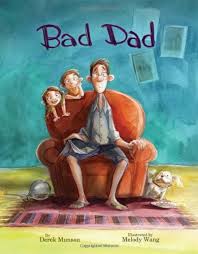
Bad Dad

Oh no!  Dad did it again.  He drank from the milk container, ate the last cookie, played with the toys in the toy department and played ball in the house!

“Sometimes we think he gets into more trouble than we do!”  But is Dad all that bad?

He helps with homework, knows tons of games, tells lots of jokes and he’s the best hider during hide-and-seek.  As dad’s virtues are extolled the narrator realizes how great Dad really is.

The word play, at the last sentence in the book, is a perfect ending that children will enjoy.  It  ties the story up in a nice neat little package.

Children and adults alike will enjoy this fun story that takes a look at all Dad’s good and bad attributes.  Readers may even see their dad reflected in the story somewhere.

Farm Boy: The Sequel to War Horse

In this sequel to War Horse readers find out more about what happened to Joey (the horse) and Albert, the boy who loved him.  Readers who haven’t read War Horse are brought up to speed by Morpurgo’s well placed summary of the preceding story.  In Farm Boy, readers learn more about Albert’s own family and the generations that follow.

At the center of this heartwarming story is an old, green Fordson tractor that is covered in cornstacks at the back of the barn.  The story unfolds mainly by Albert’s great-grandson’s narration; however, Albert’s son (Grandpa in this story) does add his own tale in the middle of the story.  Morpurgo has nicely dovetailed in Grandpa’s voice through the use of a handwritten letter from Grandpa to his grandson.   The letter is titled “Grandpa’s Story” and it tells a different tale about Joey and how the old, green Fordson tractor was obtained.

An enjoyable read that would be great as a read aloud choice.