
Zora Neale Hurston(1891-1960) was confident, charismatic and determined to be extraordinary. She grew up in Eatonville, Florida, an all-black community. She loved the arts and writing and became a writer. Her life story is one of ups and downs and many attempts at writing with some good success. She was mostly forgotten as an author until 10-15 years after her death when she was written about in Ms. Magazine . Her book, Their Eyes Were Watching God, was rediscovered and interest in her as a writer has sparked. I loved the authors’ information, humor and candor in writing this biography and I did not put it down until finished! Includes a timeline of her life, bibliography, index, and photographs. Measures 10 1/2″ x 8″. Would be excellent for Black History Month.
Tag Archives: biography
Hacksaw: The Jim Duggan Story
Jim Duggan (1954-), a wrestler, was inducted into the World Wrestling Entertainment Hall of Fame. This book tells his story from childhood to becoming a professional wrestler and entertaining crowds around the world for 30 years. Includes a few pictures. A good biography with his personal values of family, hard work, appreciation for his fans and audiences and strong American patriotism come out as the story is told.
Jennifer Lawrence: Star of the Hunger Games
Biography of the 25-year-old actress explaining her past, her previous acting, her major part in “Hunger Games,” her supportive family, and her aspirations for the future. Includes: index, bibliography, source notes, chronology of her life, and many photographs throughout the book. Well-written and shows the very human side of Miss Lawrence.
Essential Lives: Malala Yousafzai
This biography begins with the assassination attempt on Malala on her way home from school in 2012. The next few chapters provide background information: on Pakistan, Islam, the Taliban, and Malala’s childhood. The author does a good job illustrating how committed Malala and her father were to her education despite the obstacles they faced. The dangers they faced and the living conditions they endured when they had to flee their province are mentioned; however, the book seems to be targeting a young audience. It describes the living conditions in refugee camps as “less than ideal,” which I am sure is grossly understated. I do think kids will be interested in how Malala got started as an activist, with her diaries, blogs and documentaries. There is no mention of her Nobel Prize; the book was published in 2013. However, many students might already be aware of her award. The book ends with a timeline of events, important facts, a glossary and a list of resources for those wanting more information. This is a good overview, but there is not a lot of in-depth information or analysis of Malala’s life, beliefs or actions.
Walter Dean Myers
Washington Post reporter Jim Naughton called Walter Dean Myers a “one man movement.” Myers told stories about the lives of African American youth at a time when literature for youth was “monochromatic,” written by white authors about white characters. This book tells Myers’ story, from his troubled childhood and lack of success in school, to his time in the military to his career as a writer. Fans of his writing will see the roots of many of his characters in his childhood. His struggle to achieve and his perseverance in becoming a writer is inspirational. There is also a chapter on his efforts to reach children, especially troubled youth, through his writing. Myers is such a popular writer that this biography is bound to circulate well, especially after his recent death. The book is appealing, with many sidebars and photographs, and ends with a timeline of important events and a list of resources for further information.
A Marked Man: The Assassination of Malcom X
Challenging the racial status quo in America could get you killed during the 1960s. Among the martyrs who died trying to change society was Malcolm X. The slim volume by Matt Doeden, A Marked Man: The Assassination of Malcom X, documents the transformation of Malcolm Little, street hustler, into Malcolm X, a “marked man.”
Doeden sets Malcolm’s story in the context of the broader Black American narrative of racism, slavery, and racism after slavery, Jim Crow segregation. As important to Malcolm X’s biography is Malcolm Little’s conviction for burglary and sentencing to prison. There he learns about and is attracted to the teachings of Elijah Mohammad and his Nation of Islam (NOI), a combination of self-discipline and a virulent racism toward whites.
Converting to Islam, Little, emerges from prison in 1952 with a greater sense of purpose and starts life anew as Malcolm X. He quickly established himself as an effective spokesman for the NOI, inspiring blacks who listen to him speak and frightening some whites who note his depiction of them as “white devils.”
Going on a haj to Saudi Arabia, Malcolm is emotionally moved by the multi-ethnic and social nature of Islam. He returns from this road to Mecca experience understanding that “all men are brothers.” This puts him on a collision course with Elijah Mohammed and the NOI which leads to his striking out on his own mission.
Doeden cover this story quickly, but effectively. With an outstanding set of pictures and select quotes the author captures the complicated rise of Malcolm X.
The final third of the book is about Malcolm’s assassination which he evocatively captures in detail, picture, quotes, and prose. Doeden also does an outstanding job separating what we know and what we don’t know, in particular, who ordered the Malcolm’s murder.
A handy chronology about Malcolm’s life and a final “Where Are They Now” section about the major players in the story round out this satisfying volume.
(Submitted by the Washington State Civics Educator of the Year, Ed Bergh)
Darkness Everywhere: The Assassination of Mohandas Gandhi
While this book does provide a biography of Gandhi, it does not focus solely on his life. Half of the book provides the history of the group of conspirators who plotted and carried out the execution of “Mahatmaji.” Gandhi’s evolution as a proponent of nonviolent civil disobedience, from his time in South Africa to his return to British-controlled India, is juxtaposed with the growing movement for a Hindu controlled India. Vinayak Damodar Savarkar was the leader of a group of Hindu nationalists who saw Gandhi’s vision of an independent India with freedom for both Muslims and Hindus as a betrayal of all Hindus. One of Savarkar’s followers, Nathuram Godse, decided that there was only one way to prevent Gandhi from further weakening India: Gandhi had to die, and Godse was willing to implement the solution. The book follows the conspirators through the assassination and the trial, and wraps up with more about Gandhi’s message and others who were inspired to action by it. The book is colorful; it includes many interesting sidebars, photos, and direct quotations from the major players in the events that occurred. Prime Minister Nehru’s speech to his nation after the assassination of Gandhi is included along with a few good ideas for a lesson connected to the speech. The book concludes with a timeline, a who’s who section with short biographies, a very short glossary, and a list of resources for further information. I see many uses for this book in the classroom to support both history and English curriculums and I highly recommend it.
Hank Aaron: Groundbreaking Baseball Slugger
This is an excellent biography of the man often called “Bad Henry” because no one pitcher could stop him. It begins with the story of his life before baseball, back to the time when his father played for a local team. Aaron played both football and baseball in high school, but it was when he saw Jackie Robinson play for the first time that Aaron told his father that he would play professional baseball while Robinson was still playing ball. It goes on to describe Aaron’s career, particularly when he approaching Babe Ruth’s home run record. Instead of it being a time of joy, it was one of the most stressful times in his life because of the hate mail and death threats he received. The work he considered even more important was opening doors for others, helping African Americans move into management and executive positions in baseball. Filled with pictures and sidebars, this is an excellent addition to the sports section in any school library.
Shaun White: A Snowboarder and Skateboarder Who Cares
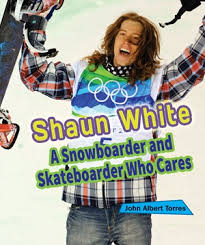
This biography profiles the life and career of Shaun White. It starts with the medical troubles he faced as an infant and continues his life story up to the present.
Shaun White is a positive role model and the writer does an apt job of highlighting all of Shaun’s good qualities – perseverance, compassion, determination, generosity and friendliness. Most upper elementary students will enjoy this book, with career stats, a glossary, additional reading titles, available websites for further reading, contact information for writing to Shaun and even his Twitter page.
The writing is on level for 4th-6th graders, told in third person. One section makes an unexpected transition to first person and seems a bit jarring. It will make the reader look to see if a page was overlooked. Other than that, this is an interesting read.
Elizabeth Cady Stanton: “Woman Knows the Cost of Life
This solid biography begins with s short description of the defining moment in Cady Stanton’s life – the Seneca Falls Convention. Chapter Two goes back to her childhood and then on to her marriage, giving the reader a clear picture of how and why Cady Stanton developed such a passion for the women’s suffrage movement. While we see Cady Stanton and her close friend Susan B. Anthony as the founders of the suffrage movement, this book shows that their opinions were often opposed by many of their contemporaries, even within the movement, as too radical. The book ends with a chapter on Cady Stanton’s legacy, followed by a chronology of events, a glossary and additional resources. This would be an excellent reference for information on Elizabeth Cady Stanton in particular and the women’s rights movement in general.