Too Cold for a Tutu

I fell in love with the cute hand-knit stuffed toy dogs [Barry & Stella] in their little hand-made clothes as they hop and jump through the Adobe Photoshopped pages of this book.

The story line hops and skips through the pages, as well, just like the young children they portray. Barry and Stella don’t stay on any activity for too long.

Barry and Stella have just received a hand-made gift of a sweater and tutu from their grandmother. Their imaginations go wild as they play outside in their new clothes in the crisp fall air. After a child’s disagreement over climbing a tree, they begin to pretend they are elephants. The story ends, after Barry and Stella have eaten a snack and the tutu has now become a lion’s mane.
Bugs in my Hair!

Author, illustrator – David Shannon can make any topic cute and adorable! The cover of this 2013 book (11.5″ X 9″) has a rumbled insect looking out at the reader from what might be a bunch of shredded carrots, if only the title were not Bugs in my Hair!  It is still cute.

It all begins when “One day, my mom made a terrible, awful discovery… Head Lice!” Shannon’s over dramatic illustrations lighten-up the topic of what is often a common childhood maledy – head lice.  Oh the itching, the blood sucking, “the humiliation”, and the not knowing exactly where the lice came from.  A few ‘treatments’ are comically illustrated [child with his entire head looking out from inside a mayonnaise jar] while mom researches for “battle-tested anti-lice weapons.” Finally, the lice are gone. BUT they come back. And “so we went through the whole thing again…”    Closing illustration of a child’s head inside a knight’s helmet is captioned, “I’m not taking any chances!”

The reader comes away with the idea that “Lice-a-palooza” are not the end of the world, but it is a relief when they are gone.

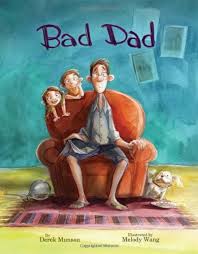
Bad Dad

Oh no!  Dad did it again.  He drank from the milk container, ate the last cookie, played with the toys in the toy department and played ball in the house!

“Sometimes we think he gets into more trouble than we do!”  But is Dad all that bad?

He helps with homework, knows tons of games, tells lots of jokes and he’s the best hider during hide-and-seek.  As dad’s virtues are extolled the narrator realizes how great Dad really is.

The word play, at the last sentence in the book, is a perfect ending that children will enjoy.  It  ties the story up in a nice neat little package.

Children and adults alike will enjoy this fun story that takes a look at all Dad’s good and bad attributes.  Readers may even see their dad reflected in the story somewhere.

How Do Dinosaurs Say I’m Mad?

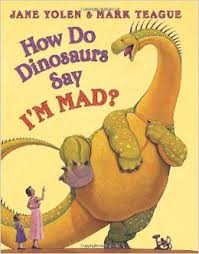
How does a dinosaur act when he’s mad?  So begins the eleventh book in the “How do dinosaurs” series.  Jane Yolen and Mark Teague team up to create an inviting book. Teague’s illustrations are spot on as they capture the physical and emotional characteristics of a temper tantrum in all its glory: stomping, kicking, throwing, pouting, sticking out tongues, ignoring and dirty looks.  Yolen takes the reader through the storm of a tantrum to a self-controlled calming end.

A good read aloud to prompt open discussion on proper behavior when we get mad.  Children will giggle as they see themselves reflected in some of the scenarios, but may listen intently to learn how to overcome those out of control feelings.

The Quayside Cat

I absolutely love the illustrations in this book:  they evoke the mood, create the setting, and give personality to the characters.  The story itself is a nice tale of a young harbor cat who listens to the stories of the old cat who’s travelled the sea.  When young Jim insists he wants to share in such adventures, the two set off together to stow away on a sea-going boat.  And adventures they find, including seasickness and rats and waves and storms.  When they do make it safely back to the harbor young Jim is ready to return to the safety and familiarity of the harbor, but the old cat says he’s had enough of land and is setting out on one last voyage.  By the end of the story Jim has become the old cat telling of stories of adventures at sea to the younger kittens on shore.  My biggest gripe with this book (keeping it from getting a better rating) is not with the author or the illustrator, but with the editor/publisher — whoever it was who decided on the text layout.  Someone made the decision that the lines of text should be aligned along their centers, giving it the look of poetry, though it’s not, which interferes with having any proper paragraph indentations to show when their is a change in speaker: the result is that there are times when confusion over who is speaking interrupts the flow of the dialogue and the story.

A Catfish Tale

Bright, vivid illustrations accompany this cajun version of the folktale of The Fisherman and his Wife.  Something about the text draws one into feeling the urge to attempt a cajun accent while reading the story of the poor but happy fisherman and his wife who one day catch a magic catfish.  Though the fisherman is content enough, his wife comes up with more elaborate wish after another to ask of the magic fish, each granted wish leading to more wants, until having all her wishes granted land her in ruin and she realizes there’s nothing she really needs.  A brief glossary at the end offers explanations for the Bayou lingo sprinkled throughout, though context is usually sufficient to make the meaning clear.  It’s a fun read, which gives the reader something to ponder.

The Unexpected Crocodile

It’s a rather odd little story about a family having guests to dinner in the middle of a rain storm.  When a crocodile arrives unexpectedly, he is invited to join the party, and proceeds to calmly eat each of the guests (who, granted, were not terribly polite), and then goes away again.  The illustrations do not particularly enhance the strange story,  as they appear half-finished.

Ruby Learns to Swim

Definitely a book for the very youngest students.  It’s got lots of repetition and rhythm and the illustrations support the text, which makes it useful for beginning readers.  It would also be helpful for building enthusiasm for a reluctant swimmer about to face lessons:  it consists of repeated phrases describing different aspects of swimming, interspersed with the mantra, “Learn to swim!”

Counting Money

A small book, written for early learners, it’s got color photos illustrating the two sentences per page which describe what coins the child in the picture has, and how much cents that equals.  It’s broken into chapters by type of coin. It’s got other text features of non-fiction books (table of contents, glossary, index). It’s not that it’s a bad book.  It’s just that there’s not much practical point to it:  no child is going to choose it for the fun of reading, and it’s not particularly necessary as a teaching tool, as actual money that children can handle would work better, so I don’t know that teachers would find the book particularly helpful.

The Great Balloon Hullaballoo

The illustrations are fun, and the colors are bright and rich.  The text is written with good rhythm and rhyme, telling the story of a young squirrel whose mother sends him off with a shopping list, insisting that the most important item on the list is cheese, as she’s planning to make pizza for dinner.  When Simon Squirrel and his friends see the moon, they declare that everyone knows it’s made of cheese, so they borrow a hot air balloon to go fetch some, but a comet blows them off course, so they end up shopping for the other items on their list at various planets.  After a meteor shower punctures their balloon they head home, but realize they still forgot the cheese.  Though it lacks enough purpose or cohesion to rate a recommendation, it’s silly and fun and kids would enjoy it.