
Trucker and Train

Memories of driving cross state over the mountain passes of Washington came to mind while reading this book.

Trucker ( a semi-truck loaded with a shipping container) is full of himself.” Trucker was bigger and stronger and tougher than anyone else on the road.”(4) The mopeds, cars, and pick-up trucks all give him a wide berth. Then one day, Trucker makes his first trip over mountains. New road, new views, and new experiences. Trucker sees his first freight train. Trucker is impressed by the number of cars Train carries, but does not like the way everyone admires Train.

Trucker tries racing Train, but Train gets the right-of-way. Trucker finally pulls ahead when Train stops at the station. Trucker starts up another mountain pass. The mopeds, cars, and pick-up trucks can pass Trucker on this uphill grade, under his heavy load. As Trucker rests at the top of the pass, he notices the train gate is broken off down in the valley. Trucker zooms into action to speed past the mopeds, cars, and pick-up trucks on the downhill grade to stop the traffic at the train crossing since the train grate arm is broken. Trucker blocks the train crossing, also, blocking the other vehicles view. They are not happy. Once Train goes speeding through the intersection the other vehicles cheer for Trucker who kept them safe. “And Trucker started off, along with the others, happy to share the road.” (32)
The Impact of Slavery in America

This compact review of slavery and race relations in American history is an excellent introduction for younger readers, but it posits a number of ideas that could be included in much more critical (higher thinking) discussion.

The book outlines the early roots of slavery and procedes with quite a thorough chronological examination of major events regarding how discrimination and racism persist.  The work also reveals how racism continues to be a concern today and suggests ways to address this concern for dealing with the more subtle aspects of racial bias.

I appreciated the simple, clear rendering of the history of slavery and the awful history that followed the civil war.  The author also included a number of ancillary details that might not be illustrated in a standard approach to the subject.  For example, it was interesting to note how the leaders of the Black Panther movement recognized how African American women in the organization were the victims of discrimination within the ranks. 

I truly did not dislike any aspect of the work.  It is hard to find anything objectionable in a book that deals with the subject of slavery and the ways in which those roots still affect culture and society today (and into the future).  Perhaps this has something to do with what has been called “white fragility”.  

The ideas were presented in clear, readable fashion geared toward younger readers.  However, the style and delivery of the vital ideas and implications in the book made it useful for much higher level thinking/questioning.  I also found the “sideline” sections to be useful as additional information to supplement the main text.

Younger, less-informed readers will find the book accessible and readable.  Those older readers who are familiar with the sad history of racism in America will be surprised by the more complex issues that might be revealed (and discussed) along the way.

I recommend this book with enthusiasm, especially for the younger reader (middle school).  It is a great introduction for the subject of slavery and how those roots still affect our society and culture.  I gleaned a good deal from my reading of Harris’ book; it is an easy way to review the essentials while affording much more discussion about the complexities of racism even in these more “enlighted” times.

Tangled

A circle gets caught in a geo-dome shaped jungle gym and cannot get out by himself. A parade of different shapes try to help and some also get stuck. Finally a straight and narrow line rushes to the rescue. With the help of a prism and sphere, line creates a lever to pop the shapes free. The line then convinces the jungle gym to make her spaces wider so the other shapes will not get tangled in her again.

A fun and engaging story to reinforce geometric shapes. The mixing of 2 and 3 dimensional shapes without any identifying the differences, however, undermines the math concepts.

Here and Now

With a message of mindfulness and meditation, Julia Denow replaces the traditional in-and-out breaths with words and page turns. The books starts with the here and now of self, pointing out where, what, and how the reader fits into the universe. The book then moves on to noticing the big and little things both evident and hidden in the world around us. Finally the book moves on to envisioning the limitless possibilities.

Beautiful illustrations help portray both the immediacy of what we experience around us as well and the grandeur of the the universe and our boundless potential. The multi-racial family makes a powerful statement about diversity by not incorporating race in the message of the text.

Some Snow Is…

Three children greet the first, long awaited snow of the year with glee even though it’s slushy and wet. The lyrical text follows these children through the whole season of snow. The reader hears of Fluff Snow, Angel Snow, Snowball Snow, Driveway Snow and so on. Each type of snow provides another unique experience. With the slushy Spring Snow, the children appear to shoo the snow away with,

Soon it will be Spring Snow,
Grass and mud and rain snow,
Time to go away snow;
no more lingering.

The last page pictures the children peering at their bikes in their garden shed ready for a new season of adventure. A perfect read for kids anticipating the arrival of snow.

Trains Run!

Trains Run! will appeal to train enthusiasts. With the repeated refrain:

Steam engine,
gas engine,
electric engine too.
Chooka-chooka! Vroom zoom!
Hssss! Whoo-oo-whoo!

The rhythmic text helps to paint a picture of the role of trains past and present, of where they travel, and their power and strength.

The illustrations capture a feeling of movement and the majesty of trains. Characters in the illustrations are of diverse race, age, and lifestyle.

Dissenter On The Bench, Ruth Bader Ginsburg’s Life & Work by Victoria Ortiz

Supreme Court Justice Ruth Bader Ginsburg’s life story is revealed between significant court cases that exemplify Gingburg’s experiences and values. From growing up Jewish in Brooklyn, to witnessing first hand the affect of “loyalty oaths” on her high school teachers in 1950, to discrimination in the workplace while pregnant in the mid-1950’s, the reader sees how social justice issues have dominated her career. Chapters focus on student rights, free expression, marriage rights (straight and gay), employment, family, civil, and women’s rights, giving background on the plaintiffs in numerous cases.

This biography includes numerous photographs, three appendices, the author’s notes, bibliography, photo credits, and an index.

Prehistoric Predators by Matthew Rake

Photoshop at its fantasy finest. Matthew Rake along with illustrator Simon Mendez work their magic presenting ten “What If” scenarios of ancient beasts who suddenly appeared today.

WARNING! These extinct beasts are not alive today, and the encounters seen in this book are not real. But just imagine if they were…”(4) Dimetrodon, Inostrancevia, Sarcosuchus, Quetzalcoatlus, Ambulocetus, Andrewsarchus, Entelodont, Phorusrhacid, Smilodon, and Hyaenodon are each individually presented as if they were alive today and matched up with a present day animal in an illustration that looks look it was taken with a camera.”Now can you imagine what might happen if they arrived back in today’s world? Well, you are about to find out…” (6) The script goes on to mention the pair briefly before moving exclusively to the prehistoric animal. The information on these prehistoric nondinosaurs makes the book worth purchasing, while the past versus present aspect makes the book catch the reader hook, line, and sinker. A few of the matches are off a bit like the Quetzalcoatlus which only lived in North America and they have it pictured with giraffes in the wild, but I’m sure the young reader will forgive this. Each prehistoric animal is given a side bar with its name pronunciation, where it lived, length, weight, and a black outline drawing of the animal standing beside a human to show its relative size.

If nothing else, the photos are eye catching!

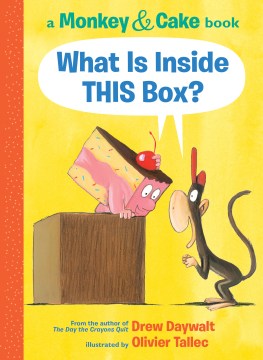
What is Inside This Box?

Monkey has a box and tells his friend, Cake, that there is a cat inside. This cat is magic, though. If the box is opened, he disappears! Cake questions this logic and he and Monkey have a spirited discussion about it. Cake is sure that there is no cat in the box, because there is a magic dinosaur in the box. And, this dinosaur disappears when the box is opened. The two friends eventually determine that they will never really know and walk away toward some pie. After they leave, a cat peeks out of the box and rides away on a dinosaur’s back.

This cute nod to Schrodeinger’s cat has simple illustrations on uncluttered pages, reminiscent of Mo Willem’s Elephant & Piggie. The text is dialogue and each character has a different color of speech bubble, making it easy for the reader to determine who is speaking at any given time. The friendship is real and they can agree to disagree in an amicable fashion, which is a lesson in itself. Early readers will enjoy the story and the characters and wonder themselves about the contents of the box!

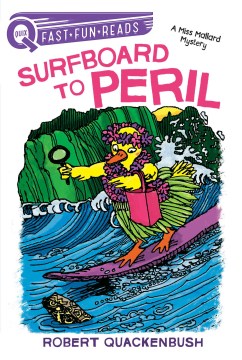
Surfboard to Peril

Miss Mallard, well-known “ducktective” has a big case to solve. She is vacationing in Hawaii and surfing with her instructors, Kai and Kawai when she hits a mysterious rock with her surfboard. It turns out that it is an ancient stone that proves the land is owned by both villages nearby. As the villagers are celebrating the stone and the answers it provides, it disappears! Miss Mallard is on the case. She dusts the area for featherprints and finds a suspicious keychain. She has three suspects, an archaeologist (Horace Shoveller), an old sailor (Joe Scaup) and a builder (Clyde Pochard) who is interested in developing the land. Through her quick wits and deductive reasoning, Miss Mallard captures the thief and restores the stone to its rightful place.

This story is a nice introduction to early chapter books, with a list of characters/descriptions in the front of the book and a glossary of potentially unfamiliar words in the back. Illustrations are black and white and the words are in larger font. Readers will enjoy this quick read and will enjoy the mystery that Miss Mallard solves for them.