The Birthday Cake Mystery

This is a wordless picture book filled with pages of detailed illustrations depicting several mysteries at once.  The setting is a park on a sunny day where a kid’s birthday party is in progress.  All the characters are animals dressed and behaving like humans.  The illustrations comically tell the stories of the progression of the birthday party, a stolen necklace, the baking of the birthday cake and several other sub plots.  There is a group of mischievous monkeys, a tantruming party guest, and some very suspicious-looking rats.  This book could be enjoyed by a wide range of ages since reading is not required and the clues for the various mysteries range from obvious to subtle.  I think it is one that children would pick up again and again to discover some new detail each time.
 

Hiking

This is a wonderful informative book about the out door sport of hiking.  There are wonderful things to see along the way.  Through the forest and into the meadow.  You don’t have to travel far to find a trailhead.  You have to prepare for all possible conditions to be ready for a hike.  Water is very important when hiking.  When you hike you should leave no trace that you were there.

There is a glossary in the back with a “To Learn Move” page.  There is also an index and in the f ront is a table of content.

Socialism

Thomas Fleming freely admits that there will be confusion as he tries to explain the philosophical shifts in the theory of socialism in his book of the same title from Marshall Cavendish’s Political Systems of the World series.  Classical definitions of socialism, communism and liberalism will are used, which means that a liberal believes that everything can and will be done to achieve liberty, or independence from the government.  What is currently described as being a “democrat” in the United States is really more of a socialist – society ensuring fairness among all people.  Fleming begins his history lesson with Plato’s Republic, Aristotle’s dissection of Plato’s ideas as unmanageable, Christianity’s influence, and the rise of Utopias.  When the US colonists declared independence and the French Revolution put the world’s elite classes on notice, the hope for new mindsets by which to inspire rose again.  This ebb and flow continues through the historical timeline of this book reaching a crescendo of sorts in the late 19th and early 20th century.  The United Kingdom, Germany and Sweden are 3 focal countries for discussion purposes in the text. The constant question of political vs economic means justifying the ends is raised again and again.  The comparison table of socialism and other governments in the back is particularly helpful.  Students will need to ignore their “Americanized” concepts of liberal vs. conservative and instead go back to history to learn how these concepts came about.  Not many pictures or sidebars to glamorize the topic, this book is good for advanced students at the high school level and above.

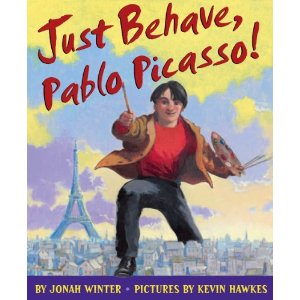
Just Behave, Pablo Picasso!

Synopsis:  At an early age Pablo Picasso was an amazing painter!  When he was in art class, students twice his age were amazed how fast he could paint.  Pablo completes an oil painting while they are still working on sketches.  Just as soon as he masters one style of painting, he moves on and paints something completely different and is soon mastering that style too.  People love it and demand more of the same!  His success makes him rich!  Pablo continues to change his style and his next painting is so different that the public calls it ugly! It doesn’t look like anything they recognize!   “Behave Picasso!” they tell him.  He refuses to copy himself and declares that, “The chief enemy of creativity is good sense!”

What I liked about it and who would enjoy it:  This is a perfect match of story and illustration.  I especially loved the recreations of Picasso’s early paintings.  The story conveys Picasso’s vibrant creativity and drive.   Hand this to young artists for inspiration and art teachers to share with their students.

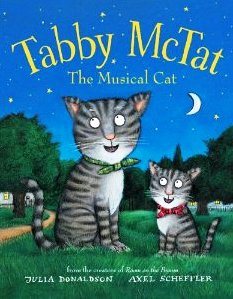
Tabby McTat: The musical cat

Synopsis:  Fred the street singer and musician and his cat Tabby McTat are purr-fectly happy singing or “busking” for tips in the town square.  One day while the cat is roaming, Fred is robbed of his money and chases the thief, breaks his leg and ends up in the hospital.  When Tabby returns Fred is gone.  Tabby finally wanders away and finds a new home with a family, but he never forgets Fred.

What I liked about it and who would like it:   This a lovely story about a long lasting friendship.  Scheffler’s illustrations have great appeal, especially the cat and kitten faces.  Also look for interesting detail in drawings and the clever “cat” endpapers that look like they are stamped on the book!  On a whole this is a very enjoyable story and cleverly illustrated.

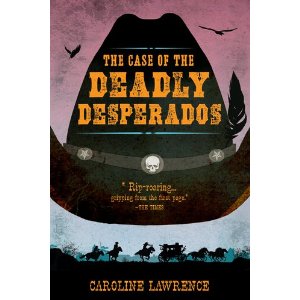
Case of the Deadly Desperados


Synopsis:  In 1862, 12 year old P. K. Pinkerton discovers his foster parents murdered in their cabin near Virginia City.   He exhibits no grief because of his autism.  But he has the sense that his own life is in danger when he discovers that the notorious outlaw Whittlin’ Walt is responsible for the murders.  He flees to Virginia City, where he meets a motley crew from the history of the era: Sam Clemens, a soiled dove (prostitute), Chinamen, and a card shark.  Constantly on the run, Pinkerton bounces from bar room, to newspaper office, to opium den and down a mine shaft with Whittlin’ Walt closing in.

What I like about it and who would enjoy it:  This is the first book in Caroline Lawrence’s new series: Western mysteries.   The story moves along well and has qualities of an Indiana Jones story that will keep kids turning the pages.   Unfortunately, I can’t recommend this title.  The appeal of this book is young; perhaps third or fourth grade, but adult situations in the story make it inappropriate for a younger age.  Sixth graders and older will think the title too young.    Recommended for large public library collections where Caroline Lawrence has a following.

How Georgie Radbourn saved Baseball

Synopsis:  When baseball player Boss Swaggert is booed and jeered off the field during a slump in his career, he vows revenge.  Years later Boss Swaggert is a very rich man and so powerful he is able to make baseball illegal.  The consequence of this is continuous winter.  Without baseball there will never be a spring or summer. Then little George Radbourn is born, a boy born for baseball!  Every time he opens his mouth it is about baseball, such as “batter up” or “line drive back through the box!”  Eventually there will be a showdown with Boss Swaggert and a contest on the baseball field!

What I liked about it and who would enjoy it:  This is a reprint from 1994 and winner of the New York Times Best Illustrated book of the year award.  David Shannon’s illustrations set a somber mood and may remind you of William Joyce’s work.   A fun title that baseball lovers and any age will enjoy!  Grab it before it goes out of print again!

Recommended for grade  K-Gr-4

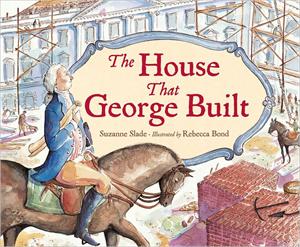
The House that George Built

Plot Synopsis:  This illustrated picture book is actually two books.  It can be read as a simple picture book by reading the repeated refrain: “This is the house that George built.”   On another part of the page is the history of the construction of a house for the President to live in, a project begun by President George Washington.  He selected the land, had a design createdand broke ground.  Eight years later it still wasn’t finished and George never lived in it, but every President since has.  Now called the White house, it continues to be a work in progress and every resident has made changes and additions.

What I liked about it and who would enjoy it:  I liked that the book can be shared on two levels and the broad double page spreads make it easy to share with groups.  The illustrations in watercolor and ink give a panoramic view of the construction.  Additional information and recommended sources and an author’s note are included.   This is very visually appealing nonfiction.   Recommended for grade 1-3

Temple Grandin: How the girl who loved cows embraced autism and changed the world

Synopsis:  When Temple Grandin was born, her parents realized she was different.  Years later she was diagnosed with autism.   Temple’s father wanted her institutionalized.  However, her mother refused to give up on her little girl.  She searched out and found the “right” schools for her daughter as she grew up.  These were places where Temple was allowed to be herself and develop her talents in spite of her struggles with language and her sensitivity to noise.   Because of her autism, Temple sees the world through pictures or visually, the way animals do.  Using this strength, she went on to college and is now a professor of animal science at Colorado State University.  She is also famous and in demand for her ability to understand animals and is an in demand consultant in agribusiness and advocate for humane treatment of animals.

What I like about it and who would enjoy it:  Sy Montgomery has written a fascinating portrait of Temple Grandin!  It is a lively telling of Temple Grandin’s life, well written and sprinkled with photos and examples of Temple’s work.   This is the kind of non-fiction you want to get into student’s hands and may well spur them to read more about this subject.  I hope that Sy Montgomery wins some award for this book!  Temple Grandin is a real-life heroine for our time!  Highly recommended for grades 5th through 8th.

Coniferous Forests

Basic general information is presented in eight chapters: #1 What is a Biome?, #2 Landscape and Climate of the Coniferous Forest, #3 Plants Growing in the Coniferous Forest have Adapted, #4 Animals Living in the Coniferous Forest have Adapted, #5 Environmental Threats, #6 Biodiversity at Risk, #7 The Future of the Coniferous Forest, and #8 Conservation Challenge. Each chapter averages 4 pages in length, generously sprinkled with labeled photos of coniferous forest animals, “Words to Know” which match the glossary section word for word, “Word Exploration”, and “Did You Know?” trivia.

The ratio of picture to text appears to be equal. If a picture is worth a thousand words, the readers will love this form of information!