Find the Perfect College for You

Blend a detailed lesson on discovering your personality/learning type with Marie and Law’s first hand knowledge of 82 possible colleges/universities majors and enviroments from across the spectrum and you see the potential their text Find the Perfect College for You has for students who just don’t know where to start their college search.

Every high school student does some sort of learning styles inventory during their school career.  Marie and Law’s inventory asks readers to evaluate themselves in being either:Introverted or Extroverted, Sensitive or Intuitive, Thinking or Feeling, and Judging or Perceiving.  Once a student identifies their learning style, the 82 colleges are listed with a description of how that college meets different combinations of the learning styles.  For example, this reviewer scored a E, S, T, J combination.  Using the index, I can find colleges that match my learning styles based on their values, structure, and the majors and minors offered.  With clear, realistic examples of each throughout the text of the learning styles for each college listed, a student can walk away with a pretty hardy list of colleges that might best fit their learning style.   I think this text would be especially  helpful for those students who don’t “fit the mold” or don’t “like the structure of organized mass education”.  They will be exposed to some smaller, unique schools.  It’s a great idea to connect learning styles to the style of the college and every career/college center should have this available for students to check out.
Walter Dean Myers

This biography of this well-known writer is excellent in that it is direct and factual. Inspiration for so many of Myers’ books is from his life.  The subtitle of this book, Urban Fiction Author, emphasizes the main focus of Walter Dean Myers’ writing.  He writes to speak to the unrepresented, disillusioned, struggling teenager that has no voice or sense of direction. Myers never forgets the challenges he faced as a young, under-educated black man growing up in Harlem in the 50s. Trying to overcome his own speech impediment, he began writing and reading poetry, winning his first writing prize at age 13. He has written over 20 books, many of which have been recognized for his ability to speak to young adults in an authentic voice. His work targets the disconnected, shy, lonely, frustrated young person that is trying to understand his world and hoping to figure out his role in that confusing, ever-changing scene.  Myers does not shy away from the tough topics, addressing them with humor, understanding and persistence. The only drawback is that it is every page is text.  Not a single picture to give interest.   Still, this biography is a useful addition to a middle or high school library as an example of a successful adult who does achieve his life-long dream, through guidance, inspiration, and most of all persistence.  It is fascinating to read the life story of such a prolific writer.

National Intelliegence

“Freedom from fear is a basic human right… Intelligence agents play a key role in securing this freedom for all Americans.”  (p.7) Before reading this five chapter book with a skeletal* amount of information I didn’t know much , if anything, about the United States national intelligence system. It is so full of secrets, the general public only knows of its failures.

There are 16 separate agencies, with 200,000 employees spending $75 million / yr. on intelligence each year. Few of these employees are spies.

There are 5 steps in the Intelligence Cycle: 1) planning, 2) collecting information, 3 & 4) processing and analyzing , 5) delivery of intelligence to President.  “The IC [Intelligence Cycle] relies on analysts to make sense of the information it gathers.” ( p. 36)  Not all the information gathered makes it past the processing and analyzing due to its  inaccuracy, being incomplete, or being outdated.

Chapter 5 discusses the controversies associated with some of the methods used in collecting intelligence, such as – waterboarding.

Includes: Map of Events – What Happened Where?, The Story Continues – New Threats, Influential Individuals, Timeline, Living History*, Glossary, and Index.

more information at www.factsfornow.scholastic.com   keywords National Intelligence

You Wouldn’t Want to Work on the Hoover Dam! An Explosive Job You’d Rather Not Do

The Great Depression of the 1930s is underway when Herbert Hoover’s dream to build a hydroelectric dam on the Colorado River is finally realized. Out of work men from California, Nevada, and Texas are a major part of the 21,000 workers employed for the dam’s construction. They arrive to find NO town, desert heat, and NO water supply.

The unnamed main character is one of the many employed unskilled workers. His facial expressions amplify and personalize the hardships of: dysentery, muddy drinking water, ditch latrines,  living in a tent city in desert heat and freezing cold, and the dangers from blasting rock.

Amidst the graphics of the construction work there is an easily understandable diagram of how the water gets to the turbines to generate the power.

Robots

Author Maggie Rosier provides insight into the skill of drawing 8 different robots illustrated by Steve Porter.

The beginner should start by drawing from a picture before drawing from their imagination. Basic supplies include drawing pencils with both soft (B) and hard (H) lead, in addition to colored pencils, paper, eraser, and black ink pen.

Drawing each robot is broken down into 5 steps beginning with the rudimentary basic key shapes, secondary shapes / appendages,  robot specific appendages/ gadgets,  fine detail, and finally shading and coloring.

Each robot is introduced with a mini-bio description of its different skills, abilities, attributes, and how body follows function.

Along the way, insets provide tips: go from light to dark, highlights, break it down to basic shapes, and test color combinations before coloring actual drawing.

Includes: glossary, index, and www.factsurfer.com.

My Favourite Fairy Tales

These fairy tales are not too long, not too short, they’re just right! Seven fairy tales are retold and illustrated by London born and Liverpool School of Art trained Tony Ross. Ross’ pencil and paint strokes are simple, if not crude, yet the movement and emotions are well defined!

Of Ross’  seven favourite  fairy tales, I was only familiar* with three of them: The Hedley Kow, The Musicians of Bremen*, Sweet Porridge, Rumpelstiltskin*, Prince Hyacinth and the Dear Little Princess, Fairy Gifts, and Beauty and the Beast*. The stories’ length averages 10-14 pages long with the ratio of picture to text often 1:1 or greater.

I particularly enjoyed the characters not retelling their story numerous times by the narrative stating “the girl explained”.

The Duff

Bianca struggle for self-control is edgy and probably a bit too sexy for a school audience in Kody Keplinger’s The Duff (Designated Ugly Fat Friend). The storyline is pretty predictable but the redeeming value is Bianca’s reflective, smart, sometimes in-your-face voice as the narrator.  Bianca is best friends with two girls she believes are much more attractive than her.  To appease her friends, she often sits on the sideline of their teen hangout while they dance the night away. Enter Wesley Rush, one of the most attractive and sexually active boys in the school.  Wesley informs Bianca that he’ll hang out by her in order to attract her best friends’ attentions because she’s the DUFF of the group.  After drowning him in Cherry Coke, one would think Bianca would have nothing to do with him again.  But then the plot gets interesting, and quite hot.  Biance turns the tables, or bed, so to speak on Wesley.  To escape her stress about being the DUFF, as well as her parents imminent divorce, she turns to Wesley, who will sleep with anything. Throughout the story, Bianca goes from highs to lows.  She’s honest with her intentions, but sometimes a bit too self absorbed, like EVERY teenager out there. There is a happy ending in it all, and upper high school or public library patrons will probably enjoy this more than they might admit in person.  (Blush, blush).

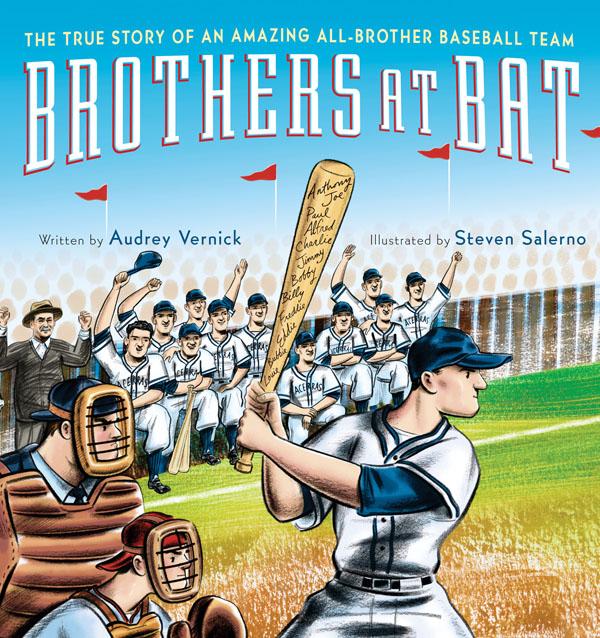
Brothers at bat: the true story of an amazing all-brother baseball team

Summary:  Here’s a story that seems almost impossible to believe, but yet it is a true story about an American family.  The Acerra family had 16 children.  Twelve were boys, just enough to field a baseball team!  This was the 1930s, and times were tough, but they stuck together as a family.   They had one passion: baseball!  It brought them a lot of joy and a lot of fun! And they were really good players!  In 1938, the brothers ranged in age from seven to thirty-two.  The oldest nine brothers formed a semi-pro team!  They played around on the East Coast and the always drew a crowd!   In the 1940s six of the brothers went to war, but they all came back and played in a baseball league another six years.  They played their last game in 1952.


What I liked about it: It’s a positive story about a family working together.  Salerno’s illustrations have a retro feel from the period from the 40s and 50s that match the time period perfectly.   Author and Illustrator add historical detail on the last page.


Who would like it:  The picture book format would suggest a younger audience:  K-3rd grade, but anyone would enjoy this all-American story.  Highly recommended.

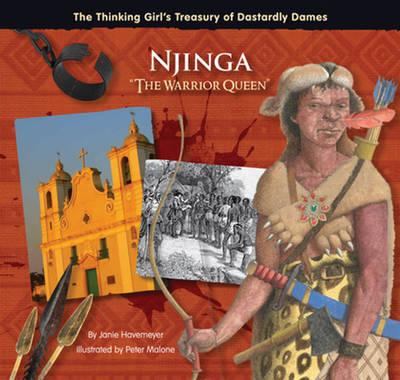
Njinga: The Warrior Queen. (The Thinking Girl’s Treasury of Dastardly Dames)

Summary:  As part of the series, “The Thinking Girl’s Treasury of Dastardly Dames,” Njinga, the Warrior Queen tells the story of a young girl growing up in West Africa.  Njinga was born into a royal African family in 1583.  When she was born, the soothsayers predicted she would not be an easy person.  Njinga was a clever girl and her father noticed and taught her how to be a ruler. After her father died, Njinga’s loyalty was always to her people.  She strived for sovereignty against other raiding tribes, the encroaching Portuguese and the slave trade.  To do this she had to be ruthless.  How dastardly was she?  Read on.


What I liked about it:  Drawings and paintings interspersed through the text make this period come alive.   The details of Njinga’s life add interest to the story, such as what she ate or wore.  (For example, she would dress like a man when she went into battle.)   .  Author Janie Havemeyer is a former elementary teacher and museum educator.  Illustrator Peter Malone has illustrated the entire series about “Dastardly dames.”

(Includes a bibliography for further reading.)

Who I would recommend it to: Recommend this series to girls in grade 4-8.   Recommended for schools and public libraries.

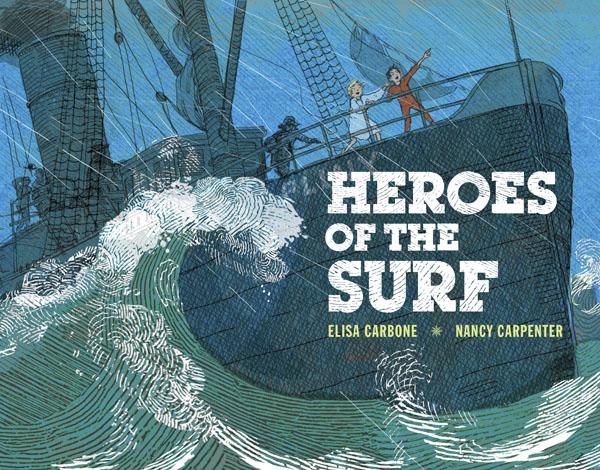
Heroes of the surf: A rescue story based on true events

Summary:   Two boys playing “pirate” on a steamship off the coast of New Jersey in 1882 find themselves in real danger when their ship runs aground.   Hope is almost lost when waves are too high to lower the life boats.  Someone spots something on the horizon.  Is it pirates?   No, there are rescuers in the surf!   Local people have prepared for ships running aground and are on their way to help!

What I liked about it: Introduces the history of the Coast Guard through a fictionalized story, but based on a actual event.   Illustrator Nancy Carpenter’s drawings vividly capture life on a steamship and the movement of the waves.

Who I would recommend it to: Grade 2-4.  This would be a great classroom read-aloud.