
The Mexican-American War explains manifest destiny and western expansion and how they led to the war. The book has a “What Have We Learned” chapter which shows a connection between the historical information and the current world. The books provide overviews of the conflicts in an easy-to-read format, including sidebars and personal narratives. There are also maps, photos, and illustrations, a glossary and a “Find Out More” section in the back with a list of additional resources to explore.. The book does a good job at presenting both sides of the Mexican-American War. In addition to battles, there are sections on some of the people involved and topics like weaponry and hardships and information on westward expansion like the Donner Party.
Score With Football Math
Without a doubt, there is a lot of math used in sports. In football, calculating a quarterback’s passing yards, figuring how many yards the football traveled for the touchdown, or the net distance of the punt, provides a gold mine for math learning in addition, subtraction, and geomentry. Math problems related to the length of the football field, the offense (passing, running and kicking), the defense (lineman, linebackers, and defensive backs), and a chapter featuring a real coach’s last game are the focus of the content. Embedded in the text is some history and stats about favorite athletes, too. One page of useful math problem-solving tips are listed…including…”Don’t get upset! You can solve problems better when you’re calm.” Lots of colored photos and colored text makes for highly attractive page layouts. Back matter includes Further Reading, Web Sites and Index. Given the recent Seahawks world championship win, this could be a popular book for teachers to use in their math programs. Other titles in the series include, basketball, race cars, and soccer.
Vehicles of World War II
Fans of military vehicles will not be disappointed in this amazingly extensive and diverse gallery of small but authentic photos. Brief comments accompany each photo explaining how it was used and special features. Vehicles on land, sea, and air , as well as four experimental vehicles are covered in this graphically, well designed publication. Periodic insets provide interesting war facts, such as…”More than 5,000 ships and 13,000 aircrafts were used in the D-Day landings.” Back matter includes Glossary Read More, Internet Sites and Index. Other titles in the War Vehicles series cover the Civil War, Iraq War, Vietnam War, and World War I.
Jane Goodall
With the Common Core State Standards focusing on non-fiction, it is hard to find quality introductory biographies for the first and second grades. The Pebble series seems to fit the bill. Jane’s Early Years are covered in two, two page spreads with photo on the left and text (four, large print sentences) on the right. At the bottom of the pages is a time line that only shows the year of her birth. The next part, Young Adult, continues in the same manner with additional years and her activities added to the time line. Life’s Work and Work Continues complete the contents. Interesting tidbits about her, as a person, help the reader connect with the biography, such as her favorite books as a child. From a developmental standpoint, I believe that less emphasis on dates and time lines is needed for the intended primary audience. It is known, in education circles, that the time line concept is not really understood until fourth grade. The back matter includes Glossary, Read More, Internet Sites and Index. Other titles in this series include: Clara Barton, Harriet Tubman, Pocahontas, Rosa Parks, and Susan B. Anthony.
Speed
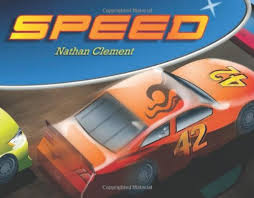
Fast paced, brightly colored, and simple text – it’s a winner!
Speed by Nathan Clement is just right for young stock car fans. Each two page computer rendered pencil drawings will capture a young reader’s attention.
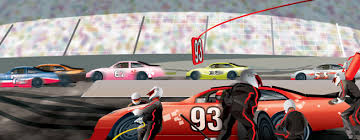 Clement manages to capture the excitement and feel of the races. The reader is taken right into the race from the shout of “start your engines” until the final checker flag. The story begs to be read again as readers discover that they have been privy to a young child’s imaginative play and “the next race is about to begin”. The end pages look like a checkered flag. The first page explains what each flag means.
This is one that I’m sure will be hard to keep on the shelf!
The Path of Names
Thirteen year old Dahlia has a summer camp experience like no other.
As part of a bargaining agreement with her parents, she must attend Camp Arava for two weeks. In trade she will then get to go to magic camp at the end of summer. Dahlia wants more than anything to improve her magic skills, so she accepts the deal. From the moment she arrives at Camp Arava unusual things begin to happen. She sees ghost children and she suddenly has inexplicably mad skills for understanding Hebrew. She begins to have visions and dreams of a man that lived seventy years ago. And then there’s the hedge maze; off limits and overgrown, but so enticing.
As the plot thickens so do the supernatural occurrences. A book of Kabala that mysteriously keeps finding its way back into Dahlia’s possesion, voices from the dead and a golem play key roles in unraveling this tale of mystery, spirituality, mysticism and adventure.
The author, Ari Goelman, has created a novel that fills a niche. Religion, mystery and adventure is a combination that is not often seen in children’s books. A component of the story revolves around spirituality and Kabala (Jewish mysticism) but Goelman handles the topic with finesse. He does not overwhelm the reader with in-depth information about the subject. He gives just enough information for a novice to understand and be engaged. Goelman deftly weaves several story lines into one engaging tale.
I found myself caring for the characters and was left wanting more when the story ended. This story might appeal to children who like mysteries, ghost stories, adventure or spirituality. The story is strong enough that if a child did not care for one aspect, it would not be enough to make them walk away. I feel this story could have a wider audience if certain items had not been included. I believe upper elementary students could have enjoyed this book if the following was left out:
In the girls cabin, the girls were to choose between a song or a story, but they wanted “S.O.S.” (sessions on sex). It was quickly overruled by a counselor in training. (p.173) This brief episode added nothing to the story, seemed a bit forced and could easily have been left out.
When a girl gets disturbed while sleeping she blurts out an expletive that some my find offensive. (p. 237)
These two items may seem minor, but when I consider my community’s culture I know this would not be a good choice as it stands. It is a shame too, because this well written, layered tale is one that upper elementary would also enjoy.
Pope Francis: First Pope From the Americas
Who is the man who became the 266th Pope of the Catholic Church on March 19, 2013? This Gateway Biography introduces us to Cardinal Jorge Mario Bergoglio of Argentina, elected to the papacy and the first non-European pope in more than 1200 years. He is the first Jesuit to be elected as well as the first pope to choose the name Francis. This biography follows Pope Francis from his days as a young chemist to his studies of theology. Not only does the reader learn of his beliefs, but also of his hobbies – including his interests in soccer and tango dancing. The true story behind the man is fascinating! The Lerner Publications Company produces a quality product from the binding to the colored photos.
The Favorite Daughter
Allen Say is the author and illustrator of numerous award-winning picture books. In this book The Favorite Daughter Mr. Say shows us a side of himself that we may not have yet seen. This is an inspiring tale of the love between a father and daughter…possibly Allen Say and his own daughter?? Yuriko has always been happy with her name, and she always loved to make art. When a new art teacher calls her “Eureka” by mistake, all the kids laugh. That makes her want to change who she is. And stop doing what she used to love. But when you run away from the things that make you “you” how do you find your way home? Yuriko’s father doesn’t have all the answers, but he does know how to help Yuriko find them herself. The author has a delightful sense of humor.
Get Well Soon, Grandpa!
What a beautiful, sentimental story! A granddaughter is staying with her grandpa when he suffers a stroke. She follows the emergency vehicle to the hospital in her mother’s car and visits her grandpa as he slowly recovers in the hospital. Grandpa recovers but can no longer live alone. This could have been a scary story for a young child, but the softness of the illustrations and the tender words made this a book I would not hesitate reading to a group of children.
What the Heart Knows: Chants, Charms & Blessings
In A Note To Readers, Newbery Award winner Joyce Sidman ( Dark Emperor) pulls us in…”We may no longer believe that words can make crops grow, prevent illness, or keep rivers from flooding. But we still believe in the power of the words themselves. Why else would we pray, sing, or write? Finding phrases to match the emotion inside us still brings an explosive, soaring joy.” These 29 thoughtful, brief poems bolster courage, encourage something to happen, help us remember, regret, and grieve, as well as celebrate thank or express love. Chant to Repair a Friendship is a beautiful invitation to reconciliation. Starting Now rallies us all to act in the face of injustice, and Lament for Teddy honors our regret in thinking we had outgrown our beloved cuddle bear. We need poetic forms to express our emotions. Thank you, Joyce Sidman! Thank you, too, to Caldecott Honor winner, Pamela Zagarenski, whose exquisite illusrations capture the text and symbolism of each poem.