
I really like the story. I wish I liked the illustrations more. It’s not even the illustrations themselves I object to, but I’ve been noticing a trend lately in too many picture books that I don’t like: the only word I can find for the color scheme is drab. The story itself is great — it’s so many elements that so many folks can relate to: moving to a new neighborhood, wishing for a tree house, father-sons bonding activity, brotherly bonding, little brother’s remorse as big brother moves on to new interests/friends, community bonding during a summer black-out, reconnecting. I like the use of silhouette, but I just can’t get past the drabness of the colors in the rest of the illustration.
Good Night, Sleep Tight
The surface tale of a favorite baby-sitter putting his young charges to bed is the setting for sharing a litany of old classic childhood rhymes. Every time Skinny Doug shares one of the old classics, the children shout for him to say it again, but he always delays until some other time, offering instead that, “I’ll tell you another I heard from my mother:” and so the children hear of bed bugs that bite, the old man who went to bed and bumped his head, the piggies who went to market, and a handful of other old classics. The simple cartoon-like illustrations insert the children and their sitter into the heart of each of the old rhymes. A great way to share some old classics.
Tea Rex
A delightfully charming, silly, mash-up showing what happens when one invites a T-Rex to a tea party. The humor in this story comes from combining the illustrations with the text. Taken alone, the genteel text is simply a manners manual instructing one on the proper etiquette when inviting guests to tea. It’s the silly illustrations that demonstrate the riotous results when applied to dinosaurs. Fun for all!
Time-Out for Sophie
Though perhaps intended primarily for pre-school audiences, early elementary students who have younger brothers or sisters at home will certainly recognize the typically toddler behaviors that keep landing Sophie in time-out. When grandma turns the tables at the end and puts herself in time-out, Sophie comes to her rescue and all is well.
Zoom in on Bees
This nonfiction book placed the vocabulary words at the BEGINNING of the book, instead of the end. It’s after the fact at the end. Appreciated is the no nonsense explanation of the anatomy, homes, and lifecycle of bees. The photos in the book were exceptional. Missing is a geography page where we can locate these creatures on the planet. Also a scale of size would be nice, how about a page comparing it to a common house fly, ant, robin, etc. so that the students could practice compare and contrast. Also, this reviewer wasn’t able to get to the suggested website, http://readysetflow.org/activitysheets/index.html. Additional purchase
Invisibility
Romance is the spark that ignites interest in this fantasy novel about spell seekers and curse casters by the husband and wife writing team of Cremer and Levithan. Each writer has individually authored popular Young Adult Fiction novels. In Invisibility, they alternate each chapter between the voice of the invisible boy, Stephen, and the emotions and observations of his “ordinary” friend, Elizabeth, the new girl in the next apartment . A lonely, awkward young woman from the mid-west, new to New York and happy to blend into anonymity of the big city of New York, Elizabeth is the only one who can see Stephen. No surprises in the plot that the only person who can see the invisible boy may be the one who can break the curse put on him by a vengeful grandfather. This is an easy read with the only memorable, serious note being the tender, insightful manner in which the sexual coming out the younger brother is handled. Recommended with limited enthusiasm.
How Big? Wacky Ways to Compare Size
The illustrations in this book are certainly eye-catching as they are contrasting colors and full of textures. Some of the things that are being compared are beyond many students’ experiences and the large numbers are so random that in some ways it’s interesting and in others it’s not so much. Who cares if the Empire State Building in New York is the same as 264 gorillas, which I doubt. Unless you’ve even been to New York and experienced the Empire State Building, how would kids distinguish it from any other building? Where we live buildings aren’t very tall due to earthquakes, so size is relative. It seems it would make more sense if the size grew exponentially but it’s so random, like 1,226,880 peas in a manatee–really?
Jack and the Beanstalk
This version of Jack and the Beanstalk was first published in 1974 and has been retold countless times since then. A disclaimer in the front states that this version is adapted from a book titled The History of Mother Twaddle and the Marvelous Achievementsof her Son Jack, written in 1807. The title is a mouthful. In this version, Jack’s mother is sweeping the floor and finds a coin and sends Jack with it to market to buy a goose. They don’t say they are poor and about to starve, nor do the illustrations show a poor, rundown home, but actually a well-equiped and furnished home. He goes to the market and rather than getting a goose he falls for a peddler selling a magic bean. The story goes as expected until Jack climbs up the beanstalk, the giant does his fe, fe, fo, fum, drinks and falls asleep. There is no golden egg-laying chicken, no bag of gold, no singing harp. Jack chops off the giant’s head and sends for his mother and they both live happily ever after. This story is too gruesome and violent to read to the audience for which it is intended. I won’t use it to compare to other stories, nor will I keep it on the shelf.
Rumpelstiltskin
Rumpelstiltskin is a classic fairy tale with this version by Galdone being the standard to which others are compared. Rumpelstiltskin is the odd little man who appears in the straw room to help the unnamed miller’s daughter spin straw into gold. The third time he helps her she agrees to give him her first child. A year later he comes to collect his due. He takes pity on her sorrow at giving up her child and allows her three days to guess his name. If she cannot, he gets the child. She sends a servant to follow him and he comes back with his name and she lived happily ever after. Many versions have been written since this one was published in 1985. However, this reissue has the same illustrations which are a little rough around the edges in comparison. It is still a book that every school library should have in its collection.
Shaun White: A Snowboarder and Skateboarder Who Cares
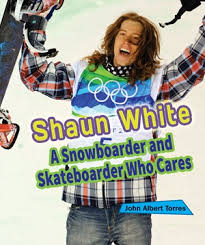
This biography profiles the life and career of Shaun White. It starts with the medical troubles he faced as an infant and continues his life story up to the present.
Shaun White is a positive role model and the writer does an apt job of highlighting all of Shaun’s good qualities – perseverance, compassion, determination, generosity and friendliness. Most upper elementary students will enjoy this book, with career stats, a glossary, additional reading titles, available websites for further reading, contact information for writing to Shaun and even his Twitter page.
The writing is on level for 4th-6th graders, told in third person. One section makes an unexpected transition to first person and seems a bit jarring. It will make the reader look to see if a page was overlooked. Other than that, this is an interesting read.