I thought it was really rather lame. It didn’t really seem to flow very well. It’s about a girl who really wants a dog but can’t have one because she’s allergic. In the winter she makes a dog out of snow (and for some reason kids laugh and tell her there’s no such thing as a snow dog, but they don’t seem to have any kind of reaction when it comes to life and starts following her around). Similar scenarios repeat each season as she makes a dog out of flower blossoms in spring and sand in the summer and leaves in the fall. For some unknown reason, although the snow and sand dogs look pretty much the same in their live forms as they started out, the leaf and flower dogs stop looking like they’re made from leaves or flowers when they come to life.
Down the Rabbit Hole: the diary of Pringle Rose, Chicago, Illinois, 1871
It pains me to say it, as I’ve really enjoyed other books in this series and other books by this author, but I was disappointed with this book. It’s like it never really committed to deciding what it was meant to be about. It’s a little about labor unrest of the time, a little about attitudes towards the mentally handicapped, a little about the rights of women and animals, and a little about the great Chicago fire. It’s got good characters and I started out enjoying it, but it never seemed to develop any kind of focus or purpose; it just sort of rambled on for a bit, and then there was an epilogue tacked on the end to wrap up the loose ends, but there was never any kind of actual conclusion.
The Mouse with the Question Mark Tail
A delightful story of the hidden world of mice that mirrors that of humans. Set during the jubilee celebration of Queen Victoria, the basic premise of the tale supposes that for every human job, there is a mouse with the same job, scurrying about in the hidden spaces, staying away from human eyes. The hero of this story grew up in the Mews outside Buckingham Palace, but has never been given a proper name, as no one seems to know his parentage: he is simply called according to the distinctive shape his tail falls into. A series of scrapes and adventures amidst the flurry of castle preparations for the grand celebration eventually lead the the revelation of his true identity.
Eye to Eye: How Animals See the World
Steve Jenkins knows how to rivet readers to his books, gazing at the gorgeous, large -format cut-paper illustrations. This particular volume explores eyes in the animal kingdom and how they use them to see the world. Twenty animals are presented…from the well known garden snail, to the lesser known brownsnout spookfish…from the small stalk-eyed fly, to the enormous hippopotamus. Each two-page spread includes two animals accompanied by a brief explanation their eyes. Young children will be drawn to this book, however, they will need scaffolding by an adult to understand the complex vocabulary and concepts, which seems to be more appropriate for an older audience. Back matter, in Steve Jenkins’ fashion, includes much more information, such as a chart explaining the evolution of the eye, as well as more facts about the animals in the book. This is the place where you can find the relative size of the animal, which is hard to conceptualize from the illustrations. Bibliography and glossary are there, as well.
The No-Dogs Allowed Rule
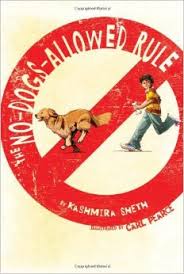 Ishan (pronounced E-Shan) a third grade boy and his brother Sunil, a fourth grader, desperately want a dog. However, Mom has a “no dogs allowed” rule. Ishan goes to great lengths to try to persuade his Mom into a “dogs allowed” rule. He helps his elderly neighbor walk his dog to prove he can be responsible (ok and to also get his dog fix for the day). He tries to cook a special meal to please his mom and try to win her over. He even changes all the family pictures in the house to dog pictures. Each well intentioned act becomes more of a disaster than a gift. So much so, that Ishan is grounded to the house during a neighborhood block meeting held at his home. During the meeting an emergency involving his neighbor occurs and Ishan saves the day. Will this be the action that changes mom’s mind to allow a dog to enter the family home?
Written with realistic speech patterns and plausible scenarios this multicultural novel introduces readers to foods of India, Hindi words and social interactions of Indian culture and family life.
Everyone Needs A Friend
Soft, colorful oil pastels welcome the reader to a sweet story about a wolf named Jack who lives alone, filling up his time with making jam and knitting warm scarves. Jack meets Walter, a mouse. (They both resemble cuddly plush toys.) They become friends while spending time together…sharing the jam on toast, and playing in the snow. The longer Walter stays, the more Jack discovers things about Walter that are annoying…like his loud snoring and the messes that he makes. Does his need for a friend outweigh the downside of Walter’s personality? Readers can identify with this dilemma, in finding and keeping their own friends. Here is an unassuming book with gorgeous illustrations and concise text…that deals with a universal theme that all of us have dealt with at some time or another. Yes, everyone needs a friend, and guaranteed, they will come perfectly flawed.
Santino Marella
 A non-fiction, Hi/Lo book about World Wrestling Entertainment (WWE) champion, Santino Marella. This short biography of Marella features full color photographs, statistics, signature moves and career history. A table of contents, index, glossary and “to learn more” page round out the book.
The publisher states that this book is intended for grades 3rd – 7th, but advanced 2nd grade readers interested in this subject would enjoy the book as well.
Seriously, Snow White was So Forgetful! : The story of Snow White as told by the Seven Dwarfs
 A fractured fairy tale that shows us Snow White as a very chatty, forgetful sort. Staying mainly on course for the plot line, Loewen gives us a different look at Snow and Prince Charming too. The story is told by Seven (Snow can’t remember the dwarfs names but can remember their designated number). He tells a tale of how Snow came to live with the seven dwarfs and how it takes the Queen three attempts to finally curse Snow (with the spell she casts in the traditionally version of the story). But no yucky kissing to break the spell, no sir. The spell is broken by an unfortunate slip and the possibility of some lunch.
Nicely illustrated by Gerald Guerlais. Children will enjoy concentrating on the pictures during a read aloud. Independent readers may linger a bit longer on each page just to absorb the content of the drawings.
Scaredy Squirrel Goes Camping
 Scaredy Squirrel is afraid of the big outdoors. Well, actually, he’s scared of more than that, a lot more, but he knows how to deal with his fears – by making lists and planning to overcome any trouble he encounters. Camping outdoors seems like way too much trouble, so he decides he would rather watch it on TV instead. In order to enjoy the outdoors on his TV he will first need to plug in his extension cord at a local campground. After making his list of fears and creating solutions to deal with them, he dons his protective gear and bravely heads out into “the wild”. Of course, something happens to derail his plans (oh no! Penguins! His worst fear!). Curiosity overrides fear as he learns a valuable lesson.
Another cute, funny and entertaining book in this series. Large colorful pictures and simple descriptive text are used to create a story that both children and adults will enjoy.
Titanic
Titanic has intermittent pages set up that asks the reader questions about the event. This book is informative from the creation of the Titanic and its physical description to its sinking, including locations of the ice field and the other ships in the area at the time. Large color photographs of the Titanic and recreations of the event, diagrams, time lines and graphs are found all throughout the book. Details allow the reader to understand the pieces of that evening and the order of their occurrence allowing the reader to make judgments of how the evening developed. Eyewitness accounts from survivors well as photos of those who did not survive can be found throughout the book. Primary sources are a strength as well as the ability to download a digital book: True Survivors’ Stories.