Children Growing Up with War

Photojournalist Jenny Matthews begins her book by discussing what it means to be a freelance photographer, how she got started and how she is able to go into conflict zones and do her job. She ends her introduction with the UN Convention Rights of the Child. She uses these rights as an organizational tool; each chapter is devoted to certain rights. Although it might seem disjointed to some, this method allows Matthews to cover a significant number of conflicts all over the world instead of just a few.

Matthews puts a personal face on conflicts. She discusses the expectation that journalists should be objective and neutral, but says she that tries to get as close as she can to her subjects. She tries to listen and observer; she wants to understand what they are going through. Trying to minimize the distance between herself and her subjects serves her well; her photographs are moving. While some of them depict the result of violence, they are not gratuitously violent. Some of them are hopeful.

There are charts with important data intermingled with the photos: how many people are displaced by war, the percentage of refugees who are children, or the percentage of children who are killed or maimed by land mines. At the end of the book, there is a map of countries referred to in the book, a short description of the major conflicts, a glossary and a list of websites for further information.
Minerva Louise

Since this book was originally published, Minerva Louise has appeared in a bouquet of friendly picture books.  In this introduction to the character, our hen interprets the sights within a house through the lens of her normal view outdoors.  A tricycle is a tractor.  A bedspread is a field of flowers.  Stoeke effortlessly depicts a friendly way to encounter newness.  The illustrations are framed in rough rectangles on white pages, and the text is written in a large font at the bottom of each page.  All of the objects are simply drawn, with easy lines and bright colors.  A practiced provider of group storytimes will wish each picture filled more of the page (to be more easily seen across a room), but lap-sharing children will enjoy the subtlety, as they get to discover each new misunderstanding.  Minerva Louise’s story is a classic in the most deserving sense.

The Last Dragonslayer

Jennifer Strange has found herself the caretaker for a bunch of magicians.  Strange lives in an alternate world to our own: magic is mainstream – though fading – and the last dragon’s land is in danger of development.  Fforde builds an unexpected version of a magical world.  He integrates magic into a version of modern life, and considers the logistics of magic as known quantity.  Readers will enjoy the use of language, clever turns of phrase, and winks to the sides of the narrative.  Fforde invents some particularly endearing characters, such as the Quarkbeast (for who wouldn’t love a razor-sharp doggish creature?), and imparts wisdom about greed and corporate development, and finding one’s place in the world.  This title has broad appeal, and will find a few passionately rabid fans as well.

Scooby-Doo: The Mystery of the Aztec Tomb

Stone Arch Books are bringing back titles where the reader is given about 13 options to choose the plot’s direction.

Scooby-Doo fans are taken on a trip to Mexico in the ‘Mystery Machine’ to help Velma’s uncle, a world famous archaeologist. As the gang enter a pyramid, Daphne touches a stone face releasing a trap door releasing a sloping shaft which splits into 3 tunnels. The reader is given his/her first choice as to which of the three tunnels to follow.   “To follow Shaggy and Scooby into a spooky cave, turn to page 12.”

“To follow Daphne into an ancient tomb, turn to page 14.”

“To follow Fred and Velma to an underground city, turn to page 16.”  (page 11)

Once the reader makes this first choice he reads a page or two of story before the reader is asked to make another choice. The book continues this way for about 4 or 5 more twists and turns in the story before “THE END” appears.

Author, Laurie S. Sutton, includes typical Scooby-Doo sayings.  Some of the story scenarios are predictable if you’ve watched their cartoons and some endings are better than others. This is a quick fun read for intermediate grade readers, especially if they are familiar with the Scooby-Doo Show.

There are 10 full page color illustrations mixed in throughout the book. I was frustrated when I couldn’t make the correct plot choices to get to particular pictures, though.

There is a glossary.

There are, also, two pages of jokes where “YOU CHOOSE which punch line is funniest!”

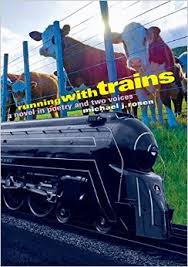
Running With Trains: a novel in poetry and two voices

Running With Trains is a story told from two perspectives and told in verse.

Set in the 1970’s, we first hear from Perry a 13 year old boy who feels adrift in turbulent times: his father is missing in action in Vietnam, his mother is studying to become a nurse in the city, and his older sister is in college where political protests keep her from connecting with her brother or family. On his weekly travels between his hometown where he lives with his grandmother, and Cincinnati where he lives with his mother on weekends; Perry looks out his window and notices Steve whose farm lies on the rail line that Perry travels each week.

Steve likes to race the train as it crosses his fields;  Steve watches the train and dreams about the people, places and adventures that he feels he may never come to know.

In alternating voices, Michael J. Rosen weaves a tale of two boys—one wishing for the stability of home, the other yearning to travel—and the unexpected impact of their fleeting encounter (when a cow causes the train to stop). After their brief meeting both boys are left wondering if the grass is indeed greener on the other side of the train window?

This is a comfortable read, not a lot of drama or high adventure.  Like the train in the story it takes the reader from point A to point B with a reliable steadiness, but it does give the reader some new perspective to consider.

Henry Holton Takes the Ice

Henry Holton’s dad played hockey.  So did his mom, his grandfather, his uncle, all twenty-three of his cousins, and his big sister, Sally.  Henry’s family was HOCKEY MAD.  Henry loved to skate, but he knew that he didn’t want to carry a hockey stick or body check other skaters.  Henry wanted to be an ice dancer.  This is a very sweet and entertaining book about following your dreams!

Disgusting Animals

This book attempts to draw in young readers by describing what is “gross” about a number of animals.  Although the pictures are vibrant and engaging, the descriptions of the animals are derogatory and often at the expense of other animals.  Nake Mole Rats, for example, have “gross genes” and look “like an old person.  It is bald and coverd with wrinkles.  The star-nosed mole “has a face only its mother can love.”  Many elementary schools battle bullying and belittling behavior; we don’t need books that describe animals in such derogatory terms.


One Direction

Fans of  One Direction, the pop music group, will be checking this book out! Each of the five members of group One Direction are given four individual pages to themselves. One of the three pages is always a total head shot of either: Harry, Niall, Louis, Zayn ( who is no longer with One Direction , as of March 2015), and Liam. Information on how each of the five lads came to be on the television show “The X Factor” is given followed by how they were then put together as a group forming One Direction.

One Direction’s (1D) world tour and  three albums are named. The fact that their tours are sold-out and all three of their albums have made it to the #1 position on the BILLBOARD CHARTS make this group phenomenal.

Reporters and fans are always eager to ask them questions and after five years of questions, you know just a few of them have already been asked once or twice.  “After awhile, being asked the same questions over and over became a bit dull. So to liven things up, Harry, Niall, Louis, Zayn, and Liam chose to have fun with the questions. Reporters got used to the boys joking around… A 1D interview soon became a laughathon!” (p. 35)

Directioners ( what One Direction fans are called) will enjoy this book. Good luck librarians getting this book back from your patrons on time for the next Directioner to check out.

Scooby-Doo! Monster Jokes

Scoody-Doo and his gang are telling jokes about monsters. The jokes are categorized : blood thirsty monsters (mostly vampire jokes); phantoms, spirits, and spooks; mad scientist jokes; six-feet under (mostly skeleton jokes); Frankenstein funnies; witch is which?; prison breaks; and werewolves, aliens, and other creepy crawlies. The jokes have nothing to do with the actual Scooby-Doo characters, but their facial expressions are funny. The sames jokes would be funny without the Sccoby-Doo illustrations, similar to jokes told on television, but without using a ‘laugh-track’ to cue the audience.

Some of the jokes I tested out on a fifth grade class orally needed to have the answers ‘seen’ for my audience to understand the joke, as on page 8: “Why did Godzilla eat all the furniture in the hotel room?  He had a suite tooth!” BUT once the punch-line was seen, laughs reigned. Homophones, dual-meaning words / phrases, and words with similar but substituted sounds make this a joke book intermediate grade students will like.

After the last joke, there are two in-depth pages on “How to Tell Jokes!” in 9 steps.

And with all that said, “What did the movie director say when she had finished her mummy movie? That’s a wrap!’  “(p. 30)