Dandy is very worried about the fifth grade spelling bee because his family has a history of winning the contest. When Dandy steps on stage and starts spelling, crazy things happen to interrupt him. The speakers buzz loudly, the microphone cuts in and out, and then thousands of bees swarm the auditorium making it impossible for Dandy to compete. Malcolm, his best friend, realizes that the contest is being haunted and the boys go into action to stop the spelling bee specter. This is book number 19 in the Ghost Detectors series. This is a fun story of the two ghost detector friends.
Return to the Crows
The eleventh book in the Faerieground series, it brings loyalty, trust, friendship and love into this fantasy of a war between the faeries and the crows. The faerie heroes go to battle to free the faerie Queen, Soli. This book ends in the midst of the war, leaving the reader to turn to book twelve for the conclusion. The illustrations are amazingly detailed watercolor images. The text is very simple, appealing to the low level readers as well as the reluctant readers.
The Prince of Peas
The Prince of Peas is a parody of the fairy tale The Princess and the Pea. The art work makes this an excellent picture book to use with high school art students. The numerous inferences throughout the story both in text and illustration make this story for a mature audience, rather than an elementary reader*.
“Princess Antoinette [ a rabbit] has decided to wed. The idea has been growing like a pea in her head.” The first prince, possible groom, is musician Prince Tristan [a cat]. He spends the night of the party playing with the musicians in the band, instead of holding Antoinette’s hand. Then, he fails the pea test under the seven mattresses because his dog does not like heights. The second prince, Prince Victor [a boar] finds his bed too skimpy, so goes out to sleep with his war horse. Antoinette gives the search for a prince one more try. Prince Philippe [a stag] is spotted saving a cat from drowning. after the ball Antoinette and Philippe hold ‘hand(s) as they bounce on his bed.” All the bouncing on the bed lets Queen Louise [a crow] know this is the right spouse for her daughter. “Antoinette is so happy, so pleased to be wed, that another idea takes shape in her head. [a page turn] The months, they pass by, the idea grows and grows… into a new little Prince with a pea for a nose!”
*The little prince has a green pea for a nose, one rabbit ear and one stag antler. So my question is, did author Sylvie Chausse mean for this to be a simple retelling of the classic Princess and the Pea? If so, is Sylvie Chausse happy with the illustrations that lead me to think there is a hidden meaning, dealing in favor of interracial marriage, on the part of the illustrator Anne Letuffe. That aside, the illustrations are mixed media, using layers of drawn art with fabric for clothing , maps, textured paper, photos of actual peas and pea plants.
One Red Shoe
This is a YA “Twilight Zone” style story in picture book form. This book asks the question, “How should we react to the violence of war in a far off country?”
The gray on gray illustrations tell the story of a war zone photo journalist who follows a 9 yr. old boy, wounded in a school bus attack, to the hospital. The photo journalist finds difficulty with this boy’s photo story because the boy reminds him of his own nephew who he gave the same pair of red shoes to for his eighth birthday. “I looked through the last shots: I had taken the same photo twelve times. In each one, Kenan was stretched out on the gurney, a bloodied bandage on his head and a red basketball shoe on his left foot.” On the next/last page turn with text, the reader finds the photo journalist talking with his nephew on the phone about he nephew’s upcoming basketball game. The last page turn reveals the photo journalist in his office contemplating this story’s events. He is siting on the edge of the desk with one foot on his chair and a lit cigarette in his hand. On the desk is a newspaper whose headline reads ‘School Bus Attacked’ under a photo of the bus.
Click, Clack, Ho! Ho! Ho!
Well it kinda feels like it falls into the category of a book you just have to have in your library, if only because all the little fans of the other Click Clack books who know there is a Christmas one, are going to want it. It’s fun. It’s got the same characters from all the other books, and it opens with Farmer Brown hanging the stockings while listening to sounds outside that send him to bed in anticipation that Santa is near. All the while, the illustrations are showing the reader that it’s really Duck in a Santa cap playing on the roof that Farmer Brown hears, but when Duck gets himself stuck in the chimney and all the other animals are trying to help, but getting themselves stuck, too, we do see Santa’s sleigh silhouetted in the distance, and sure enough Santa comes to the rescue, because of course he never gets stuck in a chimney.
The Bus Ride
The illustrations are really charming, but the story is a bit flat. It tells of a young girl (about age 6 give or take a couple years?) riding the bus by herself for the first time, to go visit grandma. Who let’s a kid that young ride a bus by themselves? Now granted, it’s obviously not meant to be taken seriously, as all the other passengers on the bus are animals dressed as people, but still. The text is mostly just a ramble of the girl’s thoughts, and the story is mostly told through looking at the details of the pictures, and that is mostly just a story of watching the different characters come and go. At the end of the ride, we see the girl connect with her grandma, proclaiming that she’s got so much to tell. But really not much happened.
Boats Float!
Rhyming text celebrates all the different kinds of boats. The illustrations are beautiful, and support the text. Both words and pictures are fairly simple, contributing to its charm.
What in the World: numbers in nature
The question-answer format invites students to ponder their own ideas about where they see numbers in nature. The illustrations are beautiful. The examples given of number sets in nature are all things kids can recognize (birds have 2 wings, clovers have three leaves, etc.), and after reaching ten fingers and toes, it asks what comes in numbers too big to count, and suggests the starts.
Sea Monsters vs. Dragons: Showdown of the Legends
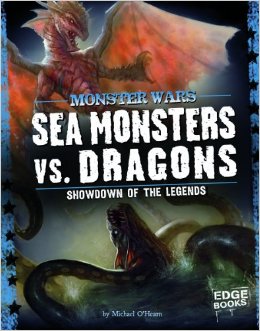 This book may appeal to boys who are reluctant readers and may be considered a hi/lo book.
Each battle contender is given stats like you might see for athletes: speed, size, weakness and attack style. The first few pages are dedicated to folklore and history surrounding each of the beasts. Twenty pages in and the battle begins, at which point the text changes to a narrated story.
Table of contents, index and glossary as well as definitions in text. A short “Read More” section provides the reader with three more book titles to explore. And the “Internet Sites“ directs the reader to National Geographic’s Komodo Dragon page and a site dedicated to the Loch Ness monster. Full color illustrations on every page.
I anticipate this series to be a big hit with many of my students.
Dragon and Captain
A fun romp celebrating the power of imagination. Told in the style of a graphic novel, all the words and dialogue tell the story of a dragon encountering what he thinks is a pirate, but turns out to be a ship’s captain whose ship has been stolen by pirates, and they work together to rescue the ship. The bright-colored illustrations go back and forth between images of what the boys see in their imaginations, and the prosaic realities of the boy in the dragon suit playing with the boy in the sailor’s hat in the backyard while the moms do laundry.