
It’s got a reasonable amount of information for a beginning reader. When one glances at the table of content, it looks like it’s got about 5-6 chapters, until you look closely and realize 4 of the 6 sections listed refer to the Non-Fiction text features included on the last three pages (More Facts, Glossary, Index, Online Resources). It really just has the two chapters: Bulldozers, which describes the different parts of the machines, and Different Jobs, which describes exactly what it says. It gets points for including a photo of a young woman as the bulldozer operator, and for including details about why the different parts are designed as they are. And it has a sturdy binding.
Bus Drivers
It’s got some information. It points out different kinds of bus drivers (some drive passengers to work or to school or on tours). It points out their responsibilities for keeping passengers safe, maintaining their buses (though to all bus drivers do that themselves?), and keeping to schedules. But it makes some cheerfully general statements that make me question: the book starts off with a girl getting on a bus for her first time and states that the driver helps her find friends. Really? Or did the driver help her find a seat, and if she happens to make friends with the others nearby, that’s pretty much dependent on luck. Do all drivers drive the same routes daily? Or do they sometimes cover for someone who is sick or take a tour group to a new destination?
Teachers
This book is completely weak on information. There is nothing that a student is going to learn from this book if they have already spent a whole day in a classroom. It completely over-simplifies the job of teachers. I realize they are trying to keep things simple for early readers, but by spending 24 pages to tell readers things they already know this book just reinforces the belief some struggling readers hold that reading holds no purpose.
Jorge el curioso de basura a tesoro / Curious George Trash into Treasure
Seriously, this book is just encouraging kids to keep junk. When George starts out to help clean up the neighborhood, he ends up deciding he wants to keep everything he found. When the man explains that a collection is one particular kind of thing, and asks George to choose one particular kind of thing to keep and to throw out the rest, George wants to keep it all, so he just arranges it all by color and and calls it a color collection. It’s still junk: a broken mug is still a broken mug, and a single high-heeled shoe still serves him no purpose, and it’s all still all over the living room floor of their apartment; but somehow we’re supposed to be impressed that he turned trash into something “beautiful”?
Hawai’i Volcanoes National Park
If it funds are limited, a book more broadly about volcanoes in general and/or a book more generally about Hawaii seem like more sensible options. But if you’ve got a class studying a unit on either volcanoes or Hawaii, and would like a selection that offers more specific information about these particular volcanoes, this is a good choice. It includes a bit of information about the history of the park, the role of volcanoes in creating the Hawaiian islands, general information about volcanoes, as well as specific details about the history and behavior of these particular ones. And it does it all with a format and simplicity of text that makes it suitable for young audiences.
Sound
It’s small, compact, simply laid out, with large font and full-page color photos. All these design elements keep it inviting and non-intimidating for young readers. There are just a few sentences per page, each easily understood, and yet it doesn’t feel skimpy on information. It manages to describe the physics of sound waves and vibrations in terms of tangible things with which young students will be familiar (e.g. stating that though sound waves move through the air invisibly, they do so much as ripples in a pond move through the water). All in all, it’s a solid choice to support the science curriculum.
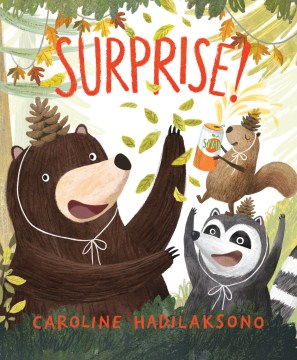
Surprise!
Bear, Raccoon and Squirrel are bored. Time to make new friends, but the other woodland creatures aren’t interested. So, the three friends search and locate a nice family of city folks that are out camping. Before they can introduce themselves, the family wanders away from the campsite. While they are gone, the three animals do their best to make the (future) party festive, by decorating (making a mess), preparing the food (eating it) and picking pine cones for hats.
They excitedly await the arrival of the their city folks friends. But, they have a surprise themselves. The city folks go running off like they’re scared! Bear, Squirrel and Raccoon are sad. But, they don’t let their sadness get in the way of their fun. They continue the party without the city folks. Fun!
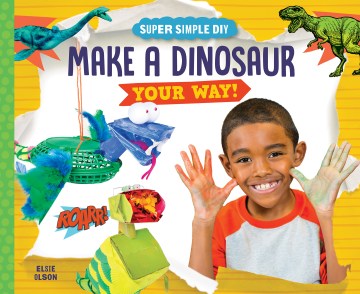
Make a Dinosaur Your Way!
Kids are encouraged to build a dinosaur and given some suggestions for materials and tools. They are not given exact instructions. Rather, they are given some guidance and lots of freedom to use their imagination. And, while there are some photos for inspiration, they don’t make the reader feel as if the dinosaur models pictured are the only way to create. This open-ended instructional text is a nice addition to the maker movement in your library.
Super Gross Slime and Snot Projects
The best way to interest kids in science is to make it as gross as possible. This book does just that by introducing slime and snot and then following up with some wonderfully disgusting projects like ‘diaper snot’ or ‘fart putty’ (who wouldn’t love a batch of that?). Materials are easily procured and adults are advised to preview the projects and provide help with sharp implements, food coloring, etc. Pull this book out when you want some great reactions from your students!

Survivor Diaries: Dust Storm!
I go down to Las Vegas, Nevada, not to gamble, but to go out into the desert hiking. I have lived where dust storms occur, but have never been in one myself. I have been on a week long bicycle tour in the Rocky Mountains. And I have gone hiking with my sons’ boy scout troop when survival gear is always inspected before leaving the parking lot. All of these play a part in this story. Now every time I think about this book, my eyes get scratchy and itchy.
This book is set in the Chihuahuan Desert in New Mexico. It is the retelling of what should have been a great time at a club geocaching competition by sixth graders on bicycles. It turns out to be a story of survival , as the title suggests, but it is also the tale of how two young people rediscover their lost friendship and why.
When the club’s van gets stuck, Mr. Lee goes for help, while the 6th grade geocaching team stays with Mrs. Sloan and the van. Martin’s need to win this competition has Martin sneaking through Mr. Lee’s brief case to find the coordinates. Jen sees this and follows Martin out into the desert, when no one is looking. Shortly, the dust storm engulfs them. At times, they have no idea where the other one is the dust is so blindingly thick and loud. The dust stings their eyes and skin, fills their ears and noses. The dust is choking. They survive the storm, but will they survive the desert! They are lost. Their bicycles are ruined. They are in an arroyo which will be the path of the flash flood, that follows a dust storm.
Jen has book knowledge and Martin has math on his side. If they work together these two who were once good friends might get out of this alive. They will face coyotes and the coldness of the desert by night, extreme heat without shade and thirst without water by day.
What Jen and Martin did not do is stay put, so searchers could easily find them. They can hear the rescue helicopter, but it can not see or hear them.
What Jen and Martin did do correctly and how they were finally rescued could have all been avoided, but they are back to being friends due to being put to this test. They, also, are doing volunteer hours of community service to help pay back for the hours put into their rescue effort.
I am looking forward to reading the other three books in this series.
After the story there are ‘Survival tips from the New Mexico Search and Rescue Council’, plus a list of the ten bare essentials of wilderness travel.