
In the fourth book in the series The Vanderbeekers Lost and Found does not disappoint! This is a heart-warming story about a family of seven with five children ranging from ages 5-14. The Vanderbeekers’ have long-established relationships with their neighbors, taking them on as part of their own family in a fast-paced, realistic novel about community in a New York City brownstone. The kids in the book are strategizing to keep a close friend from moving out of state while he suffers from poverty, homelessness and neglect. The loss of a loved one is a very sad, major event in the book but what shines is the family’s ability to overcome and embrace their memories of him. I loved that pure generosity, helping others and friendship from the kids’ perspectives is a constant throughout the book. While the story touches on poverty and making ends meet, the real reason I would recommend for grades 5 and up would be the parts about loss/grief and dating. The high school freshmen discuss homecoming, boyfriends and jealousy (topics I prefer to reserve for middle grades.)
Brawler
Take the UFC to a whole new underground, illegal and nearly deadly, once-you-are-in-you-are-in-for-life level of mixed martial arts and you get Brawler by Neil Connelly. There are many brawlers in this low-brow community. Slated to win the state championship in his weight class for the 2nd year in a row, Eddie MacIntyre loses control during the district wrestling tournament, taking a swing at the referee and breaking his jaw. Assault charges on the way, Eddie is accosted by a gentleman who has been watching his aggressive wrestling style for quite some time. Eddie chooses to go down the road to big money in bad places. Eddie is given a personal trainer- a girl with Tae-Kwon-Do skills whose father was also wrapped up in the business, as was Eddie’s own father, unbeknownst to him. Once you’re in, you’re in until you are dead or near death from revenge. Eddie is truly a brawler, beating guys stronger than him because he could forecast their next moves. But there’s no good way out of this life which keeps readers going until the end just to see how Connelly resolves the story. While brutal and very detailed with wrestling jargon, fans of MMA will probably devour it.
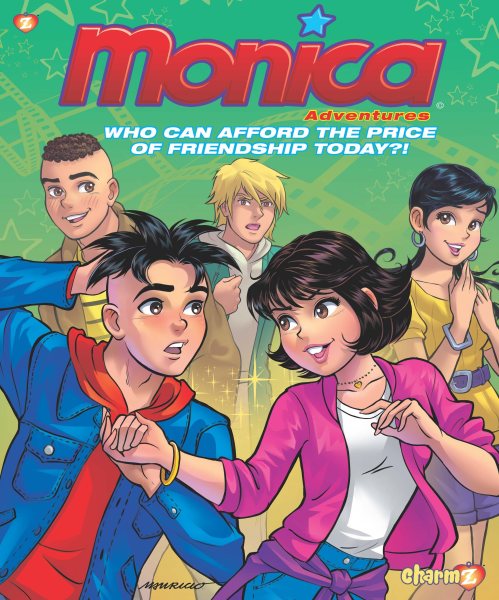
Monica adventures. #1,Who can afford the price of friendship today?! (Monica Adventures, Book 1)
This is the first graphic novel in a series about the adventures of teenage girl Monica and her friend group, “Monica’s Gang.” It’s actually based on a widely-loved comic strip from Brazil that started in the 1960s. While the insanely popular comics were about the adventures of a group of kids, the graphic novel follows the same group as teens as they try to navigate their changing relationships and new challenges while still maintaining their strong friendships with each other.
It’s a fun story very reminiscent of Archie comics, and it was neat learning about the comic’s history at the end and noticing sprinklings of the classic comic referenced in the graphic novel. I found I was able to follow along with the story without having any background in the comics previously. The illustrations were fun and the characters were engaging and animated.
I did find issue with a couple elements in the story that I feel detracted from the book overall. This is intended for kids aged 8-12, but it focused pretty heavily on Monica and her friend J-Five’s growing affection for each other. I wished it was more about their friend group’s random adventures and less about romance. Additionally, Monica’s friend Maggy is really focused on the caloric content of foods. In her character description at the start, the book says she’s “…virtually obsessed with proper nutrition, sports, and exercise…” but instead of showing an interest in nutrition, she just seemed obsessed with how many calories were in what she was eating. There’s also a couple in one scene (page 56) where the girl explains to her date that girls have to care more about calories and fat because “If we were to stop and think like you boys…we wouldn’t have these bodies and we’d have big ol’ bellies!” and then an image is depicted showing a guy with a little bit of a stomach next to a thin girl. She proceeds to tell her date that he should get back to working out more. I know it’s a comic, but these “jokes” fell flat on me and I don’t think they are what we should be encouraging for little kids. I may have felt better if Maggy was shown that eating healthily is about balance (It could have been a good teaching moment.), but instead the other characters just kinda rolled their eyes and got her low-calorie stuff, or they just laughed about it. Pages 12-14 further show strange food comments (“I need to maintain my silhouette, girl!”) and show the girls, all thin with large breasts, in bikinis on the beach.
Overall, it was a cute story and it’s always fun to see beloved comics get reimagined and reintroduced to new audiences. However, it just doesn’t sit well in a 2020 library, and I wish they had updated their perceptions on body image with their updated look and format.
Izzy in the Doghouse by Caroline Adderson
Izzy has a big personality and she often gets in trouble. One day at recess she gets her friend, Zoe, in trouble again and this time Zoe is not as fast to forgive. Izzy doesn’t know what to do while she waits for Zoe to be her friend again. Izzy’s live-in nanny and single parent mom, help her navigate the struggles of not knowing if her friend will forgive her. Izzy’s mom decides that Izzy’s exuberance shows that she has a lot of love to give, so they adopt a puppy. Izzy relates to this to her own adoption story as told by her mom. This is a beginning chapter books with large type and black and white pictures.
What Grew in Larry’s Garden by Laura Alary, ill. Kass Reich
What Grew in Larry’s Garden besides unusually colorful tomatoes, carrots, rainbow chard, purple potatoes, and more was kindness, trust, warmth, beauty, healing, love and so much more.
Larry’s summer garden grew vegetables. The heirloom tomatoes provided Larry with seeds he sprouted in winter for his students. His students cared for them and watched them grow. Then the students gave the plants away to neighbors and strangers alike, along with an individualized letter as to why they were being gifted with the plant.
Community can grow from small acts of kindness like tiny seeds into fruitful plants.
Based on a true story.
Beehive by Jorey Hurley
Author, illustrator Jorey Hurley creates a picture book on the life of a beehive using fifteen words. Those fifteen words are almost an inch tall in bold type. Each one of those fifteen words adorns a separate double-page spread of distinct, yet simple images telling the story of a queen bee starting a new hive after a “swarm”.
buzz, swarm, explore, find, build, lay, feed, grown, fly, collect, pollinate, guard, sting, keep, honey
For those of us who need a few more words to understand the life cycle of a beehive be sure to read the “author’s notes” at the end.
Simply impressive!
The Big Idea Gang: BEE THE CHANGE by James Preller, ill. Stephen Gilpin
Do you need a book to let school aged children know they can help change the world for the better? Then, The Big Idea Gang: BEE THE CHANGE fits the bill. Readers will learn how important honeybees are to the world’s food chain, while also learning that the lessons their teachers’ are instructing them in, for persuasive writing, do work in the real world.
While elementary friends, Kim Park and Lizzy O’Malley, get excited about honeybees through Kim’s parent’s friend Ozzie- the beekeeper, they learn how important honeybees are to the food we eat daily. Then, they get their friend Deon Gibson, Lizzy’s twin brother- Connor , and Otis Smick interested in honeybees. Finally, when they ask their teacher for help, she guides them through the steps of persuasive writing’s call to action. The gang gets the principal, the school nurse- who is in charge of the school garden, Ozzie the beekeeper, and a big school turnout of students and parents on a drizzly Saturday morning to plant a much bigger garden that will attract honeybees.
The Big Idea Gang: BEE THE CHANGE works well at showing how elementary students can change the world for the better, but Preller’s writing may be a bit too obvious he is teaching a science lesson, too . Stephen Gilpin’s black and white illustration ( two or three per chapter) show a diverse group of ordinary students working together and enjoying it.
Included at the story’s end, Deon and Connor recap twelve honeybee facts they found interesting. Then, their teacher presents five pages on how to engage people with your ideas or writing.
If you need a book to show why and how persuasive writing is important, The Big Idea Gang: BEE THE CHANGE does the job in a very obvious way.
Pony Girls: Charlie by Lisa Mullarkey, ill by Paula Franco
Pony Girls is set at a summer horse camp for young school aged girls. Eight year old Charlie, the main character, is full of anxiety. Charlie has a difficult time being able to complete any activity because of her all consuming anxiety. Luckily for Charlie, her friends and camp staff are there to support her, as are Charlie’s mother and therapist, Dr. Bell ( who are in communication with the camp staff), when she is not at camp. Charlie uses strategies learned from Dr. Bell to help her through the tough times, multiple times, throughout the day, but the same strategy does not help each and every time. Sometimes deep breathing helps, other times it is folding origami, or petting a cat or horse, or her newly added strategy of ‘visualization’. Little by little, strategy by strategy, with the support of the people around her, Charlie is learning to cope with camp and life in general. It helps when a friend mentions she is also afraid of the dark, so keeps a flashlight under her pillow. It helps when the neighboring farm asks for the Pony Girls help socializing their rescued horses. It is a win / win situation.
Pony Girls: Charlie is so heart warming from the deep concern the characters have for Charlie and each other, but of course, as in real life, there is at least one person, who is not part of the solution. If you are not part of the solution, then you are part of the problem. This book, also, has one.
Paula Franco’s black and white illustrations, one in each of the ten chapters, gives added life to the story, especially through facial expressions. The large text font is easy on the eyes. The 8″ X 5.75″ size of the book makes it comparable in size to a standard paperback book.
Sumer camp is fun, even with a bit of homesickness or other anxiety, and Pony Girls: Charlie is no exception!
Knot Cannot, by Tiffany Stone
Illustrated by Mike Lowery
Knot Cannot is a humorous story of homophone wordplay that will make the reader chuckle. Can Knot do what Snake can? He cannot – slither, hiss, swallow, shed, climb, or swim. There is not a lot Knot CAN do. But he can save snake from the a bird by twisting him into a knot so he’s too big to swallow. Knot’s envy gives way to an understanding of his own self worth. Valuing what he can do helps Knot recognize the reciprocal nature of friendship.
Cartoon-like illustrations support the story’s silliness. A hilarious read aloud that celebrates the playfulness of language and the importance of inflection to convey meaning.
Act, by Kayla Miller
Act is book 3 in a series of graphic novels featuring Olive, her family, and friends. It contains a diverse cast of characters. Olive feels the need to “act” when she learns a friend was unable to join the class for a field trip due to her family’s lack of funds. Olive’s librarian Aunt encourages peaceful protest and provides the opportunity to research protest movements. When an election for 6th grade representatives for the Student Council is announced, Olive decides to run. The campaign leads to strained friendships, but Olive’s kind heart is clear throughout the book. The story concludes with a bit of a twist and a satisfying end. The book addresses making a difference and some pitfalls of taking a stand. It ends with a recipe, a brief synopsis of protests of the past, and a bibliography related to protesting.