Thanks A Lot, Universe

Middle school is a tough time for many students, but especially if they have problems with social anxiety. Mix that in with having a father who just began running from the police for dealing marijuana (this story is set in Halifax, Nova Scotia) and a mentally unstable mother who entered the hospital, both on your thirteenth birthday. Oh, so sorry Brian. Now Brian and his younger brother are being put into foster care, at least for the time being.

Brian and Ezra were on the same basketball team last winter. They think they can call each other a friend, but Brian is so quiet, shy even, that it is difficult to tell. Ezra does say, “Hi,” to Brian and Brian will try to give a response back.

Then, there is Ezra who is figuring out his sexual orientation is different from his other friends from grade school. How will Ezra’s friends react if-and-when Ezra tells them. One of these friends is all about having a girl friend and wants Ezra to notice a specific girl who is interested in him. Oh, Ezra.

Fate has put Brian and Ezra together just as author Chad Lucas has by assigning all odd numbered chapters to Brian and all even numbered chapters to Ezra. Fate has been kind to both Brian and Ezra in doing this.

When foster care is extremely difficult to handle, especially because of Brian’s past birthday and Brian stands up for himself to a school bully, Brian finally takes matters into his own hands. Brian and his younger brother run away. While Brian’s running away is on a ‘need-to-know’ basis at school, the police officer and his social worker, are involved. Brian’s mother, Brian’s father’s good friend, and eventually Ezra round out the team who convince Brian to return ‘home’.

“A little kindness goes a long way” (p. 124) and this story will definitely have readers wanting kindness to win!
Wingmaker

Two little ants, Leaf and Lou, learn from their friend Gramma Tinker the second half of a Lappert Moth’s life cycle from caterpillar to adult moth. (So this is not your typical gorgeous butterfly getting all the ‘ooohs’ and ‘aaaahs’.) The WINGMAKER in the title refers to the metamorphosis, inventor and caterpillar, Gramma Tinker is about to undergo on her way to becoming an adult moth. Illustrator David Huyck helps fill us in on the information Gramma Tinker learns along the way from her guests a fly, a hummingbird, and a bat in the notes she is writing down in her notebook. The facial expressions are cute but I was not always quite up to speed on the silk weaving Gramma Tinker was doing do prepare herself for her two week sleep into mothhood.

Different Kinds of Fruit by Kyle Lukoff

From the author of the Newbery Honor book “Too Bright to See” and the picture book “When Aidan Became a Brother,” Kyle Lukoff presents us with a novel on the queer community through the eyes of sixth grade Annabelle. When a vocal, cool binary student, Bailey, joins her class, Annabelle is instantly infatuated with them, and begins to wonder if this is actually a crush. When she brings Bailey home, Annabelle’s parents instantly act awkward and seem to be discouraging their friendship. Misreading their attitude about Bailey’s gender identity, her parents share with Annabelle that her dad is not only transgender, but a seahorse father. (He was the one who birthed Annabelle when it was discovered that her mother was unable to have children). Once this is out in the open, Annabelle, Bailey, and their families get involved in the Spectrum Families chapter in Tahoma Falls and Seattle, WA. Annabelle continues to try to “figure out which letter in LGBTQ+ applied to me, now that I know that I was something.” National Coming Out Day (NCOD) is quickly approaching and Annabelle feels pressured to figure it out soon.

From the very beginning, I saw this is as an “instructive manual” on how to “they/them” and teach terms such as butch, femme, seahorse, pan, and more. While I respect this possible motive by the author, for me, it drove the book rather than an interesting plot. I believe there are better books out there on questioning your sexual and gender identity, but if you’re looking to add to your collection, this may appeal to lower middle school students.

The Chance to Fly

People of color usually come to mind when I think of Diverse Books, but while this novel has some of that, it is mostly about a person with a disability – wheelchair bound from the age of two by way of a car accident.

Natalie Beacon, age 13 years, has just arrived in New Jersey with her parents from San Francisco, CA. This family move leaves the Beacons not knowing anyone in this new town. While Nat’s father is busy talking with the Redker’s College wheelchair racing team coach to get Nat signed up for the team and thus a new set of friends, Nat discovers a poster calling for open auditions to the summer production of WICKED. Nat loves musicals and wants to be in one in the worst way. Obstacle, Nat. You are in a wheelchair. Do not try something new that is going to let you down and get your feelings hurt. Stay with wheelchair racing. You are good at that.

The Chance to Fly is a coming of age story with the obstacles of over protective parents, making new friends in a new town, trying something new (live theater) you have wanted for a long time, and how to make people see Natalie the person and not just see a girl in a wheelchair. Obstacle after obstacle Nat takes them on, sometimes secretly, sometimes with her heart in her throat, and sometimes with a yell and a scream. Sounds like a thirteen year old right?

Co-written by Stacy Davidowitz, of the Camp Rolling Hills series, and Ali Stroker, a Tony Award winning actor bound to a wheelchair herself, this book is a shear delight for tweens, extra especially if they enjoy live theater.

Kidstory: 50 children and young people who shook up the world

First there was history, then there was ‘herstory’, and now Tom Adams presents “Kidstory” : 50 children and young people who shook up the world. As the INTRODUCTION states: “…these children are not the only amazing ones. This book could have included fifty more amazing children. And another fifty, And fifty more…contributing to making this world a better place.” (pg 5)

The contents list five chapters: Think & Invent, Crete & Dream, Hope & Believe, Lead & Triumph, and Change & Conquer. Each chapter contains ten young people (under the age of 20) who have made a wonderful contribution to their/our world. Some of these young people are well known from past history, examples – Louis Braille ( Create & Dream) , Pocahontas (Change & Conquer) , and Anne Frank (Hope & Believe), while others are known from more recent times: Greta Thunberg ( Think & Believe), Bethany Hamilton and Laura Dekker (Lead & Triumph), and Malala Yousafzai ( Hope & Believe). Seven of these young people were born before 1899, thirty-four between 1900 and 1999, and the last nine from between 2000-2005.They come from North and South America, Europe and Asia, Africa, and Australia.

My favorite young person, previously unknown to me, is Ann Makosinski ( Think & Invent) (pg. 14-15) who invented “The Hollow Flashlight [which] uses just the heat of your hand to power it.” Ann invented it to help her friend living in the Philippines be able to study after dark because their electricity supply was not very reliable.

Quite a few of these young people have been awarded the International Children’s Peace Prize.

This book is inspiring!

Horse Power: how horses changed the world

56 million years ago, there were horses on the face of this earth. The modern horse is about 4 million yeas old. “About six thousand years ago, when horses first let humans climb astride their backs, a world of change was set in motion.” (4)

Jennifer Thermes does a wonderful job of including horses from around the world in this history of horses and their works of labor for humankind Horses have helped with farming, going to market, and carrying messages, as well as, people. Only Antarctica does not have a sustainable breed of horse living wild on the continent. On every other continent some domesticated horses have escaped and reverted back to the wild, AKA mustangs in the United States.

Once the ‘hosreless carriage’ came on the scene, horses in everyday human life began to loose ground as work animals. Jennifer Thermes states that “Humans traded manure in the streets for pollution in the air”. (I would like to interject that manure on a large scale also has its pollution problems in this day and age, as well.)

The watercolor, pencil, colored pencil, and ink artwork is soft and warm probably much like to hair on a horse’s muzzle. The book’s front endpaper include a world map including locations of 35 of the world’s 350+ breeds of horses. While the closing endpaper represents prehistoric cave drawings of horses.

Do not skip reading the Author’s Note or the Timeline at the end of the book.

All in all, a very satisfying book for horse lovers.

The Crown Heist

A Lost Art Mystery by Deron Hicks

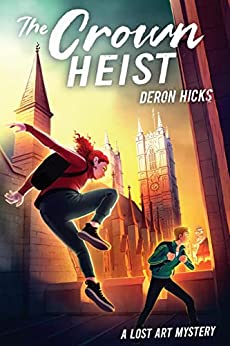
Twelve-year-old Camille has never met her father and is now on her way to London to see him for the first time. Her father is a history professor and is a renowned expert in British legend. When Camille and her friend Art go to meet her father, they find out he is missing and could be in grave danger. This is the start of unraveling a mystery to find a long-missing object and save her father. This book is full of twists and turns that keep the reader guessing up until the very end. Embedded within the book are QR codes to scan when reading that add art history lessons to the narrative. QR codes are a fun way to make the story more interactive. This book is part of the Lost Art Series and a sequel to The Rembrandt Conspiracy. Although it is book three in the series, it can be read as a stand-alone narrative.

Fossil Hunter: How Mary Anning Changed the Science of Prehistoric Life by Cheryl Blackford

This fascinating account of Mary Anning’s life will have a lot of appeal to both dinosaur lovers and students looking for a biography of a woman in a role that is typically filled by a male. I haven’t decided yet if I’ll catalog it in the 560’s under dinosaurs and fossils, or in the biography section.

Young Mary was only thirteen when she uncovered the first complete skeleton of a prehistoric creature later named the Ichthyosaur. Mary came by her fascination with fossils naturally, working alongside her father in the cliffs near Lyme Regis in England. Conditions were perfect for unearthing fossils as the wet weather loosened the soil on the cliffs, sending muddy avalanches sliding to the beach below. However, this was very dangerous work. Mary’s own father died on site of a rockfall resulting from an avalanche.

Following her father’s death, the family was thrown into poverty, so Mary helped in the one way she know how to make money — she sold fossils to tourists. In these days (the early 1800’s), it became quite fashionable for wealthy families to buy “curiosity cabinets” to display collections of interesting objects. Soon, Mary was selling her fossils for much more money. By the age of 29, Mary had already made four momentous fossil finds: (1) the world’s most complete ichthyosaurs, (2) the world’s first complete plesiosaur, (3) the first pterodactyl found in Britain, and (4) the world’s first squaloraja.

Self-educated in the field of paleontology and geology, Mary contributed to these fields through her tireless discoveries and research in libraries. But it was always a male that received the credit for her scientific contributions. Born in 1799, females were not allowed to go to college or join the British Society for the Advancement of Science. Without her due credit, Mary struggles financially for much of her life.

This book is beautifully illustrated, provides drawings and log entries by Mary Anning, is contains quotes by famous scientists who knew her, a Timeline, and a Glossary.

Can You Believe It? How to Spot Fake News and Find the Facts

nonfiction by Joyce Grant

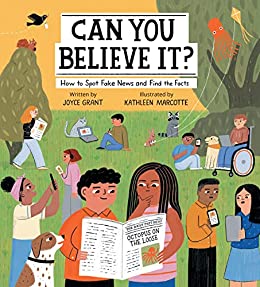
In today’s world, kids are constantly looking at the internet and it is important for them to know how to tell the difference between real and fake news. This book is a guide on how to know what “fake news” is and, most importantly, how to spot the difference. The information is presented in an easy-to-read format that is suitable for upper elementary students and beyond. It includes examples, definitions, and useful content. This guide can help students make good choices about what to believe and share. This is a critical skill in our digital world.  

Playing the Cards You’re Dealt by Varian Johnson

While the majority of the plot revolves around Ant’s families’ love for the card game “Spades,” there are a number of important subplots. Fifth-grader, Ant, feels the pressure to win the tournament this year, having bombed in last year’s tournament. His family has been winning the Spades tournaments for three generations, and he still hasn’t forgiven himself for doing poorly last year. He and his friend are crushed in Spades by the new student, Shirley, and her partner, which shakes Ant’s confidence.

Subplots include issues around Ant’s family dynamics. His father is an alcoholic and a gambler. His mom has kicked him out of the house. While Ant loves his dad, new facts are revealed about him that show him in a poor light. This gives a second meaning of the title, “Playing the Cards You’re Dealt.” One more subplot includes the fact that Ant has developed a crush on Shirley and she seems to like him back.

The Afterward leads readers to information about Alcoholics Anonymous and support for Teenagers affected by alcoholism.

Overall, the story was good, but probably best-suited for an elementary school, being the protagonist is a fifth graders. The characters were well developed, the plot sometimes funny. I liked Varian Johnson’s book, “The Parker Inheritance” more than this one.