
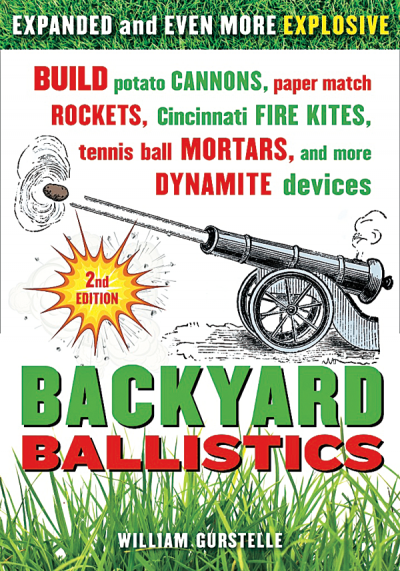
Backyard Ballistics: Build potato cannons, paper match rockets, Cincinnati fire kites, tennis ball mortars, and more dynamite devices by William Gurstelle 2nd edition.

Synopsis:  William Gurstelle, a professional engineer, is a believer in DIY Science and the creativity of amateurs.   He wanted to create a book to inspire new generation of young scientists and engineers and encourage hands on experimentation.  He was told he would never find a publisher due to safety concerns with the projects he chose.  When he did find a publisher and the first edition had strong sales.  In the 2nd edition published in 2012, the author has added new devices and added more sources for materials.  He strongly emphasizes safety above all else for each project.   Instructions are clear, (including diagrams, materials & photographs),and  are clearly designed to help you complete the project successfully.  Sources are listed for each project and each project has related information on scientific principles and history.   Projects range from the simple Cincinnati fire kite to the complicated Electromagnetic pipe gun.


What I like about it and who would enjoy it:  The author is highly qualified in the subject area and the projects included in the books are meticulously researched.    Gurstelle is the author of “The practical Pyromaniac, the Art of the catapult, and “Building Bots.”   He has been building DIY projects for thirty years and is the Pyrotechnics and Ballistics editor at Popular Mechanics.     “Backyard Ballistics” belongs in every public library.  Hand this to Science teachers, Boy Scout leaders and remember safety first! (Adult, high school)
 

A Diamond in the Desert by Kathryn Fitzmaurice

Synopsis:  After the bombing of Pearl Harbor, Tetsu Kishi, his mother and sister Kimi are sent to Arizona to a relocation camp called Gila River.  Their father is sent elsewhere to be questioned by the government.    At Gila River the family faces a harsh climate with rattlesnakes and scorpions, a community latrine with no walls, food that makes them sick and little or no privacy.   Tetsu and Kimi worry about the family dog they left behind.  Is he alive?  They write letters to a neighbor hoping to find out.  They also wait for word from their father.  Tetsu misses playing baseball, a passion he shared with his father.

When the authorities start a school for the camp, life becomes a little less grim for Tetsu, especially when he meets other boys who love baseball.   They start building a ball field and practicing for competition.  All goes well until his sister Kimi falls ill and Tetsu stops playing to take care of the family.


What I liked about it and who would enjoy it:  This is good historical fiction for 5th through 8th grade and excellent choice for elementary and middle school libraries.  Author Kathryn Fitzmaurice spent many months at the Pacific Laguna Niguel National Archives and also interviewed former internees.  Many of the incidents in the story come directly from her interviews.  In short episodic chapters, Fitzmaurice draws a compelling portrait of a grim historical period and the people caught up in it.  Resources are appended for student research.  (Grade 5th – 7th)

Robotics, Discover the Science and Technology of the Future

Great nonfiction book with illustrations with 20 great projects!  This is a user friendly, student friendly text and description.  Student and teacher will both like this one–high interest and full of useful information.  Complete with glossary, websites, resources, and books.  This book is recommended!

Animal Classes, Reptiles

This nonfiction book on reptiles has extreme coloring amplifying their visuals. Too much.  It has an air of inaccuracy with the bright coloring that was used with photoshopping the animal pictures.  It’s exaggerated.  It doesn’t feel authentic.   I’m sure that primary kids will haves their eyes caught, but they really don’t need this encouragement for a book about animals.  Why enhance the colors on animals?  The graphic layout around it is bright enough, and it didn’t need the animal colors enhanced.  Addition.

Making a Jack-o-Lantern, Step by Step

This is a great primary aged nonfiction book that explains the process of making a jack ‘o lantern.  It starts with the farm growing the pumpkins, along with types, sizes, and selection.  The book follows a story format paragraphs explaining the father and son stepping out the process of creating a jack o’lantern.  There is a glossary, index, read more, and Internet sites. Nice addition.

Military Robots

This is a simplified, well-done, nonfiction book explaining select military machines and their uses.  One of the things that I do like about this book is the simplified explanations without glorifying guns.  Some of the nonfiction military books are bombarding the reader with photos of big guns, bright colors, and eye catching visuals which entertain rather than teach.  With a topic as serious as service people sacrificing their lives, I appreciate the tone of the book.  Which isn’t a visit to a discotheque, but rather to explain what the equipment is in a realistic manner.  Recommended.

The Science Behind Food

This is a very smart book.  The graphic display is just enough to capture attention and even help to organize your attention, but it not too much to be distracting.  The information is just as admirable.  Smart science with tracing food energy back to the sun.  The foods are broken down into the basic groups and then digestion, a recipe to try, glossary, websites, books and index.  There is a glossary at the bottom of each page, explaining vocabulary. There is a stream of captions that add extra tips for learning.  This is a great book to teach and share updated food information to fourth or fifth graders.  Recommended.

Ice Dancing

I think the graphic design is a bit over done.  Lots of design an color on the front, but it almost looks messy.  The table of contents is distracting with the busy graphics and colors.  Although, color and graphics are important to pull kids into a book, this is too much.  It almost gives me a headache.

The information is chopped up and spread out in unrelated paragraphs.  For someone who is just browsing, this may be desirable, but ifyou are trying to organize and collect data for a research project.  There are some Book, DVD, and website recommendations in the back.  Along with a small index.  This books would make a nice addition to a library.

Eight Days Gone

This is an easy non-fiction for very young children about the eight day Apollo II mission to the moon in July 1969.  Written with rhymes and descriptive vocabulary, each word is chosen carefully and sparingly to tell the reader or listener this exciting story.   The illustrations are cartoonish with action detail that will interest young readers.  At the end, the Author’s Note gives a summary of events of the mission and explains with more detail than the narrative of the main story.  There is also an actual photo from NASA of the lunar module ascent from the moon to the command module with the earth looking tiny on the horizon.  The bibliography page at the end lists books and kid-friendly websites for more information.