
Danny is not the most popular kid in school. In fact, he is a bit of a geek. Unfortunately things get in his way of success, like the new kid, Ty Randall. Ty seems perfect. He is handsome, serious and dedicates his time outside of school to worthy causes which is everything Danny’s not. Danny’s jealousy of Ty gets out of control, and he sets up Ty to fail in the school talent show. But when the show rolls around, Danny regrets his choice and makes the sacrifice himself, protecting Ty from the embarrassment. Illustrations throughout will entice reluctant readers.
Author Archives: SSBRC Former Member
When Tara makes the trip to stay with extended family in Willow Falls, she loses all her cash forcing her to accept an odd job from an odd woman in an odd antique shop. While working for this woman, Tara makes new friends, has adventures, and makes connections with people from her parents’ past. All her hard work pays off as her job comes to a close in a big way on her 13th birthday.
Legend of the Ghost Dog
Years ago, a young girl named Dodie played with her little sister and sled dog pups. In short chapters sprinkled throughout the book, her story is told.
Present day, twelve year old Tee, her father and younger brother, Jack are on an extended stay in Nome, Alaska. While Tee’s father is busy with research, she and a new friend, Quin, take walks enjoying the snowy scenery. They are repeatedly disturbed by an aggressive shadow of a ghost dog. At one point, a sudden blizzard traps the girls in a shack. The mysterious ghost dog leads the way to a long time resident, Dodie. Together the girls and Dodie put pieces of the mysterious puzzle together discovering the truth about the ghost dog and the death of Dodie’s little sister. Elizabeth Cody Kimmel creates an adventure with an intriguing mystery that demands the reader to get answers.
The Mostly True Story of Jack
Jack is easy to forget. He doesn’t make friends easily, and his own parents seem to ignore him on a regular basis. Then, one day, he goes to spend the summer with relatives in a small town in the Midwest. In this town, the very walls of the house where he’s staying seem to respond to his presence.
What follows is a wide-ranging tale which combines elements from The Schwa was Here (Shusterman) with a contemporary interpretation of ancient Gaia myths (though Gaia is never named). The story starts strong, with suspense and foreboding dripping from short chapters describing the experiences of several different characters. Barnhill attempts to combine classic elements (a small town setting, an ancient destiny, a small group of heroic kids) with more contemporary touches (a skateboard, occasional turns of phrase). Unfortunately, it doesn’t entirely work. The reader gets the feeling that a more experienced writer might have told the story in a more effective way. The (very appealing) cover of this title foretells the climactic revelation in such a way that when it comes, it is not a surprise. There are sophisticated themes here, but also plot holes — and overall, things don’t quite gel.
The Camping Trip That Changed America: Theodore Roosevelt, John Muir, and Our National Parks
National Parks have not been around forever. There were many steps required to create a protected lands system in the United States. Theodore Roosevelt played a pivotal role during one of those important points in history. This book tells the story of one camping trip which influenced Roosevelt’s passionate advocacy. In the middle of a busy trip across the states, President Roosevelt spent several days with the naturalist John Muir, camping in the land which would become Yosemite National Park. This is an approachable piece of a much larger story, told in simple, concrete terms. The men are referred to using their childhood nicknames, and the story is told chronologically, with short paragraphs on nearly every page. The text is complimented by full color illustrations, which are surrounded by white space until the men enter the wild land, and which then engulf the pages. Mordicai Gerstein’s depictions of redwood forests and Yosemite Valley are particularly stunning. This is a lovely story spotlighting a little-known piece of history in a way that will be approachable and engaging to young and old alike.
Types of Maps
The format is attractive in this series of books. Good use of color and graphics, without having the color be a distraction instead of an enhancement. The captions, and pictures are distributed in good coverage. As with most new non-fiction books, this has a great resource list in the back to further your learning. The only change I would make would be to tone the font size down a little. Making the font BIGGER doesn’t make it EASIER to read. I think the size should honestly reflect the level of the reading, and in nonfiction books of substance, it will be higher. Recommended.
Natural Disasters, Investigate Earth’s Most Destructive Forces
This is a fabulous science book with experiments related to weather and geological activity on our planet. The experiments come with a short story introduction based on a real event, and then supply an experiment with a supply list, step by step instructions, and some simple pictures drawn by the illustrator. Just the right amount of information is given to spark interest, get a student going on an activity and create results. Recommended.
Write On, Mercy! The Secret Life of Mercy Otis Warren
This is a fabulous book about a strong female character who writes political news for a newspaper, during a time when women weren’t allowed to participate in politics. Of course Mercy had to use a pen name, but her work stirred a lot of emotion, debate and rhetoric for the masses to contemplate. She was 75 years old the first time she penned her name to her work! She did much to record the history of our revolution in the United States. Recommended!
Starcross: A Stirring Adventure of Spies, Time Travel and Curious Hats
Starcross was a delightful read! Reeve has the rare gift of being able to weave together big vocabulary and complex themes in a manner easily accessible to young audiences. At it’s core, Starcross, is the story of what would happen if Victorian era Britain was able to colonize the solar system. What I was most impressed with was Reeve’s ability to weave together the Victorian cultural motifs and sci-fi elements. My favorite example of this is the novel’s villains, the Moobs, mind-controlling, time-traveling alien invaders disguised as top hats. Even the sci-fi elements reflect the historic beliefs of Victorian Britain: space ships are literal ships, and the vacuum of space contains breathable air. The book also plays as elaborate parody of colonial politics: a major plot involves a French spy working with the United states to upset British intergalactic supremacy. Starcross acts as a serious reflection of the values and beliefs of Victorian England, playing them for absurdity merely by altering the setting.
The whimsical pros are captivating, it’s a great story, and it contains a treasure trove of knowledge about Victorian England made more accessible for the fictional elements. This is the type of book needed to instill in young readers a lifelong love of the written word. My only critique is the characters are fairly generic, never taking on much of a life beyond their setting. It’s also worth noting this is a sequel to Reeve’s previous book, Larklight.
Jordan Beaudry, Washington Reading Corps
Write Fantasy Fiction in 5 Simple Steps
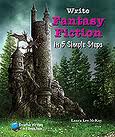 The “five simple steps” are broken down into five short but insightful chapters. Beginning with “Start With an Idea”
and wrapping up with “What to Do With Your Finished Story”, each step is one chapter unto itself. Each chapter’s
beginning page is a step to be taken when writing fantasy fiction. The step is isolated and the reader’s attention is
drawn to the page by the use of a deep pink, one inch, page border. This visual sign post commands the reader to
pay attention and take note. Within each chapter, assignments are suggested as a way to get the reader to practice
the craft of writing. Each chapter also includes resources to further help learn the craft, such as: a Famous
Fantasies book list, tips (start a daily journal, create maps and word lists for your story), ideas (have different
people critique your work, do your research) and web links (to authors’ and organizations’ websites).
McKay breaks down the writing process into bite sized chunks which allows the reader to work at a slow and methodical pace, or to read in small increments when help is needed. The text heavy book may not initially appeal to younger readers; however, those who do pick up this book may find exactly what they are looking for and find it easy to understand. Teachers and librarians may also find this book useful as a teaching tool because most subsections within the chapters are mini-lessons. These could easily be plugged into a lesson plan and the book as a whole could be used for a unit plan.
Table of Contents, Book Key (for icons that are interspersed throughout the text), Chapter Notes, Glossary, Further Reading suggestions, Internet Addresses and an Index are all included.