This nonfiction book placed the vocabulary words at the BEGINNING of the book, instead of the end. It’s after the fact at the end. Appreciated is the no nonsense explanation of the anatomy, homes, and lifecycle of bees. The photos in the book were exceptional. Missing is a geography page where we can locate these creatures on the planet. Also a scale of size would be nice, how about a page comparing it to a common house fly, ant, robin, etc. so that the students could practice compare and contrast. Also, this reviewer wasn’t able to get to the suggested website, http://readysetflow.org/activitysheets/index.html. Additional purchase
Author Archives: SSBRC Former Member
How Big? Wacky Ways to Compare Size
The illustrations in this book are certainly eye-catching as they are contrasting colors and full of textures. Some of the things that are being compared are beyond many students’ experiences and the large numbers are so random that in some ways it’s interesting and in others it’s not so much. Who cares if the Empire State Building in New York is the same as 264 gorillas, which I doubt. Unless you’ve even been to New York and experienced the Empire State Building, how would kids distinguish it from any other building? Where we live buildings aren’t very tall due to earthquakes, so size is relative. It seems it would make more sense if the size grew exponentially but it’s so random, like 1,226,880 peas in a manatee–really?
Jack and the Beanstalk
This version of Jack and the Beanstalk was first published in 1974 and has been retold countless times since then. A disclaimer in the front states that this version is adapted from a book titled The History of Mother Twaddle and the Marvelous Achievementsof her Son Jack, written in 1807. The title is a mouthful. In this version, Jack’s mother is sweeping the floor and finds a coin and sends Jack with it to market to buy a goose. They don’t say they are poor and about to starve, nor do the illustrations show a poor, rundown home, but actually a well-equiped and furnished home. He goes to the market and rather than getting a goose he falls for a peddler selling a magic bean. The story goes as expected until Jack climbs up the beanstalk, the giant does his fe, fe, fo, fum, drinks and falls asleep. There is no golden egg-laying chicken, no bag of gold, no singing harp. Jack chops off the giant’s head and sends for his mother and they both live happily ever after. This story is too gruesome and violent to read to the audience for which it is intended. I won’t use it to compare to other stories, nor will I keep it on the shelf.
Rumpelstiltskin
Rumpelstiltskin is a classic fairy tale with this version by Galdone being the standard to which others are compared. Rumpelstiltskin is the odd little man who appears in the straw room to help the unnamed miller’s daughter spin straw into gold. The third time he helps her she agrees to give him her first child. A year later he comes to collect his due. He takes pity on her sorrow at giving up her child and allows her three days to guess his name. If she cannot, he gets the child. She sends a servant to follow him and he comes back with his name and she lived happily ever after. Many versions have been written since this one was published in 1985. However, this reissue has the same illustrations which are a little rough around the edges in comparison. It is still a book that every school library should have in its collection.
Shaun White: A Snowboarder and Skateboarder Who Cares
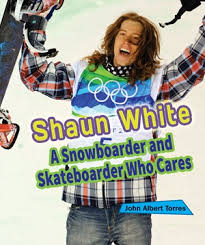
This biography profiles the life and career of Shaun White. It starts with the medical troubles he faced as an infant and continues his life story up to the present.
Shaun White is a positive role model and the writer does an apt job of highlighting all of Shaun’s good qualities – perseverance, compassion, determination, generosity and friendliness. Most upper elementary students will enjoy this book, with career stats, a glossary, additional reading titles, available websites for further reading, contact information for writing to Shaun and even his Twitter page.
The writing is on level for 4th-6th graders, told in third person. One section makes an unexpected transition to first person and seems a bit jarring. It will make the reader look to see if a page was overlooked. Other than that, this is an interesting read.
The Sultan’s Tigers
The Trelawney family has it’s share of adventurers. While in Ireland for his grandfather’s funeral, Tom discovers a packet of letters from an ancestor dated over 200 years earlier. His ancestor was a soldier in India who had gotten his hands on some loot when the sultan was overthrown. Afraid he is dying, he hides the treasure, a golden tiger encrusted with jewels. Apparently others have found out about these letters and believe them to be a map to the treasure. Tom convinces his rerckless Uncle Harvey that the treasure is probably still where it was hidden, for why else would someone have killed his grandfather over it. Tom and Harvey set out for India (without his parents knowing where he went) and have an adventure of a lifetime. The characters are so real they come alive in the story. The action is non-stop and the dialogue humorous. The first book is also excellent and this sequel doesn’t fail to keep up. I can’t wait for the next Trelawney adventure.
Counterfeits
Green Lanterns- Hal Jordan and Kilowog are transporting Red Lantern – Razar for destroying a planet and all its inhabitants. Unbeknownst to the Green Lanterns a set of evil invisible beings are aboard, too. These beings are there to get nourishment from the emotions of Razer, Hal, and Kilowog. Their invisibility causes confusion. Then they create copies of the people they are feeding off. As Green Lantern- Hal Jordan puts the clues together, he successfully defeats the invisible beings (shadows) by using extreme light.
Includes: Draw Your Own Hal Jordan, Green Lantern!, glossary, and 5 Visual Questions.
The Hunted: Polar Prey
Reluctant older readers will enjoy this short 21 chapter fast-paced story. The chapters run from two to four pages in length.
“Way up north in the Arctic on the Hudson Bay, a huge polar bear lay quietly on the frozen sea.” [Introductory line] Elsewhere, 12-yr. old Jeremy must find a way to save his mother, Paula, who is now floating on an ice berg, after the ice she was taking core samples on for Global Warming Research Station broke off into the sea.
Don’t panic, panic kills remembers Jeremy.
Jeremy snowmobiles to the Inuit village seeking Felix’s father who can fly a helicopter to rescue his mother.
In the meantime, the polar bear has started swimming toward the iceberg Paula is on in search of a meal.
Who will get to Paula first, the polar bear or the helicopter. Don’t panic, panic kills.
Here Comes Firefighter Hippo
Little Hippo is playing and pretending he is a firefighter. He has a truck and rushes off to fight a fire. He first encounters Big Hippo and gets stuck in the mud and needs help getting out. He then runs into gazelle and gets stuck in the long grass and needs help getting out. And so it goes, he rushes to help and ends up needing help. A simple story and simple text, easy for young kids to understand.
Listen, Buddy
Subtitled “A Story About Learning to Listen,” this reissue of a 1995 book teaches listening and social skills to young children. Issued as part of a ‘new’ series ‘Laugh-Along Lessons,’ this book includes a free downloadable audio version. After not hearing the directions, Buddy got lost and learned the hard way what happens to those who don’t listen.