Well-written text provides accurate information about this exceptional predator. What type of animal the komodo dragon is, where they live, and what they eat is presented in a clear, easily read format. Captioned, colorful photos and side boxes offer additional facts. Web sites supplement pages with fascinating, additional material. Captions not only offer more information, many share primary sources, and include questions to encourage deeper thinking. Aligned to Common Core Standards, one is prompted to write reports or responses to observations made from the text. Students will be drawn to this nonfiction book starting with the cover photo. Teachers will see this as an excellent resource as a teaching tool for informational text.
Author Archives: SSBRC Former Member
Guantanamo Boy
Khalid, a fifteen year old from England, is on a trip to Karachi to visit family when he is mistaken for a terrorist and sent to Kandahar and then Guantanamo Bay. An innocent victim of the war on terror, he is held, interrogated and tortured for two years. This fictionalized story representing real situations illustrates the captives’ feelings of helplessness and boredom, the brutality and indifference of the jailors, and the consequences both intended and unintended of the war on terror. This story is riveting and will grab the attention of most teens. There is a timeline and discussion questions at the end that should prompt a lot of dialogue.
Getting Somewhere
Instead of serving time in juvie, four girls elect to enter a new correctional program. Each of the girls has some sort of history that makes them reluctant to trust. Working together helps the girls to slowly begin to open up to each other. However one of the girls tries to sabotage both the girls’ success and the entire program.
This could have been a compelling story about four girls bonding and coming to terms with their issues, however, the characters are not well-developed. Lauren, the girl who betrays the others, is unpleasant, vindictive and not a sympathetic character at all. Could have been much better than it was.
Better off Friends
Levi moves to the Midwest at the beginning of seventh grade and just hopes to fit in with the guys. When pretty girl Macallan is assigned to show him around, they immediately discover their love of British comedy and become fast friends. The book, looking back and told in alternating voices with a few present day comments thrown in, follows the pair through 11th grade and attempts to answer the question: Can boys and girls just be friends? While the pair seem to navigate more than a few ups and downs, jealousy sets in when they date others. Sweet, gentle – definitely a summer read.
Snorkeling With Sea-Bots!
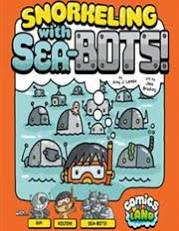 Kolten goes out into the water for some snorkeling fun. What he discovers is an underwater city of hard working robots whose job it is to keep the ocean running smoothly.
I feel comic books and graphic novels are a great way to draw reluctant readers into reading. Comics Land stories I believe are trying to do just that – draw in reluctant readers. The stories are brightly colored, easy to read and follow and are written with a touch of unexpected humor.
I like that the back matter includes a “word power” section where readers can check the glossary for unknown words. Here they will also find a pronunciation guide as well as the meaning of the word. Each book in this series also contains questions to aid in critical thinking skills, vocabulary scramble, word/picture match, find the hidden objects and a how to draw section.
Yes the story line does not hold much weight, but the beauty in these little gems (the Comics Land series that is) is that this format is highly appealing to young readers. Beginning readers will gain confidence in their skills in a easy to access manner and learn along the way.
The Good, The Bad and The Monkeys
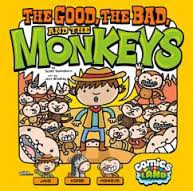 Jake has an unusual job of herding monkeys. When monkey rustlers come and try to steal his “herd”, Jake acts responsibly to tend to his small group.
I feel comic books and graphic novels are a great way to draw reluctant readers into reading. Comics Land stories I believe are trying to do just that – draw in reluctant readers. The stories are brightly colored, easy to read and follow and are written with a touch of unexpected humor.
I like that the back matter includes a “word power” section where readers can check the glossary for unknown words. Here they will also find a pronunciation guide as well as the meaning of the word. Each book in this series also contains questions to aid in critical thinking skills, vocabulary scramble, word/picture match, find the hidden objects and a how to draw section.
Yes the story line does not hold much weight, but the beauty in these little gems (the Comics Land series that is) is that this format is highly appealing to young readers. Beginning readers will gain confidence in their skills in a easy to access manner and learn along the way.
Triple H
Pro wrestling WWE fans this might be the book for you if you like a bad boy champion.
Triple H has gone by a few names on his way to the top: Terra Ryzing, Jean-Paul Levesque, The “Connecticut Blueblood”- Hunter Hearst Helmsley now shortened to Triple H, and his nickname – The Game. His real name is Paul Michael Levesque. He loved wrestling from an early age and started working towards it by first becoming a body builder. Then he moved on to wrestling, first with the IWF, then WCW, and finally with the WWE.
The book is set up for fans with more photos than text. The photos show the “intense competitor” Triple H is especially through glimpses of his facial expressions. Nine times the text is centered within the fist shaped hole of a shattered glass window, adding to the intensity.
Includes an eight item timeline of his life, an index, and glossary.
Hidden Like Anne Frank
This book tells the stories of 14 Jews who went into hiding in the Netherlands during World War II to survive. The stories are stark; a few have moments of happiness but most are stories of desperation, fear and longing. Some of the survivors lived in more than 25 different locations before the Netherlands was liberated. Some spent their time hiding in confinement in small spaces; others were able for at least a while to move around in a home and have contact with other people. Some stayed with family or friends; others lived with perfect strangers.
Prins was inspired to write the book because his mother was forced to go into hiding in the Netherlands when she was only six years old. The experiences of the survivors vary greatly; however, many describe themselves as broken after the war. So many looked forward to liberation, only to discover that it was not significantly better: they had no homes to return to, no possessions, no businesses, and frequently, no sense of family after living apart for so long. They could not connect again with parents who sent them into hiding and had to hide apart from their children. Many felt closer to their “foster” families than their own.
Although I was compelled by the stories to finish the book, I am not sure who the audience will be. The voices in this book are stilted; whether that is a factor of translation, the unease of telling of their stories or that the survivors told their stories in the voices of the children in them who lived it, it felt off. I do think students who are fascinated by the Holocaust, especially if they have just finished The Diary of Anne Frank, will want to read this book.
Itsy-Bitsy Animals
From zebras to badgers, from parrots to seahorses, this cuddly picture book celebrates cute animals. Each page features one adorably illustrated species, surrounded by butterflies and pastel-patterned backdrops. The illustrations are accompanied by short sentences pairing each animal with an action. It is unclear what qualifies an animal as “itsy-bitsy” – not all of the animals featured are babies, and neither are all of them small. This is especially obvious when animals pictured opposite each other are in very different scale. This does not profess to be a nonfiction work, however. Thus, these small problems may be overlooked. Families will enjoy the gentle text and friendly beasts. While we may not see a badger curled up with rabbits and ducklings any time soon, it isn’t a bad way to imagine the world. The field is thick with inoffensive books like this – making this entry an additional purchase.
The Arab-Israeli Six-Day War
Recently a group named Hamas, located in the Gaza Strip, and the nation of Israel engaged in prolonged exchanges of rocket attacks and air strikes. A series of “ceasefires” did nothing to assuage the violence. This military tit-for-tat response has its roots in the results of what historians refer to as the Arab-Israeli Six-Day War and which is the topic of a new book (by the same name) in the “Perspectives on Modern World History” series.
The 1967 Six Day pitted Israel against Egypt, Syria, and Jordan. In that short conflict Israel defeated all three and took land from each. The land taken from Jordan, the West Bank (of the Jordan River) and East Jerusalem were inhabited by Palestinians, a Moslem ethnic group. Israel won the war, but has been unable to win the peace, mainly because of their inability to figure out what to do with the Palestinians. This Israeli victory on the battlefield has spawned numerous negotiations, an occasional agreement, and Palestinian anger which nurtured terrorism.
“The Arab-Israeli Six-Day War” is a collection of essays examining in detail the causes, miscalculations, and results of that short-lived conflict. The book begins with a short chronology of events leading to war, the war, and its results. The intent of the essays is to provide different perspectives on the major questions which still dominate the debate. For instance, was Israel’ pre-emptive attack on it neighbors justified? Abba Eban, Israel’s Ambassador to the U.N. at the time, builds a case for war. Another essay contends that Israel, militarily, had nothing to fear. “The Postwar Occupation Provided Many Benefits to Palestinians as Well as Israeli” is countered a short piece written by a Palestinian, “Israel’s Postwar Occupations Imposed Harsh Conditions on Palestinians.”
A couple of essays touch on the subject of how to unravel this complicated issue, but one comes to understand how national myths and bravado, domestic politics, and the international political scene make reasonable men seek solace in armed confrontations.
This volume provides an excellent introduction for someone new to the subject, relying on historical facts wrapped in competing perspectives.
(Submitted by the Washington State Civics Educator of the Year, Ed Bergh)