
Through the use of their very sharp spine and venom, plus camouflage and nerves that sense the electrical fields of prey, stingrays are excellent survivors in the wild. Being ovoviviparous, their young hatch from eggs inside the mother, then are born live and self sufficient. Having first developed around 200 million years ago, stingrays have close relatives in the sea world. Stingrays live close to shore and thus are heavily affected by human pollutants. These topics and more fun facts are covered in this amazingly informative text, which is also full of equisite photos. Front Matter includes a fact file list of Class, Order, Families, Genus, Species, World Distribution, Habitats, Distinctive Physical characteristics, Habits, and Diet…helpful to elementary researchers. Back Matter includes, Glossary, Habitat Map, Find Out More, Index and About the Author. If all of the books in this Nature’s Children series are this quality, I’m going to be purchasing others.
Author Archives: SSBRC Former Member
Tin
In a world of robots, who act like humans (the Jetsons, without the people), Tin is asked to babysit his little sister Nickel with the help of their dog Zinc. All is well until Nickel floats away holding onto the string of a balloon. Tin and Zinc follow in hot pursuit. Eventually, Tin and Zinc return Nickel home just before their mother arrives home. The plot is cliche, the artwork carries the story.
The artwork is very geometrical with straight lines, angles, and minimal curves. The artwork appears to be simple on first glance. But then , the use of multiple shades of one particular color per object draws the eye in for a more in-depth look.
Too Cold for a Tutu
I fell in love with the cute hand-knit stuffed toy dogs [Barry & Stella] in their little hand-made clothes as they hop and jump through the Adobe Photoshopped pages of this book.
The story line hops and skips through the pages, as well, just like the young children they portray. Barry and Stella don’t stay on any activity for too long.
Barry and Stella have just received a hand-made gift of a sweater and tutu from their grandmother. Their imaginations go wild as they play outside in their new clothes in the crisp fall air. After a child’s disagreement over climbing a tree, they begin to pretend they are elephants. The story ends, after Barry and Stella have eaten a snack and the tutu has now become a lion’s mane.
Bugs in my Hair!
Author, illustrator – David Shannon can make any topic cute and adorable! The cover of this 2013 book (11.5″ X 9″) has a rumbled insect looking out at the reader from what might be a bunch of shredded carrots, if only the title were not Bugs in my Hair! It is still cute.
It all begins when “One day, my mom made a terrible, awful discovery… Head Lice!” Shannon’s over dramatic illustrations lighten-up the topic of what is often a common childhood maledy – head lice. Oh the itching, the blood sucking, “the humiliation”, and the not knowing exactly where the lice came from. A few ‘treatments’ are comically illustrated [child with his entire head looking out from inside a mayonnaise jar] while mom researches for “battle-tested anti-lice weapons.” Finally, the lice are gone. BUT they come back. And “so we went through the whole thing again…” Closing illustration of a child’s head inside a knight’s helmet is captioned, “I’m not taking any chances!”
The reader comes away with the idea that “Lice-a-palooza” are not the end of the world, but it is a relief when they are gone.
Bad Dad
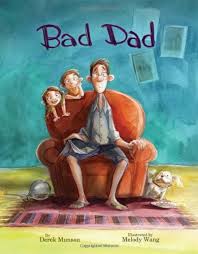 Oh no! Dad did it again. He drank from the milk container, ate the last cookie, played with the toys in the toy department and played ball in the house!
“Sometimes we think he gets into more trouble than we do!” But is Dad all that bad?
He helps with homework, knows tons of games, tells lots of jokes and he’s the best hider during hide-and-seek. As dad’s virtues are extolled the narrator realizes how great Dad really is.
The word play, at the last sentence in the book, is a perfect ending that children will enjoy. It ties the story up in a nice neat little package.
Children and adults alike will enjoy this fun story that takes a look at all Dad’s good and bad attributes. Readers may even see their dad reflected in the story somewhere.
How Do Dinosaurs Say I’m Mad?
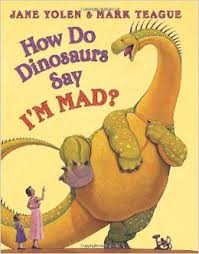 How does a dinosaur act when he’s mad? So begins the eleventh book in the “How do dinosaurs” series. Jane Yolen and Mark Teague team up to create an inviting book. Teague’s illustrations are spot on as they capture the physical and emotional characteristics of a temper tantrum in all its glory: stomping, kicking, throwing, pouting, sticking out tongues, ignoring and dirty looks. Yolen takes the reader through the storm of a tantrum to a self-controlled calming end.
A good read aloud to prompt open discussion on proper behavior when we get mad. Children will giggle as they see themselves reflected in some of the scenarios, but may listen intently to learn how to overcome those out of control feelings.
Eye to Eye: How Animals See the World
Steve Jenkins knows how to rivet readers to his books, gazing at the gorgeous, large -format cut-paper illustrations. This particular volume explores eyes in the animal kingdom and how they use them to see the world. Twenty animals are presented…from the well known garden snail, to the lesser known brownsnout spookfish…from the small stalk-eyed fly, to the enormous hippopotamus. Each two-page spread includes two animals accompanied by a brief explanation their eyes. Young children will be drawn to this book, however, they will need scaffolding by an adult to understand the complex vocabulary and concepts, which seems to be more appropriate for an older audience. Back matter, in Steve Jenkins’ fashion, includes much more information, such as a chart explaining the evolution of the eye, as well as more facts about the animals in the book. This is the place where you can find the relative size of the animal, which is hard to conceptualize from the illustrations. Bibliography and glossary are there, as well.
The No-Dogs Allowed Rule
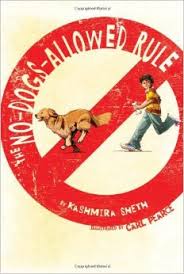 Ishan (pronounced E-Shan) a third grade boy and his brother Sunil, a fourth grader, desperately want a dog. However, Mom has a “no dogs allowed” rule. Ishan goes to great lengths to try to persuade his Mom into a “dogs allowed” rule. He helps his elderly neighbor walk his dog to prove he can be responsible (ok and to also get his dog fix for the day). He tries to cook a special meal to please his mom and try to win her over. He even changes all the family pictures in the house to dog pictures. Each well intentioned act becomes more of a disaster than a gift. So much so, that Ishan is grounded to the house during a neighborhood block meeting held at his home. During the meeting an emergency involving his neighbor occurs and Ishan saves the day. Will this be the action that changes mom’s mind to allow a dog to enter the family home?
Written with realistic speech patterns and plausible scenarios this multicultural novel introduces readers to foods of India, Hindi words and social interactions of Indian culture and family life.
Everyone Needs A Friend
Soft, colorful oil pastels welcome the reader to a sweet story about a wolf named Jack who lives alone, filling up his time with making jam and knitting warm scarves. Jack meets Walter, a mouse. (They both resemble cuddly plush toys.) They become friends while spending time together…sharing the jam on toast, and playing in the snow. The longer Walter stays, the more Jack discovers things about Walter that are annoying…like his loud snoring and the messes that he makes. Does his need for a friend outweigh the downside of Walter’s personality? Readers can identify with this dilemma, in finding and keeping their own friends. Here is an unassuming book with gorgeous illustrations and concise text…that deals with a universal theme that all of us have dealt with at some time or another. Yes, everyone needs a friend, and guaranteed, they will come perfectly flawed.
Santino Marella
 A non-fiction, Hi/Lo book about World Wrestling Entertainment (WWE) champion, Santino Marella. This short biography of Marella features full color photographs, statistics, signature moves and career history. A table of contents, index, glossary and “to learn more” page round out the book.
The publisher states that this book is intended for grades 3rd – 7th, but advanced 2nd grade readers interested in this subject would enjoy the book as well.