
In previous stories, Tallulah has learned much about ballet. Now she is excited because she and her brother are going to dance camp. Once there, she finds she is also going to take the dreaded tap class. She loves the grace of ballet and hates the clickety-clack noise of tap. Her roommate, Kacie, loves tap and hates ballet. Both like being skilled in their dance choice and dislike being corrected. It’s Tallulah’s brother, Beckett, who helps them realize that although they both have their favorite styles, trying something new involves coaching. It takes patience and a willingness to try. The watercolor illustrations are a good complement to the text showing action and dance moves.
Author Archives: SSBRC Former Member
The Night Before Preschool
This another of Natasha Wing’s “The Night Before…” books. Following the format of The Night Before Christmas by C. Clement Moore, the rhyming text shares the hopes and fears of a preschool boy. On his first day, Billy mostly hangs back and watches. The others enjoy singing, dancing, dressing up, playing outside, and eating snacks. At nap time he can’t relax until one girl shares her plush bunny. When his mom arrives at the end of the day with his teddy, Billy decides preschool is fun and he would be back! Colorful, pleasant illustrations portray Billy’s worries and all the fun to be had at preschool. Originally published in 2011, this delightful story is a re-issue.
Hogs Hate Hugs
After enduring all kinds of hugs from all kinds of friends and family members, Little Hog has had enough. He posts a sign stating “Hogs Hate Hugs” and signs it Little Hog. The others are shocked. Mouse has an idea and she shares it with Mommy Hog. Late one day, Little Hog is walking through the forest feeling a bit lonely. When he hears strange sounds behind him, he glances around and sees a scary “monster” getting close! Panicked, he starts to run. Then the monster trips and his mother and all his friends tumble out. Little Hog is so relieved he decides he loves hugs after all. Colorful and expressive watercolor illustrations add humor and details to the story.
Spy Guy: The Not-So-Secret Agent
“Spy Guy was a spy. But not a very good one.” Spy Guy needs help so he goes to the Chief, his dad. In short rhymes, the Chief gives advice. To sneak, don’t speak or squeak. Spy Guy’s attempts fall short. Finally the Chief offers Spy Guy a challenge – to sneak up on him. After several tries, Spy Guy gets a hint from a spider and surprises his Chief. Mission accomplished! One last rhyme provides a closing rule, “The secret to spying is to never stop trying.” Illustrations are large and expressive with plenty of white space to showcase details. There is a spider on every page, watching the trials of Spy Guy. Its inclusion in the artwork adds detail and interest to the story without using words.
The Scarecrows’ Wedding
In a tale told in rhyme, two scarecrows, Betty O’Barley and Harry O’Hay, decide to marry. After making a list of everything they will need for the wedding, they set off to gather them. The geese give feathers for a dress, the cows have bells, a crab brings a necklace of shells, and mice find rings from a curtain. The only thing left are pink flowers. While Betty rests, Harry goes off to find them. Meanwhile, the farmer notices Harry is gone and replaces him with Reginald Rake. Reginald quickly begins to woo Betty by showing her how clever he is. He foolishly lights a cigar and tries to blow smoke rings. A small fire starts when he drops the cigar. (Everyone knows smoking is harmful.) Betty is in danger yet Reginald runs off in a panic. Just in time, Harry returns with pink flowers in a pail of water. Disaster is diverted and the wedding takes place as planned. The artwork is bright and colorful, filled with additional details of the insects and small animals found in fields.
The Mysterious Woods of Whistle Root
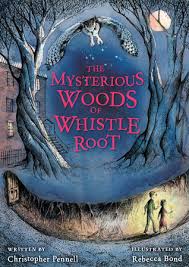 The debut novel by Christopher Pennell, The Mysterious Woods of Whistle Root, is a perfect read-aloud or a read alone for the intended audience. It is a tale of magic and friendship that captivates from the very first sentence:
“In a small town called Whistle Root, rats play music in the moonlight.” From that beginning, nothing that comes later can be too strange to be believed and really makes for a fun, refreshing fantasy.
The rats play music from the rooftops so the owls can dance. There are vegetables appearing on rooftops, of which one character comments: “ I notice that you have a squash on your roof, dear. How lovely. I only have broccoli”. Rats talk and fly on breezes, mysterious messages appear inside a hat that is in a wooden crib in the middle of the woods, strange whispers can place people in a deep sleep and an unique beast appears who likes to adorn himself with owl feathers. It may have been difficult to pull off the sorts of unusual happenings found in this book, but Pennell does it with entertaining ease. He presents the activities and events so casually and deftly that it becomes very easy for the reader to accept them as a natural part of this odd, wonderful world.
The main character is Carly Bean Bitters, a young girl who can only sleep during the day and no one knows why. She is lonely as all children are awake when Carly is asleep. One magical night that all changes when Carly becomes friends with Lewis, a violin-playing rat. Lewis has lost two members of his musical trio. When a member is missing from the band a vegetable stands in “for you must always have exactly three members.” Lewis already has a squash on Carly’s rooftop but Lewis proclaims that “ it would be too embarrassing to have two vegetables in the band and (the squash is a lousy drummer)”. So he asks Carly to join his group.
Soon after, Carly and Lewis become friends with Green. He is a boy who lives with his grandmother underneath the school. Green has a hidden door to his house in a little used, dark area of the school library – the reference section. The three friends set out to uncover the reason for the strange change in behavior among the owls in Whistle Woods. They had always danced to the rats’ music, but now they hunt them instead. Also, Green’s grandma has fallen into a sleep from which she cannot be awakened. Carly and Green are willing to do what is needed to get Grandma back and restore the once peaceful owl and rat relationship. Unraveling the mysteries will help restore everything to “normal”.
The illustrations by Rebecca Bond are charming pen and ink doodlings that complement the text. My first response at seeing the illustrations was disappointment. In our flashy, colorful world I expected the same for the illustrations. However, I realized as I became acquainted with the book that the media choice really was perfect. Pennell provides a wonderful description and Bond provides a nice framework for readers to use their own creative imagination to fill in the color and detail. In the end I thought it was a wise choice.
Others have compared this novel to The Dreamstealer by Sid Fleischman with its storyteller’s voice and the extravagance of its imagination, and Kenneth Grahme, C.S. Lewis, E.B. White and Kate DiCamillo for its well-imagined talking animals… just to name a few.
It has just the right blend of mystery and scary with a fairy tale ending.
I’m a truly hoping that this will be a series, as I would love to get lost in the world of Whistle Root again and again.
Fleabrain Loves Franny
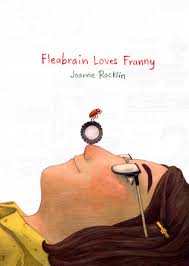 Fleabrain Loves Franny, by Joanne Rocklin, portrays the unlikely friendship between a young girl and a flea.
Set in Pittsburgh, 1952, Franny Katzenback is recovering from polio and wondering if she’ll ever walk again. Franny reads and falls in love with the brand-new book Charlotte’s Web. At a critical point during her illness she imagines she is being cared for by angels, which just turn out to be nurses in white uniforms. So when she starts to receive letters from a flea, who lives on the tip of her dog’s tail, it seems like just another delusion.
But Fleabrain proves his existence and a strong friendship forms. Fleabrain is a strange and marvelous fluke of nature. He is a self-taught genius and just happens to be a voracious reader. He helpsFranny gain courage, self-confidence and strength to fight her battles with prejudice, discrimination and the struggle of recovery. He is determined to stand by and motivate Franny during this difficult time in her life because he finds he truly loves her. Fleabrain becomes Franny’s Charlotte.
The other characters in the book include her older sister Min, whom she sarcastically calls “Saint Min”, her best friend from a distance Walter Walter (yes, double named), the mean-spirited Nurse Olivegarten, Franny’s adored grandfather Zadie, and Dr. Gutman a neighbor and scientist working with Jonas Salk to find the cure for polio.
Rocklin’s inclusion of many daily life routines and practices of the 1950’s add to the story’s realism. She introduces young readers to some realities of disability and the harsh and often times unfair reactions of others. She also does a good job of introducing many topics for classroom discussion. Readers may learn not only about paralysis, polio, Jonas Salk, vaccines, infectious diseases and prejudices; but also about literary and cultural references such as E. B. White’s Charlotte’s Web, Franz Kafka’s Metamorphosis, James Howell’s Paramoigraphy, the philosophy of Friedrich Nietzsche and Jewish folklore and traditions. These may sound like heavy topics for young readers, but Rocklin provides small spoonfuls of understanding to the reader. As Franny learns of these things in incremental, digestible pieces, so does the reader.
Included is an author’s note reflecting on polio and the issue of disability, and a bibliography of referenced works and songs. Teachers can also go to Rocklin’s website and get a CCSS aligned discussion guide and activities list.
Ludwig van Beethoven
A journey through the music and lives of the most influential classical musicians, these illustrated biographies (First Discovery – Music) include a CD and fragments of the musicians’ most iconic compositions. Ludvig van Beethoven is easy to read with great illustrations and photographs and paintings from this time period. On each page there are also recommendations of creative activities.
This Is the Rope: A Story from the Great Migration
Jacqueline Woodson, Newbery Award winning author, has used a simple rope connecting generations of family history. For three generations that rope is first used as a jump rope, then passed down as a rope to secure suitcases onto a car for a big move from South Carolina to New York City, then as a clothes line, a pull toy and a string to hold up a sign at a family reunion. Even though this is a work of historical fiction, the story is based on the Great Migration that her family, and six million other African Americans, experienced over generations from the early 1900’s until the mid 1070’s. The rope is a symobl of “Hope.” Written with such insight and poetic grace, this thoughtful and moving piece of storytelling will linger in the hearts of the readers for a long time. So will the beautifully done James Ransome illustrations.
Alex the Ant Goes to the Beach
Alex the Ant Goes to the Beach is a delightful adventure story that both entertains and educates the young listener or reader. Facts about ant natural history, such as scent trails, scout ants, and their diet of ‘Yummy mold’ grown on decaying wood, are introduced seamlessly. While the book teaches knowledge and facts about ants, it is also playful and engaging for young readers, including sound play, interesting word choices, and some suspenseful moments. Appealing, fun illustrations make this book a gem!